

Tripoli-based govt ‘pursuing permanent truce after clashes’

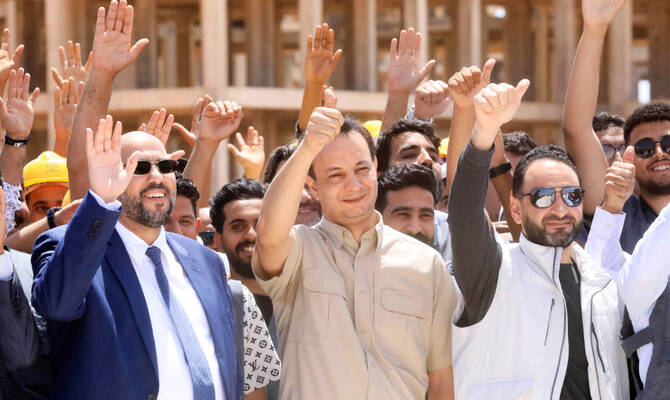
Belqasim Haftar, who is in charge of eastern Libya’s reconstruction fund, waves to the crowd during an inspection tour of a building project in Benghazi. (AFP)
Short Url
Updated 19 May 2025
Follow

Tripoli-based govt ‘pursuing permanent truce after clashes’

  • UN mission welcomes creation of ceasefire committee, calls for protection of all civilians

TRIPOLI: Libya’s UN-recognized government said on Monday it was pressing efforts to reach a permanent ceasefire after days of deadly clashes in the capital and protests demanding the prime minister’s resignation.

The fighting last week pitted an armed group aligned with the Tripoli-based government against factions it has sought to dismantle, resulting in at least eight dead, according to the UN.

The Libyan Defense Ministry said in a statement that “the efforts toward a ceasefire remain ongoing” and that it was “directly” overseeing the process to ensure stability.

The fighting had largely ended by late on Thursday, according to an Interior Ministry official and the UN mission in Libya, but without any formal ceasefire agreement.

The UN mission, UNSMIL, welcomed on Sunday the creation of a “truce committee building on the fragile peace reached last week” after the violence that saw heavy artillery used in central Tripoli.

UNSMIL said the committee “is focused on facilitating a permanent ceasefire with emphasis on the protection of all civilians, and to agree on security arrangements for Tripoli.”

Tripoli saw a return to relative calm late last week as flights resumed, shops reopened, and people returned to work, but the situation remained volatile as calls for Prime Minister Abdul Hamid Dbeibah’s resignation grew.

The clashes were sparked by the killing of an armed faction leader by a group aligned with Dbeibah’s government — the 444 Brigade, which later fought a third group, the Radaa force that controls parts of eastern Tripoli and the city’s airport.

It came after Dbeibah announced a string of executive orders seeking to dismantle Radaa and dissolve other Tripoli-based armed groups, but excluding the 444 Brigade.

The 444 Brigade said on Monday it had uncovered a mass grave with 10 bodies in Abu Salim, a district of Tripoli that before last week was controlled by the group of Abdelghani Al-Kikli, whose killing sparked the clashes.

Dbeibah had accused Al-Kikli’s group, the Support and Stability Apparatus, of multiple abuses, including “cold-blooded” executions and forced disappearance of critics.

In an address on Saturday after securing the public support of several dignitaries, Dbeibah called on armed groups in Tripoli to align themselves with “state institutions.”

“Our goal is a Libya free of militias and corruption,” he said.


Syria opens aid corridor to Kurdish-majority town

Updated 5 sec ago
Follow

Syria opens aid corridor to Kurdish-majority town

  • The Syrian Democratic Forces find themselves restricted to Kurdish-majority areas in the northeast and Kobani in the north

DAMASCUS: Syria’s military said on Sunday it had opened a humanitarian corridor to the Kurdish-majority town of Kobani, filled with displaced people, as a UN convoy carrying lifesaving aid headed there.

The aid came as the Defense Ministry announced a 15-day extension of the ceasefire across all fronts of Syrian Arab Army operations, effective at 11 p.m. on Jan. 24.

The ministry said the ceasefire extension comes in support of the US operation to transfer Daesh detainees from prisons in Syria to Iraq.

The Operations Command of the Syrian Arab Army warned the Syrian Democratic Forces and PKK militias against continuing their violations and provocations. 

It also announced the opening of two humanitarian corridors, one to Kobani and another in nearby Hasakah province, to allow “the entry of aid.”

Gonzalo Vargas Llosa, representative of the UN’s refugee agency in Syria, said on X that “thanks to the cooperation with the Syrian government ... a convoy of 24 trucks carrying essential food, relief items, and diesel” departed for Kobani “to deliver life-saving and winter assistance to civilians affected by the hostilities.”

The Syrian Democratic Forces find themselves restricted to Kurdish-majority areas in the northeast and Kobani in the north.

Kobani, which Kurdish forces liberated from a lengthy siege by Daesh in 2015, became a symbol of their first major victory against the terrorists.

The Syrian Petroleum Company said it had begun transporting crude oil from the Jbessa oil field in eastern Hasakah province to the Baniyas refinery on Syria’s Mediterranean coast.

The move follows the arrival of the first shipment of crude oil from Deir Ezzor fields to storage facilities in Baniyas, where it will be processed.