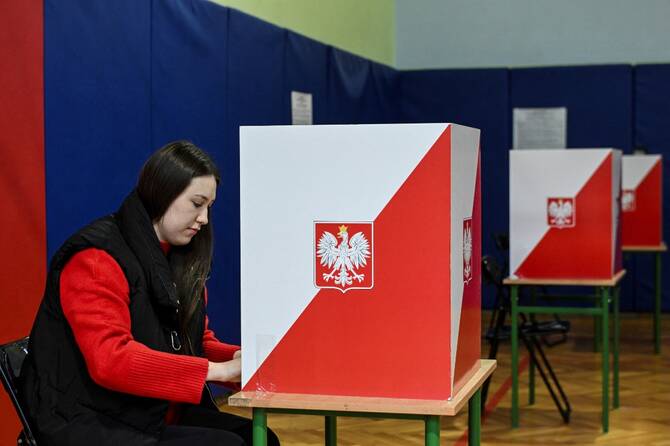
WARSAW: Poles are voting Sunday in a presidential election at a time of heightened security concerns stemming from the ongoing war in neighboring Ukraine and growing worry that the US commitment to Europe’s security could be weakening under President Donald Trump.
The top two front-runners are Warsaw Mayor Rafał Trzaskowski, a liberal allied with Prime Minister Donald Tusk, and Karol Nawrocki, a conservative historian with no prior political experience who is supported by the national conservative Law and Justice party.
Recent opinion polls show Trzaskowski with around 30 percent support and Nawrocki in the mid-20s. A second round between the two is widely expected to take place on June 1.
The election is also a test of the strength of other forces, including the far right.
Sławomir Mentzen, a hard-right candidate who blends populist MAGA rhetoric with libertarian economics and a critical stance toward the European Union, has been polling in third place.
Ten other candidates are also on the ballot. With such a crowded field and a requirement that a candidate receive more than 50 percent of the vote to win outright, a second round seemed all but inevitable.
Polling stations opened at 7 a.m. (0500GMT) and close at 9 p.m. (1900GMT). Exit polls will be released when voting ends, with results expected by Tuesday, possibly Monday.
Polish authorities have reported attempts at foreign interference during the campaign, including denial-of-service attacks targeting parties in Tusk’s coalition on Friday and allegations by a state research institute that political ads on Facebook were funded from abroad.
Although Poland’s prime minister and parliament hold primary authority over domestic policy, the presidency carries substantial power. The president serves as commander of the armed forces, plays a role in foreign and security policy, and can veto legislation.
The conservative outgoing president, Andrzej Duda, has repeatedly used that power over more than the past year to hamper Tusk’s agenda, for example blocking ambassadorial nominations and using his veto power to resist reversing judicial and media changes made during Law and Justice’s time in power from 2015 to late 2023.
A Trzaskowski victory could be expected to end such a standoff. He has pledged to support reforms to the courts and public media, both of which critics say were politicized under Law and Justice. Tusk’s opponents say he has also politicized public media.
Nawrocki, who leads a state historical institute, has positioned himself as a defender of conservative values and national sovereignty.


![]()

Poles vote for a new president as security concerns loom large
Short Url
https://arab.news/59aks
Poles vote for a new president as security concerns loom large


Latest updates


Recommended


© 2026 SAUDI RESEARCH & PUBLISHING COMPANY, All Rights Reserved And subject to Terms of Use Agreement.