

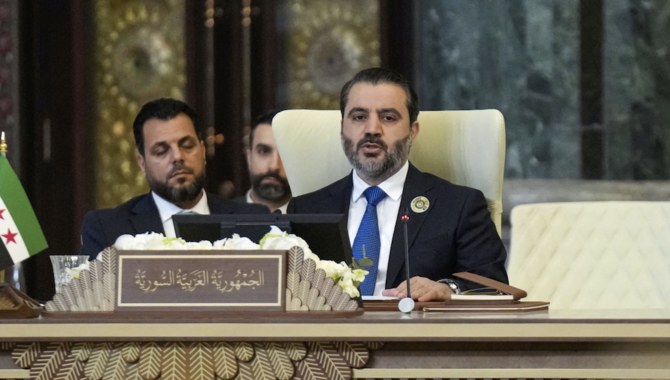
Syrian foreign minister hails sanctions relief, pushes for inclusive recovery at Arab Summit

Syria has begun taking serious steps toward national recovery and reconciliation, based on a commitment to inclusivity and sovereignty, Syrian Foreign Minister Asaad Al-Shaibani said on Saturday during his address at the 34th Arab Summit in Baghdad. (WAM)
Short Url
Updated 17 May 2025
Follow

Syrian foreign minister hails sanctions relief, pushes for inclusive recovery at Arab Summit

  • Asaad Al-Shaibani says Syria entering a new phase ‘that embraces diversity, guarantees representation, preserves dignity’
  • ‘Syria is for all Syrians, with no place for marginalization or exclusion,’ FM tells Baghdad forum

BAGHDAD: Syria has begun taking serious steps toward national recovery and reconciliation, based on a commitment to inclusivity and sovereignty, Syrian Foreign Minister Asaad Al-Shaibani said on Saturday during his address at the 34th Arab Summit in Baghdad.

Delivering his country’s remarks at the high-level gathering, Al-Shaibani said Syria was entering a new phase of “inclusive national dialogue that embraces diversity, guarantees representation, and preserves dignity.”

He added that the move marked what he described as an unprecedented effort to rebuild the nation on foundations that reject marginalization and exclusion.

“Syria is for all Syrians, with no place for marginalization or exclusion,” he declared, underlining the country’s refusal to accept “guardianship” or to serve as a battleground for external conflicts.

Al-Shaibani also welcomed the recent decision by US President Donald Trump to lift sanctions imposed on Syria, a move he hailed as a “positive and important step” on the path to national reconstruction.

He credited “sincere Arab diplomatic efforts” for helping to bring about the breakthrough.

The minister extended special thanks to Saudi Arabia and Turkiye for their role as effective mediators at a “pivotal historical moment,” and expressed deep gratitude to Qatar, the UAE, Jordan, and member states of the Gulf Cooperation Council for their support during what he called a “delicate stage” for Syria.

“Lifting the sanctions is not the end, but rather the beginning of a path that we hope will be paved with real cooperation and the integration of Arab efforts,” he said.

He also stressed the need to work together to bolster regional development, safeguard Arab national security, and enhance overall stability.

Al-Shaibani revealed that Syria was finalizing preparations for a national parliament that would represent the full spectrum of Syrian society, alongside efforts to draft a permanent constitution aimed at protecting rights, upholding sovereignty, and establishing the rule of law.

“Any project aimed at weakening or dividing the Syrian state under any pretext is categorically rejected by the Syrian state and people in all their components,” he said.


Two dead in UAE, 8 injured in Qatar from waves of Iranian strikes on Gulf neighbors

Updated 8 sec ago
Follow

Two dead in UAE, 8 injured in Qatar from waves of Iranian strikes on Gulf neighbors

  • UAE defense ministry said Iran fired 137 missiles and 209 drones at the territory
  • Qatar intercepted most of the 65 missiles and 12 drones launched by Iran, said officials

ABU DHABI: Explosions rocked cities across the Gulf on Saturday, killing two people in Abu Dhabi, while smoke and flames rose from Dubai landmark The Palm as Iran launched waves of attacks in retaliation for US and Israeli strikes.

The attacks hit airports in Abu Dhabi, Dubai and Kuwait, as well as Gulf military bases and residential areas, raising fears of a wider conflict and rattling a region long seen as a haven of peace and security.

Across the UAE, Iran fired 137 missiles and 209 drones at the territory, the country’s defense ministry said, as projectiles streaked across the skies of every Gulf state but Oman, a mediator in the recent US-Iran talks.

The UAE defense ministry said most of the missiles and drones were intercepted but at Abu Dhabi’s Zayed International Airport officials said at least one person was killed and seven wounded in an “incident.”

Earlier, falling debris killed a Pakistani civilian in Abu Dhabi, the United Arab Emirates’ capital, officials said.

At Dubai International Airport four people were injured according to airport authorities and four others were also hurt at the luxury Palm development.

In Qatar, officials said Iran launched 65 missiles and 12 drones toward the Gulf state, most of which were intercepted, but eight people were injured in the salvos, with one of them in critical condition.

“We are scared of what the future is for us now, and we can’t say how the next few days are going to be,” Maha Manbaz, a nursing student in Doha told AFP.

‘Terrified’

Smoke poured from US bases in Abu Dhabi and Bahrain’s capital Manama, home of the American navy’s Fifth Fleet, witnesses saw.

A drone struck Kuwait’s international airport and a base housing US personnel was targeted. Three Kuwaiti soldiers and 12 other people were wounded, authorities said.

After Iran’s Revolutionary Guards reported missile strikes, US Central Command (CENTCOM) said on X that no American naval vessels were hit, damage to US facilities was minimal, and no US casualties had been reported.

Residential buildings were also targeted in Manama, with officials saying firefighters and civil defense teams had been dispatched to the scene.

“The sound of the first explosion terrified me,” said a 50-year-old retiree living near the US base in Manama’s Juffair area, where residents were quickly evacuated.

The UAE, Saudi Arabia and Qatar warned they reserved the right to respond to the attacks.

The oil-and-gas-rich Arab monarchies, lying just across the Gulf from Iran, are long-term American allies and host a clutch of US military bases.

“The Gulf states are sandwiched between Iran and Israel, and have to bear the worst inclinations of both,” said Bader Al-Saif, an assistant professor at Kuwait University.

“Iran’s attacks on the Gulf are misplaced. They’ll only alienate its neighbors and invite further distancing from Iran,” he added.

Conflict is unusual in the Gulf, which has traded on its reputation for stability to become the Middle East’s commercial and diplomatic hub.

‘Significant damage’

The unprecedented barrage targeted Qatar’s Al Udeid base, the region’s biggest US military base, as well as Riyadh and eastern Saudi Arabia.

The UAE, Qatar and Kuwait all announced that their airspace was closed.

An AFP journalist in Qatar saw one missile destroyed in a puff of white smoke, while another in Dubai saw a volley of Patriot interceptors taking off.

Iran fired missiles at Al Udeid last June after US strikes targeted Iranian nuclear facilities during a brief war with Israel.

The escalation also saw Saudi Crown Prince Mohammed bin Salman and UAE President Mohamed bin Zayed speak for the first time since a public row in late December.

The Saudi de facto ruler called the Emirati president and the pair discussed Iran’s retaliatory strikes on the Gulf and expressed solidarity and sympathy.

In Kuwait, an Iranian missile attack caused “significant damage” to the runway at an air base hosting Italian air force personnel, Italian Foreign Minister Antonio Tajani was quoted by the ANSA news agency as saying.

Late on Saturday, Kuwaiti officials said a drone targeted a naval base there with air defense forces intercepting the projectile, according to a post by the defense ministry on X.

For many residents in the Gulf, which has drawn a cosmopolitan, largely expat population, the reaction was one of shock.

“I heard the explosions, I don’t know what I felt,” a Lebanese woman living in Riyadh told AFP.

“We came to the Gulf because it’s known to be safer than Lebanon. Now I don’t know what to do or how to think really.”