Biden audio release pressures Democrats who would rather talk about Trump

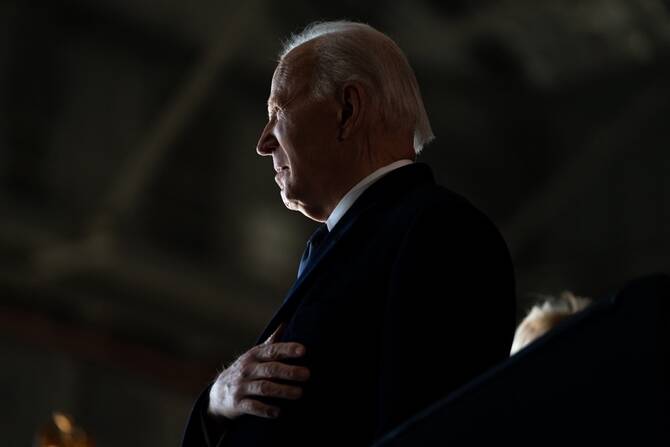
Former US President Joe Biden. (AFP/File)
Short Url
Updated 17 May 2025
Follow

Biden audio release pressures Democrats who would rather talk about Trump

PHOENIX: Joe Biden’s time in public office is now behind him, but his age and mental acuity have become a litmus test for the next leaders in his party.
Audio was published Friday from portions of interviews Biden gave to federal prosecutors in 2023, the latest in a stream of reports putting questions about Biden’s health back in the spotlight. Months after former President Kamala Harris lost to President Donald Trump, a new book alleges that White House aides covered up Biden’s physical and mental decline.
Several potential Democratic contenders for the 2028 nomination have been asked in recent days whether they believe Biden was declining in office or whether he should have sought reelection before a disastrous debate performance led to his withdrawal.
Many Democrats would prefer to focus on Trump’s second term. Trump has done his best to prevent that — mentioning Biden’s name an average of six times per day during his first 100 days in office, according to an NBC News analysis — and Republicans have followed his lead, betting that voters frustrated by Trump’s policy moves will still prefer him over memories of an unpopular presidency.
In the race for Virginia governor, one of this year’s highest-profile contests, Republican Winsome Earle-Sears is running a pair of digital ads tying Democrat Abigail Spanberger to Biden, with images of the two hugging and the former president calling her a friend.
“The stench of Joe Biden still lingers on the Democratic Party,” Democratic strategist Sawyer Hackett said. “We have to do the hard work of fixing that, and I think that includes telling the truth, frankly, about when we were wrong.”
Democratic Sen. Chris Murphy of Connecticut told Politico this week that “there’s no doubt” that Biden, now 82, experienced cognitive decline as president.
Pete Buttigieg, the former transportation secretary, wasn’t nearly as blunt but still stopped short of defending Biden’s decision to run. He responded “maybe” when asked Tuesday whether the Democratic Party would have been better off if Biden hadn’t tried to run for a second term.
“Right now, with the advantage of hindsight, I think most people would agree that that’s the case,” Buttigieg told reporters during a stop in Iowa.
Illinois Gov. JB Pritzker said he didn’t see signs of mental or physical decline in his meetings with Biden.
“I saw him a few times,” he told CNN this week. “I certainly went to the White House whenever there was an opportunity for me to make the case for something for people in my state. And I never had the experience of anything other than a guy who brought to the table a lot of good ideas about how to solve problems.”
The book “Original Sin,” by journalists Jake Tapper of CNN and Alex Thompson of Axios, revives a core controversy of Biden’s presidency: his decision to run for a second term despite voters, including Democrats, telling pollsters that he should not run again. Biden would have been 86 at the end of a second term had he won in November.
A spokesperson for Biden did not respond to a request for comment.
“We continue to await anything that shows where Joe Biden had to make a presidential decision or where national security was threatened or where he was unable to do his job,” the spokesperson has told many media outlets in response to the book.
Late Friday, Axios published portions from audio recordings of Biden’s six hours of interviews with prosecutors investigating his handling of classified documents after his term as vice president ended in 2017.
The Biden administration had already released transcripts of the interviews, but the recordings shed light on special counsel Robert Hur’s characterization of Biden as “a sympathetic, well-meaning, elderly man with a poor memory” and appeared to validate his claim that the then-president struggled to recall key dates, including the year his son Beau died of cancer in 2015.
Biden and his aides pushed back aggressively against Hur’s report, which they characterized as a partisan hit. Biden was at that time — early 2024 — still planning to run for a second term and fending off accusations that he was too old for another four years in the job.
The recordings released by Axios include Biden’s discussion of his son’s death. His responses to some of the prosecutors’ questions are punctuated by long pauses, and his lawyers at times stepped in to help him recall dates and timelines.
Before he dropped his reelection bid last summer, Biden faced widespread doubts within his own party, even as Democratic leaders dismissed both a series of verbal flubs and Republican allegations about his declining acuity.
In January 2022, just a year into Biden’s first term, an AP-NORC Center for Public Affairs Research poll found that only 48 percent of Democrats wanted him to seek reelection. That fell to 37 percent of Democrats in an AP-NORC poll conducted in February 2023. Three-quarters of Americans — and 69 percent of Democrats — said in August 2023 that they believed Biden was too old to serve as president for another four-year term.
And shortly after his debate flop, nearly two-thirds of Democrats said Biden should withdraw from the race.
Biden and former first lady Jill Biden appeared on ABC’s “The View” in a preemptive defense of his health and decision-making before the first excerpts of “Original Sin” were published.
He said he’s responsible for Trump’s victory but attributed Harris’ loss, at least in part, to sexism and racism. He maintained that he would have won had he remained the Democratic nominee. Both Bidens rejected concerns about his cognitive decline.
Patricia McEnerney, a 74-year-old Democrat in Goodyear, Arizona, said Biden should not have tried to run again.
“I think it’s sad the way it ended,” she said.
She compared him to Douglas MacArthur, the World War II and Korean War general famously dismissed by President Harry Truman.
“I think he needs to stop giving interviews. I think that would help,” McEnerney said. “Like MacArthur said, generals just fade away.”
Janet Stumps, a 66-year-old Democrat also from Goodyear, a Phoenix suburb, had a different view.
“I don’t think it’s going to hurt the Democrats,” Stumps said. “I feel badly that he feels he has to defend himself. I don’t think he has to. Everybody ages. And the fact that he did what he did at his age, I think he should be commended for it.”
Hackett, the Democratic strategist, predicted Biden won’t be a major factor in the 2026 midterms or the 2028 presidential primaries. But he said Democrats who want voters to trust them would be well-served “by telling the truth about the mistakes that our party made in the run-up to 2024.”
“Those mistakes were largely driven by Joe Biden, and I think any Democrat not willing to say that is not really prepared to face the voters, who want the truth and they want authenticity,” Hackett said.
Rick Wilson, a former GOP strategist who co-founded the anti-Trump group the Lincoln Project, said Republicans want to talk about Biden to avoid defending Trump. But he said the strategy is folly.
Besides “political nerds,” he said, “no one else cares.”


US vaccine advisers say not all babies need a hepatitis B shot at birth

Updated 6 sec ago
Follow

US vaccine advisers say not all babies need a hepatitis B shot at birth

  • Vaccine advisers named by Kennedy reverse decades-long recommendation
  • Kennedy’s advisory committee decided to recommend the birth dose only for babies whose mothers test positive
  • President Donald Trump posted a message calling the vote a “very good decision”

NEW YORK: A federal vaccine advisory committee voted on Friday to end the longstanding recommendation that all US babies get the hepatitis B vaccine on the day they’re born.
A loud chorus of medical and public health leaders decried the actions of the panel, whose current members were all appointed by US Health Secretary Robert F. Kennedy Jr. — a leading anti-vaccine activist before this year becoming the nation’s top health official.
“This is the group that can’t shoot straight,” said Dr. William Schaffner, a Vanderbilt University vaccine expert who for decades has been involved with ACIP and its workgroups.
Several medical societies and state health departments said they would continue to recommend them. While people may have to check their policies, the trade group AHIP, formerly known as America’s Health Insurance Plans, said its members still will cover the birth dose of the hepatitis B vaccine.
For decades, the government has advised that all babies be vaccinated against the liver infection right after birth. The shots are widely considered to be a public health success for preventing thousands of illnesses.
But Kennedy’s Advisory Committee on Immunization Practices decided to recommend the birth dose only for babies whose mothers test positive, and in cases where the mom wasn’t tested.
For other babies, it will be up to the parents and their doctors to decide if a birth dose is appropriate. The committee voted 8-3 to suggest that when a family elects to wait, then the vaccination series should begin when the child is 2 months old.
President Donald Trump posted a message late Friday calling the vote a “very good decision.”

The acting director of the Centers for Disease Control and Prevention, Jim O’Neill, is expected to decide later whether to accept the committee’s recommendation.
The decision marks a return to a health strategy abandoned more than three decades ago
Asked why the newly-appointed committee moved quickly to reexamine the recommendation, committee member Vicky Pebsworth on Thursday cited “pressure from stakeholder groups,” without naming them.
Committee members said the risk of infection for most babies is very low and that earlier research that found the shots were safe for infants was inadequate.
They also worried that in many cases, doctors and nurses don’t have full conversations with parents about the pros and cons of the birth-dose vaccination.
The committee members voiced interest in hearing the input from public health and medical professionals, but chose to ignore the experts’ repeated pleas to leave the recommendations alone.
The committee gives advice to the director of the Centers for Disease Control and Prevention on how approved vaccines should be used. CDC directors almost always adopted the committee’s recommendations, which were widely heeded by doctors and guide vaccination programs. But the agency currently has no director, leaving acting director O’Neill to decide.
In June, Kennedy fired the entire 17-member panel earlier this year and replaced it with a group that includes several anti-vaccine voices.
Hepatitis B and delaying birth doses
Hepatitis B is a serious liver infection that, for most people, lasts less than six months. But for some, especially infants and children, it can become a long-lasting problem that can lead to liver failure, liver cancer and scarring called cirrhosis.
In adults, the virus is spread through sex or through sharing needles during injection drug use. But it can also be passed from an infected mother to a baby.
In 1991, the committee recommended an initial dose of hepatitis B vaccine at birth. Experts say quick immunization is crucial to prevent infection from taking root. And, indeed, cases in children have plummeted.
Still, several members of Kennedy’s committee voiced discomfort with vaccinating all newborns. They argued that past safety studies of the vaccine in newborns were limited and it’s possible that larger, long-term studies could uncover a problem with the birth dose.
But two members said they saw no documented evidence of harm from the birth doses and suggested concern was based on speculation.
Three panel members asked about the scientific basis for saying that the first dose could be delayed for two months for many babies.
“This is unconscionable,” said committee member Dr. Joseph Hibbeln, who repeatedly voiced opposition to the proposal during the sometimes-heated two-day meeting.
The committee’s chair, Dr. Kirk Milhoan, said two months was chosen as a point where infants had matured beyond the neonatal stage. Hibbeln countered that there was no data presented that two months is an appropriate cut-off.
Dr. Cody Meissner also questioned a second proposal — which passed 6-4 — that said parents consider talking to pediatricians about blood tests meant to measure whether hep B shots have created protective antibodies.
Such testing is not standard pediatric practice after vaccination. Proponents said it could be a new way to see if fewer shots are adequate.
A CDC hepatitis expert, Adam Langer, said results could vary from child to child and would be an erratic way to assess if fewer doses work. He also noted there’s no good evidence that three shots pose harm to kids.
Meissner attacked the proposal, saying the language “is kind of making things up.”
Health experts say this could ‘make America sicker’
Health experts have noted Kennedy’s hand-picked committee is focused on the pros and cons of shots for the individual getting vaccinated, and has turned away from seeing vaccinations as a way to stop the spread of preventable diseases among the public.
The second proposal “is right at the center of this paradox,” said committee member Dr. Robert Malone.
Some observers criticized the meeting, noting recent changes in how they are conducted. CDC scientists no longer present vaccine safety and effectiveness data to the committee. Instead, people who have been prominent voices in anti-vaccine circles were given those slots.
The committee “is no longer a legitimate scientific body,” said Elizabeth Jacobs, a member of Defend Public Health, an advocacy group of researchers and others that has opposed Trump administration health policies. She described the meeting this week as “an epidemiological crime scene.”
Republican Sen. Bill Cassidy, a liver doctor who chairs the Senate health committee, called the committee’s vote on the hepatitis B vaccine “a mistake.”
“This makes America sicker,” he said, in a post on social media.
The committee heard a 90-minute presentation from Aaron Siri, a lawyer who has worked with Kennedy on vaccine litigation. He ended by saying that he believes there should no ACIP vaccine recommendations at all.
In a lengthy response, Meissner said, “What you have said is a terrible, terrible distortion of all the facts.” He ended by saying Siri should not have been invited.
The meeting’s organizers said they invited Siri as well as a few vaccine researchers — who have been vocal defenders of immunizations — to discuss the vaccine schedule. They named two: Dr. Peter Hotez, who said he declined, and Dr. Paul Offit, who said he didn’t remember being asked but would have declined anyway.
Hotez, of the Texas Children’s Hospital in Houston, declined to present before the group “because ACIP appears to have shifted its mission away from science and evidence-based medicine,” he said in an email to The Associated Press.