

Tripoli back to calm after bout of deadly violence

Short Url
Updated 17 May 2025
Follow

Tripoli back to calm after bout of deadly violence

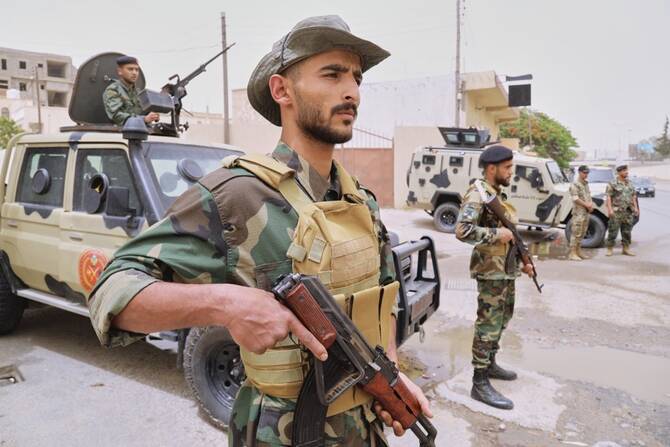
 TRIPOLI: Flights resumed on Friday at Tripoli’s airport as businesses and markets reopened after days of deadly fighting between armed groups in the Libyan capital.
“Last night, for the first time since Monday, residents of the capital were able to sleep without hearing explosions or gunfire,” an Interior Ministry official said.
After the bout of violence that pitted armed groups aligned with the Tripoli government and rival factions it seeks to dismantle, the official said that “we believe the situation is moving toward a ceasefire.”
Tripoli was calm again, with markets, gas stations and other businesses reopening at a
usual pace while many residents headed to mosques for the Friday prayer, AFP reporters said.
Flights to and from Tripoli’s Mitiga airport, which have been suspended since the fighting began early this week, resumed on Friday.
Authorities have deployed teams to clear the streets of barricades, burned-out vehicles and rubble caused by the violence, the latest outburst in Libya, which has remained deeply divided since the 2011 revolt that toppled and killed longtime leader Muammar Qaddafi.
The violence in Tripoli was sparked by the killing of Abdelghani Al-Kikli, head of the Support and Stability Apparatus faction, by the Dbeibah-aligned 444 Brigade.

FASTFACT

Flights to and from Tripoli’s Mitiga airport, which have been suspended since the fighting began early this week, resumed on Friday.

A second wave of clashes pitted the 444 Brigade against another group, the Radaa force, which controls parts of eastern Tripoli and several key state institutions.
A string of executive orders had sought to dismantle Radaa and dissolve other Tripoli-based armed groups, excluding the 444 Brigade.
The UN said on Thursday there was a “truce” in Tripoli, calling on “parties to take urgent steps to sustain and build upon it through dialogue.”
It said that “at least eight civilians” were killed in the clashes, “which drew armed groups from outside the city and subjected heavily populated neighborhoods to heavy artillery fire.”
The Interior Ministry source said authorities were patrolling key parts in Tripoli on Friday, as “armed groups’ vehicles” withdrew from flashpoint areas.
“It’s a positive thing, and it indicates good intentions,” said the source.
The UN support mission in Libya, UNSMIL, had called on Thursday “for all armed formations to return to their barracks without delay.”


Syrian army declares a closed military zone east of Aleppo as tensions rise with Kurds

Updated 5 sec ago
Follow

Syrian army declares a closed military zone east of Aleppo as tensions rise with Kurds

ALEPPO, Syria: The Syrian army on Tuesday declared an area east of the northern city of Aleppo a “closed military zone,” potentially signaling another escalation between government forces and fighters with the Kurdish-led Syrian Democratic Forces.
Several days of clashes in the city of Aleppo last week that displaced tens of thousands of people came to an end over the weekend with the evacuation of Kurdish fighters from the contested neighborhood of Sheikh Maqsoud.
Since then, Syrian officials have accused the SDF of building up its forces near the towns of Maskana and Deir Hafer, about 60 km (37 mi) east of Aleppo city, something the SDF denied.
State news agency SANA reported that the army had declared the area a closed military zone because of “continued mobilization” by the SDF “and because it serves as a launching point for Iranian suicide drones that have targeted the city of Aleppo.”
On Saturday afternoon, an explosive drone hit the Aleppo governorate building shortly after two Cabinet ministers and a local official held a news conference on the developments in the city. The SDF denied being behind the attack.
The army statement Tuesday said armed groups should withdraw to the area east of the Euphrates River.
The tensions come amid an impasse in political negotiations between the central state and the SDF.
The leadership in Damascus under interim President Ahmad Al-Sharaa signed a deal in March with the SDF, which controls much of the northeast, for it to merge with the Syrian army by the end of 2025. There have been disagreements on how it would happen.
Some of the factions that make up the new Syrian army, formed after the fall of former President Bashar Assad in a rebel offensive in December 2024, were previously Turkiye-backed insurgent groups that have a long history of clashing with Kurdish forces.
The SDF has for years been the main US partner in Syria in fighting against the Daesh group, but Turkiye considers the SDF a terrorist organization because of its association with the Kurdistan Workers’ Party, or PKK, which has waged a long-running insurgency in Turkiye. A peace process is now underway.
Despite the long-running US support for the SDF, the Trump administration in the US has also developed close ties with Al-Sharaa’s government and has pushed the Kurds to implement the March deal.
Shams TV, a station based in Irbil, the seat of northern Iraq’s semi-autonomous Kurdish region, had been set to air an interview with Al-Sharaa on Monday but later announced it had been postponed for “technical” reasons without giving a new date for airing it.