

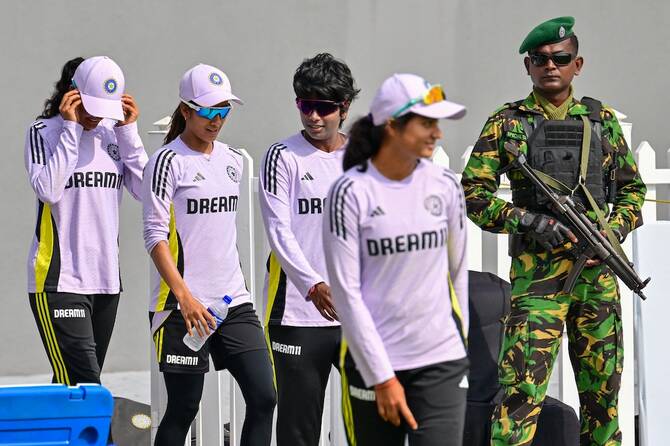

At times of political turbulence between nations that involves loss of life and suffering, it seems inappropriate to talk about sport, despite its capacity to build bridges between peoples.
Yet, during the recent outbreak of hostilities between India and Pakistan, it has been impossible to ignore the effect that the escalating crisis has had on the sport.
In part, this was because both the Pakistan Super League and the Indian Premier League were suspended. In part, it was because cricket has been swept up inexorably as an actor in the unfolding geopolitical drama.
The flashpoint for the IPL occurred in Dharamsala during a match on Thursday May 8. A blackout in the stadium occurred after 10.1 overs had been bowled, later attributed to power failure caused by air raid sirens warning of possible strikes in neighboring Jammu.
Evacuation of the estimated 17,500 crowd was ordered because of security concerns. I can testify that this is a ground with difficult access and egress. It must have been a terrifying experience and many have wondered why the match was allowed to start, given that one at the same location the following day had already been rescheduled.
Suspension of the league was announced on May 9.
The PSL’s flashpoint was on Wednesday May 7 following reports of Indian drones entering Pakistan airspace. One of them was shot down at the food street adjacent to the Rawalpindi stadium, where a match was due to take place.
This was rescheduled, but widespread reservations were expressed by the 37 foreign players involved in the PSL. Most of them were not happy to stay in Pakistan, a sentiment sufficient to persuade the Pakistan Cricket Board that suspension was necessary.
On May 8, Mohsin Naqvi, the PCB chair announced that the remainder of the tournament would be shifted to the UAE, so “the domestic, as well as foreign cricketers, who are our precious guests, can be saved from the possible reckless targeting by India.”
In his view, India’s actions were “manifestly done to disrupt the ongoing HBL Pakistan Super League X.” This may be stretching the point but what happened next is a source of conjecture.
The Emirates Cricket Board seemed to have been prepared to host the remainder of the PSL, with some players quickly transferring to Dubai. However, the next day, this plan was shelved. Various explanations have been advanced.
One is that, since the UAE has almost four million Indians, who account for 35 percent of the population, there was no appetite to run the risk of transferring tensions or stirring unrest. Another is that pressure was exerted by a combination of the International Cricket Council and the Board for Control of Cricket in India.
As is well known, the ICC’s chair is the former secretary of the BCCI and son of India’s interior minister. Together, the ICC and BCCI form the powerbase of international cricket, with access to the top of the Indian political process.
Quite frequently, announcements by the BCCI are openly predicated on the basis of having taken advice from the government. Whether this linkage assisted in being able to swiftly communicate to franchises the announcement of a ceasefire effective from 5 p.m. Indian Standard Time on May 10 is unknown.
Although a number of foreign players and coaches had left India, following the announcement of suspension on May 9, others were at airports or aboard planes standing on tarmacs. The whole suspension process was turbo-thrust into reverse, even to the extent of individuals leaving tarmac-bound planes.
From a distance, it may seem difficult to comprehend what appears to be the unseemly haste with which the BCCI sought to restart the IPL on May 17. Some Australian players and coaches had only just reached their homes when messages were received to turn around and resume their IPL obligations.
Quite what this whole imbroglio has done to trust levels between foreign players/coaches and the IPL remains unsaid, for contractual reasons.
The same may apply to the PSL, which has announced resumption, also on May 17, with or without its foreign players, although the PCB seems to be taking a more emollient line.
Both the IPL and PSL are symbols of national pride, their resumptions an indicator of resilience and unity. Ironically, this situation would not have existed had the two leagues not been played simultaneously this year for the first time.
The ongoing fractious relations between Indian and Pakistan cast a long shadow over cricket, not just now, but for the foreseeable future. Cricket does not cause these tensions but, increasingly, finds itself caught in the crossfire.
However, it is also perfectly capable of creating troubles in its own right. A prime example occurred in the ICC Women’s T20 World Cup Asia Qualifying 2025 tournament in Bangkok last week.
Teams from nine countries are competing to land one of two qualifying spots to progress to the next stage of the tournament, due to be held in England in 2026.
The teams are divided into three groups: A comprises Bhutan, Kuwait and Thailand; B has Malaysia, Qatar and the UAE; and C consists of Nepal, Hong Kong (China) and Bahrain. Each team plays the other teams in their group twice.
The pressure to progress from the event was illustrated vividly by the UAE against Qatar. In 16 overs the UAE scored 192 for no wickets. Then, with sounds of thunder and threats of rain, the team’s management became concerned that the match might not be completed. In that case the two points on offer would be shared.
Two weeks ago, I wondered in my column if the modern generation of cricketers, brought up on short formats, which do not allow declarations of innings, knew the meaning and origins of declaration cricket.
The UAE coach enquired if a declaration was possible and when informed that it was not, hatched an alternative strategy. This was to instruct his batters to retire out, according to Law 25.4, which states that a batter may retire at any time during his or her innings when the ball is dead.
The umpires need be informed of the reason. Normally, that is because of illness, injury or any other unavoidable cause. In these cases, a batter is entitled to resume his or her innings. If for any reason this does not happen, that batter is to be recorded as “Retired — not out.”
If a batter retires for any other reason, the innings of that batter may be resumed only with the consent of the opposing captain. If for any reason his or her innings is not resumed, that batter is recorded as “Retired — out.”
This was the strategy adopted by the UAE, leading to the farcical sight of a succession of batters, some without equipment, rushing to the pitch to inform the umpires of their decision. The resultant scorecard displayed nine batters as “Retired Out, 0” in a score of 192 all out.
One cricket website suggested this is a world record number of ducks in a single innings. This rather facile statement is unlikely to be shared by others more concerned with the game’s integrity.
The rain and thunder relented sufficiently for Qatar to start its innings which lasted only 11.1 overs, the team bowled out for a paltry 29. The UAE’s strategy has been variously described as clever, shocking and surprising. Others may see it as being against the spirit of the game, however that is defined.
The original purpose of the law was to allow batters to retire out in practice matches. More recently, it has crept into T20 cricket when a batter has been deemed to be scoring too slowly and the coach wishes to introduce a replacement capable of scoring more quickly.
No doubt, consequent on the UAE’s action, there will be calls for a revision of the law relating to retired out. Traditionalists regard the act as taking away the essence of the game, the battle between bowler and batter.
Revision is within the control of cricket’s administrators. Resolving the conflict between India and Pakistan is not. However, making decisions of integrity for the management of the game are, or should be, paramount.
It is hard to resist a sense that neither mass retired outs nor the incorporation of cricket into the conduct of national conflicts will assist in enhancing perceptions of the game’s integrity.


