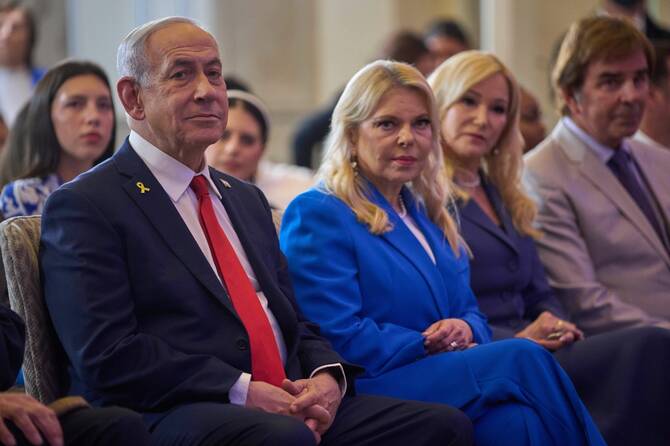
JERUSALEM: Israeli Prime Minister Benjamin Netanyahu said in an interview published on Friday that he hopes to “taper off” Israeli dependence on American military aid in the next decade.
Netanyahu has said Israel should not be reliant on foreign military aid but has stopped short of declaring a firm timeline for when Israel would be fully independent from the US
“I want to taper off the military within the next 10 years,” Netanyahu told the Economist. Asked if that meant a tapering “down to zero,” he said, “Yes.”
Netanyahu said he told President Donald Trump during a recent visit that Israel “very deeply” appreciates “the military aid that America has given us over the years, but here too we’ve come of age and we’ve developed incredible capacities.”
In December, Netanyahu said Israel would spend 350 billion shekels ($110 billion) on developing an independent arms industry to reduce dependency on other countries.
In 2016, the US and Israeli governments signed a memorandum of understanding for the 10 years through September 2028 that provides $38 billion in military aid, $33 billion in grants to buy military equipment and $5 billion for missile defense systems.
Israeli defense exports rose 13 percent last year, with major contracts signed for Israeli defense technology including its advanced multi-layered aerial defense systems.


Netanyahu hopes to ‘taper’ Israel off US military aid in next decade
https://arab.news/zmzs6
Netanyahu hopes to ‘taper’ Israel off US military aid in next decade

- Netanyahu has said Israel should not be reliant on foreign military aid but has stopped short of declaring a firm timeline for when Israel would be fully independent from the US


Syria welcomes Canada’s decision to amend sanctions
- Husarieh said the decision could pave the way for Canadian participation in Syria’s reconstruction and infrastructure development
DAMSCUS: Syria’s Central Bank governor, Abdulkader Husarieh, commended the Canadian government’s decision to amend the sanctions imposed on Damascus under the Special Economic Measures Regulations, including the lifting of the comprehensive economic embargo in place since May 2011.
In a post published on his personal Facebook page, Husarieh described the move as an important milestone that reinforces the implementation of understandings reached during his recent visit to Canada.
He added that the amendment provides an opportunity to boost economic relations and activate cooperation between Canadian and Syrian banks and financial institutions.
Husarieh said the decision could pave the way for Canadian participation in Syria’s reconstruction and infrastructure development.
Meanwhile, the Syrian Arab Red Crescent and the Turkish Red Crescent signed cooperation agreements on Friday to strengthen humanitarian efforts in Syria amid ongoing crises and economic hardship.
Syrian Arab Red Crescent President Hazem Bakleh met in Damascus with Alper Kucuk, the Turkish Red Crescent’s director general for international affairs and migration services, to discuss rising humanitarian needs and ways to enhance coordination in support of vulnerable communities.
According to a statement released by the Syrian organization, the agreement provides for expanding relief and service activities.
It includes support for the construction of a new Red Crescent branch headquarters in Idlib province and the launch of a project to distribute hot meals and bread in Damascus and Aleppo during the holy month of Ramadan.
The Syrian Arab Red Crescent has sought to broaden partnerships with regional and international organizations in recent years to strengthen its operational capacity across multiple provinces, as the country continues to face economic strain and humanitarian challenges affecting large segments of the population.


