

Pakistan PM reaffirms India ceasefire commitment, says Kashmir resolution key to regional peace

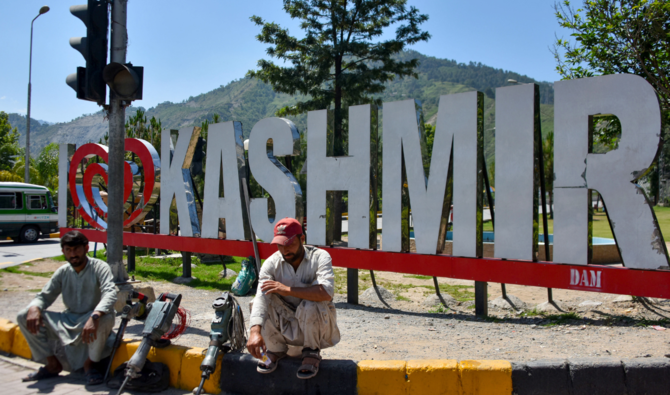
Workers wait along a road in Muzaffarabad, the capital of Pakistan-administered Kashmir, on May 14, 2025. (AFP)
Short Url
Updated 15 May 2025
Follow

Pakistan PM reaffirms India ceasefire commitment, says Kashmir resolution key to regional peace

  • Shehbaz Sharif expresses concern over ‘provocative statements’ by Indian leaders following the ceasefire
  • He tells Azerbaijani president Pakistan remains prepared to defend its sovereignty against any attack

ISLAMABAD: Prime Minister Shehbaz Sharif on Thursday reaffirmed Pakistan’s commitment to a recently agreed ceasefire with India but stressed that lasting peace in South Asia would only be possible through the resolution of the Kashmir dispute in line with UN Security Council resolutions.

Sharif made the statement during a phone call with Azerbaijani President Ilham Aliyev, days after cross-border hostilities between India and Pakistan were halted under a ceasefire announced by US President Donald Trump.

According to an official statement, Sharif said his country had accepted ceasefire in the interest of regional peace but warned that it remained prepared to defend its sovereignty and territorial integrity in the face of another attack.

“The Jammu and Kashmir dispute is the root cause of instability in South Asia, which should be resolved in accordance with the UN Security Council’s resolutions,” he said, according to the Prime Minister’s Office.

He also expressed concern over recent “provocative statements” by Indian leaders following the agreement.

Sharif thanked Azerbaijan for its stance on Kashmir and reiterated Pakistan’s appreciation for the solidarity shown by its leadership and people during the recent standoff.

The two leaders also discussed bilateral ties, with the Pakistani prime minister welcoming progress on proposals for up to $2 billion in Azerbaijani investments in Pakistan across multiple sectors.

He said Islamabad was committed to transforming its relations with Baku into a mutually beneficial economic partnership.

President Aliyev congratulated Sharif on Pakistan’s handling of the recent crisis and expressed support for the ceasefire agreement.

He reaffirmed Azerbaijan’s commitment to strengthening bilateral cooperation.

The Pakistani premier extended an invitation to Aliyev to undertake an official visit to Pakistan, which the Azerbaijani leader accepted.


Pakistan, China to sign multiple MoUs at major agriculture investment conference today

Updated 18 January 2026
Follow

Pakistan, China to sign multiple MoUs at major agriculture investment conference today

  • Hundreds of Chinese and Pakistani firms to attend Islamabad event
  • Conference seen as part of expanding CPEC ties into agriculture, trade

KARACHI: Islamabad and Beijing are set to sign multiple memorandums of understanding (MoUs) to boost agricultural investment and cooperation at a major conference taking place in the capital today, Monday, with hundreds of Chinese and Pakistani companies expected to participate.

The conference is being billed by Pakistan’s Ministry of National Food Security and Research as a platform for deepening bilateral agricultural ties and supporting broader economic engagement between the two countries.

“Multiple memorandums of understanding will be signed at the Pakistan–China Agricultural Conference,” the Ministry of National Food Security said in a statement. “115 Chinese and 165 Pakistani companies will participate.”

The conference reflects a growing emphasis on expanding Pakistan-China economic cooperation beyond the transport and energy foundations of the flagship China-Pakistan Economic Corridor (CPEC) into agriculture, industry and technology.

Under its first phase launched in 2015, CPEC, a core component of China’s Belt and Road Initiative, focused primarily on transportation infrastructure, energy generation and connectivity projects linking western China to the Arabian Sea via Pakistan. That phase included motorways, power plants and the development of the Gwadar Port in the country's southwest, aimed at helping Pakistan address chronic power shortages and enhance transport connectivity.

In recent years, both governments have formally moved toward a “CPEC 2.0” phase aimed at diversifying the corridor’s impact into areas such as special economic zones, innovation, digital cooperation and agriculture. Second-phase discussions have highlighted Pakistan’s goal of modernizing its agricultural sector, attracting Chinese technology and investment, and boosting export potential, with high-level talks taking place between planning officials and investors in Beijing.

Agri-sector cooperation has also seen practical collaboration, with joint initiatives examining technology transfer, export protocols and value-chain development, including partnerships in livestock, mechanization and horticulture.

Organizers say the Islamabad conference will bring together government policymakers, private sector investors, industry associations and multinational agribusiness firms from both nations. Discussions will center on investment opportunities, technology adoption, export expansion and building linkages with global buyers within the framework of Pakistan-China economic cooperation.