

Pakistan resolves to enhance UAE ties into ‘mutually beneficial economic partnership’

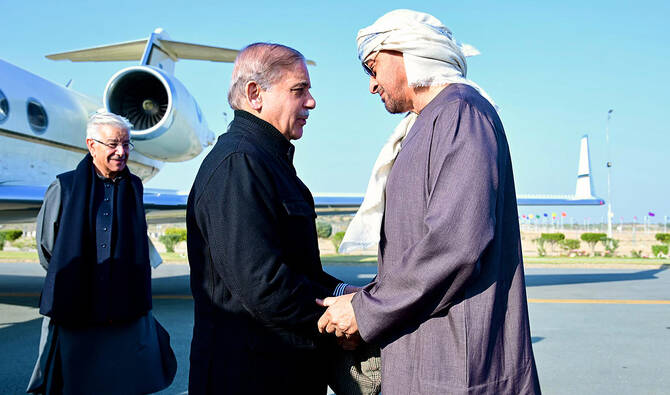
In this file photo, taken on January 5, 2025, Pakistan Prime Minister Shehbaz Sharif meets the UAE President Sheikh Mohamed bin Zayed Al Nahyan in Rahim Yar Khan, Pakistan. (Photo courtesy: PMO/File)
Short Url
Updated 14 May 2025
Follow

Pakistan resolves to enhance UAE ties into ‘mutually beneficial economic partnership’

  • Shehbaz Sharif speaks to UAE President Sheikh Mohammed bin Zayed Al-Nahyan
  • Pakistan PM thanks UAE for playing constructive role to defuse South Asia tensions

ISLAMABAD: Prime Minister Shehbaz Sharif on Wednesday reaffirmed his country’s resolve to strengthen Pakistan’s ties with the United Arab Emirates (UAE) into a “mutually beneficial economic partnership,” his office said in a statement.

Sharif’s government has moved closer to the UAE in recent months in its efforts to attract international investment and ensure stability for Pakistan’s fragile $350 billion economy.

In January last year, Pakistan and the UAE signed multiple agreements worth more than $3 billion for cooperation in railways, economic zones and infrastructure, a Pakistani official said.

Sharif spoke to UAE President Sheikh Mohammed bin Zayed Al-Nahyan over the telephone, the Pakistani Prime Minister’s Office (PMO) said. He noted “with great satisfaction” that bilateral cooperation between the two countries was progressing, especially in the areas of economy and investment.

“He [Sharif] renewed his strong resolve to transform the existing Pakistan-UAE ties into a mutually beneficial economic partnership,” the statement said.

Both leaders discussed Pakistan’s recent tensions with India which triggered an armed conflict between the two nations recently.

India and Pakistan pounded each other with missiles, drones, and artillery fire last week. The conflict erupted when India fired missiles into Pakistan last Wednesday after weeks of tensions over an attack on tourists in Indian-administered Kashmir on Apr 22. New Delhi blamed the attack on Pakistan, while Islamabad denied involvement.

US President Donald Trump announced Washington had brokered a ceasefire between the two states on Saturday after Pakistan launched retaliatory strikes.

“During their warm and cordial conversation, the Prime Minister conveyed profound gratitude for UAE’s diplomatic efforts and constructive role to defuse the recent crisis in South Asia,” the PMO said.

“He added the UAE had always stood by Pakistan, through thick and thin.”

Sharif’s office said he reaffirmed Pakistan’s commitment to uphold the ceasefire understanding, as well as its resolve to defend its sovereignty and territorial integrity at all costs.

“The UAE President welcomed the ceasefire understanding, while appreciating Pakistan’s efforts for peace,” the PMO said.

Separately, Sharif also spoke to UN chief Antonio Guterres to thank him for his efforts to defuse tensions in South Asia, the PMO said.

The UAE holds immense importance for Pakistan, given that it is Islamabad’s third-largest trading partner after China and the United States, and a major source of foreign investment, valued at over $10 billion in the last 20 years, according to the UAE foreign ministry.

It is also home to more than a million Pakistani expatriates. Policymakers in Pakistan consider the UAE an optimal export destination due to its geographical proximity, which minimizes transportation and freight costs while facilitating commercial transactions.


Pakistan Air Force conducts successful test of air-launched cruise missile

Updated 03 January 2026
Follow

Pakistan Air Force conducts successful test of air-launched cruise missile

  • The indigenously developed ‘Taimoor’ missile has a range of 600 kilometers and carries a conventional warhead
  • The missile is designed to fly at low altitudes, which enables it to evade hostile air, missile defense systems

ISLAMABAD: The Pakistan Air Force (PAF) has successfully conducted a test of an air-launched cruise missile, ‘Taimoor,’ the Pakistani military said on Saturday, marking another significant milestone in advancement of national aerospace and defense capabilities.

The indigenously developed Taimoor weapon system is capable of engaging enemy land and sea targets with high precision. The missile has a range of 600 kilometers and carries a conventional warhead.

The missile test comes months after a brief but intense military conflict between Pakistan and India in which the nuclear-armed neighbors exchanged missile and artillery fire and deployed drones and fighter jets.

Equipped with state-of-the-art navigation and guidance system, Taimoor is designed to fly at very low altitudes, enabling it to effectively evade hostile air and missile defense systems.

“Its precision-strike capability significantly enhances the conventional deterrence and operational flexibility of Pakistan Air Force, further strengthening the country’s overall defense posture,” said the Inter-Services Public Relations (ISPR), the military’s media wing.

“The successful flight test underscores the technical maturity, innovation and self-reliance achieved by Pakistan’s defense industry.”

The missile’s launch was witnessed by senior officers of the armed forces along with distinguished scientists and engineers, who played a pivotal role in the development of this advanced weapon system.

PAF’s Air Chief Marshal Zaheer Ahmed Baber Sidhu congratulated the scientists, engineers and the entire PAF team on this remarkable achievement, lauding their professional excellence, dedication and unwavering commitment to strengthening Pakistan’s defense capabilities.

“The air chief reaffirmed that such accomplishments are a testament to the nation’s resolve to achieve technological self-sufficiency and maintain a credible conventional deterrent in the evolving regional security environment,” the ISPR said.

“The successful test of the Taimoor weapon system reflects Pakistan Air Force’s continued pursuit of operational readiness, technological superiority and national security objectives.”

Pakistan has placed greater emphasis on battle readiness in recent months. On Dec. 15, Pakistan Navy test-fired surface-to-air missile in the northern Arabian Sea.

Prior to that, Chief of Defense Forces Field Marshal Asim Munir visited frontline garrisons of Gujranwala and Sialkot to observe a field training exercise involving tanks and drones, where he had highlighted the importance of technological adaptability, saying modern warfare required agility, precision, situational awareness and rapid decision-making.