Germany arrests three Ukrainians over Russian sabotage plot

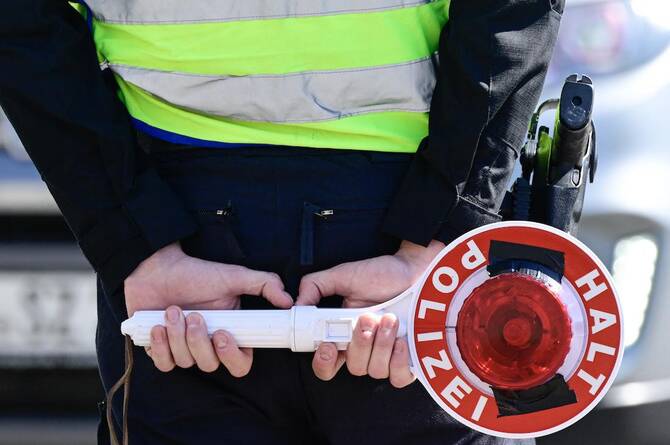
A German federal police officer hold a spolice signalling disc during a control of vehicles coming into Germany. (File/AFP)
Short Url
Updated 14 May 2025
Follow

Germany arrests three Ukrainians over Russian sabotage plot

  • The accused allegedly aimed to send packages from Germany containing explosive devices to recipients in Ukraine
  • Germany has been on high alert for sabotage plots directed from Moscow

FRANKFURT: German prosecutors said Wednesday they had arrested three Ukrainians accused of plotting sabotage attacks on goods transports for Russia, amid soaring tensions between Moscow and Berlin.

The suspects, detained in Germany and Switzerland, had told individuals “believed to be acting on behalf of Russian state authorities” that they were ready “to commit arson and explosive attacks on goods transport in Germany,” federal prosecutors said.

The accused allegedly aimed to send packages from Germany containing explosive devices to recipients in Ukraine, which would go off as they were being transported, they said.

Germany has been on high alert for sabotage plots directed from Moscow since Russia’s 2022 full-scale invasion of Ukraine led to a rapid deterioration in ties.

In a speech to parliament Wednesday, new Chancellor Friedrich Merz accused Russia of targeting Germany and other European countries with acts ranging from cyberattacks, espionage and sabotage to disinformation, poison attacks and murders.

Such acts were “overwhelmingly the work of the Russian government and its helpers,” he said, accusing Moscow of “attempts at division and destabilization.”

In the latest case Wednesday, one of the suspects, partially identified as Vladyslav T., posted two test packages in Cologne at the end of March, which contained GPS trackers, prosecutors said.

The order to send them was given by Yevhen B., who provided the contents from the packages via the third suspect, Daniil B.

The suspects, arrested between Friday last week and Tuesday, are “strongly suspected” of acting as foreign agents for the purpose of carrying out sabotage, prosecutors said.

They are also accused of plotting to commit arson and cause explosions.

Vladyslav T. and Daniil B., arrested in the German cities of Cologne and Konstanz, respectively, have been remanded in custody.

Yevhen B. was detained in the Swiss canton of Thurgau, and is due to appear before a judge after being transferred to Germany.

Moscow-Berlin relations have been in the deep freeze since Russia invaded Ukraine and the West imposed a barrage of punishing sanctions.

Germany, Kyiv’s second-biggest military back after the United States, has been shaken by a string of alleged sabotage and espionage cases linked to Russia.

In a case separate from Wednesday’s arrests, media recently reported that European intelligence services believed that Russia was behind a plot to plant explosive devices on cargo planes.

Several people reportedly implicated in the operation, which saw parcels explode at two DHL depots last July, were thought to be low-level operatives hired by Moscow.

In other cases of alleged Russian interference, a former German intelligence officer stands accused of handing sensitive information to Moscow while Berlin has blamed Moscow for being behind a cyberattack on members of the center-left SPD party.

Russia has denied being behind such actions.

Merz has vowed to keep up Germany’s support for Ukraine, insisting that: “There must be no doubt where we stand: namely... on the side of this attacked country.”


Pope names veteran Vatican diplomat as ambassador to the US to manage relations with Trump

Updated 4 sec ago
Follow

Pope names veteran Vatican diplomat as ambassador to the US to manage relations with Trump

  • Italian Archbishop Gabriele Caccia, 68, is currently the Holy See’s ambassador to the UN
  • He replaces French-born Cardinal Christophe Pierre

ROME: Pope Leo XIV on Saturday named a veteran Vatican diplomat as his new ambassador to the United States to manage one of the Holy See’s most important bilateral relationships at a crucial time, with ties strained over the Trump administration’s war in Iran and immigration crackdown.
Italian Archbishop Gabriele Caccia, 68, is currently the Holy See’s ambassador to the United Nations in New York. He replaces French-born Cardinal Christophe Pierre, who at age 80 is retiring as apostolic nuncio in Washington.
Caccia served as the Holy See’s ambassador to Lebanon and the Philippines before being posted to the UN in 2019. Ordained a priest in Milan in 1983, Caccia later served as “assessor” in the Vatican secretariat of state, a key administrative post in the Holy See’s most important office.
He inherits a complicated and consequential dossier on both the US church and state fronts at a time of global turmoil.
Pierre’s tenure as ambassador was notable for clear signs of friction between the leadership of the US Conference of Catholic Bishops, which tends to skew conservative, and the more progressive priorities of Pope Francis’ pontificate.
The relationship with the US and its church is crucial for the Holy See, not least because US Catholics are the most generous donors to the Holy See’s coffers.
Leo, history’s first US-born pope, is well aware of the dynamic, having served as Francis’ point man on bishop nominations for two years before his 2025 election. Leo has emphasized a message of pacification and unity in the church.
The first Trump administration clashed with Francis especially on migration, and that tension has continued in Leo’s pontificate and the second Trump term. Leo has repeatedly insisted that the Trump administration respect the human dignity of migrants, while acknowledging its right to its borders.
More recently, Leo has expressed “profound concern” about the US-Israeli war in Iran and urged both sides to “stop the spiral of violence before it becomes an irreparable abyss.”
In comments last Sunday, Leo called for the resumption of diplomacy. Weapons, he said, only sow “destruction, pain and death.”
In a major foreign policy speech earlier this year, Leo also made clear he opposed the US aggressive use of military power, in an apparent reference to Washington’s incursion in Venezuela and threats to take Greenland. He denounced how nations were using force to assert their dominion worldwide and “completely undermine” peace and the post-World War II international legal order.
Caccia said in a statement Saturday he was humbled by Leo’s appointment and faith in naming him ambassador to his native country.
“I receive this mission with both joy and a sense of trepidation,” according to a statement reported by Vatican News. He said his was a mission “at the service of communion and peace,” recalling that this year marks the 250th anniversary of the US independence.
The current president of the US conference, Archbishop Paul S. Coakley, welcomed Caccia’s appointment and offered the US hierarchy’s “warmest welcome and our prayerful support.”
The Holy See has a tradition of diplomatic neutrality, though Leo has spoken out strongly against the humanitarian toll of Israel’s military action in Gaza and Russia’s invasion of Ukraine.