Pakistan and Russia agree to establish new steel mill in Karachi 

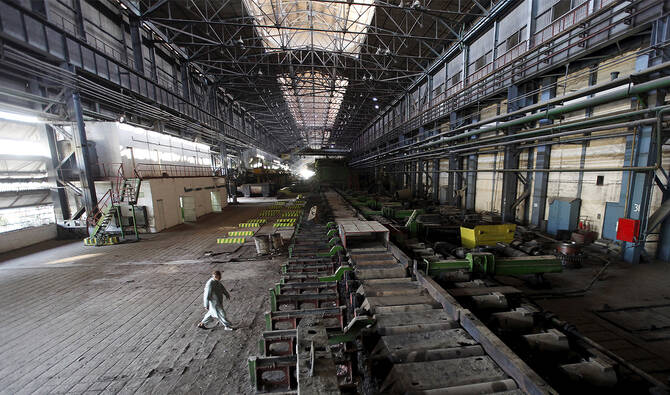
A man walks past machines at the hot strip mill department of the Pakistan Steel Mills (PSM) on the outskirts of Karachi, Pakistan, on February 8, 2016. (REUTERS/File)
Short Url
Updated 14 May 2025
Follow

Pakistan and Russia agree to establish new steel mill in Karachi 

  • The two countries have worked on deepening their ties in recent years, focusing on energy cooperation
  • Both sides also collaborated in the 1970s when the Soviet Union helped set up Pakistan Steel Mills

ISLAMABAD: Pakistan and Russia have agreed to establish a steel mill in Karachi, state media reported on Tuesday, aiming to boost bilateral ties and expand industrial collaboration between the two countries.

Their understanding reflects a broader deepening of Pakistan-Russia relations in recent years, including energy cooperation on oil and gas supplies. In 2023, the two sides worked on a deal for the delivery of Russian crude to Pakistan, and talks have continued on broader energy partnerships.

The two countries are also collaborating on the Pakistan Stream Gas Pipeline, a major infrastructure project aimed at transporting imported gas from Karachi to Punjab to help meet Pakistan’s energy needs.

The idea of the new steel mills was discussed during a meeting between Russian representative Denis Nazaroof and Special Assistant to the Prime Minister (SAPM) Haroon Akhtar Khan.

“The primary focus of the discussion was the establishment of new steel mills in Pakistan,” the Associated Press of Pakistan (APP) news agency reported.

The new project echoes the historic collaboration between the two sides in the 1970s, when the Soviet Union helped set up Pakistan Steel Mills (PSM).

PSM was once the country’s largest industrial complex. However, the facility suffered decades of neglect, financial mismanagement, and political interference, ultimately shutting down production in 2015 after accumulating billions in losses.

“Pakistan is a secure and thriving hub for investment, and the international community has recognized its potential,” Khan said during the meeting.

“I invite all Russian businesspeople to explore investment opportunities in Pakistan,” he added.

Khan also emphasized the Prime Minister’s vision to attract foreign investment and underscored the potential for meaningful Pakistan-Russia cooperation in the steel sector.


Pakistan, China to sign multiple MoUs at major agriculture investment conference today

Updated 18 January 2026
Follow

Pakistan, China to sign multiple MoUs at major agriculture investment conference today

  • Hundreds of Chinese and Pakistani firms to attend Islamabad event
  • Conference seen as part of expanding CPEC ties into agriculture, trade

KARACHI: Islamabad and Beijing are set to sign multiple memorandums of understanding (MoUs) to boost agricultural investment and cooperation at a major conference taking place in the capital today, Monday, with hundreds of Chinese and Pakistani companies expected to participate.

The conference is being billed by Pakistan’s Ministry of National Food Security and Research as a platform for deepening bilateral agricultural ties and supporting broader economic engagement between the two countries.

“Multiple memorandums of understanding will be signed at the Pakistan–China Agricultural Conference,” the Ministry of National Food Security said in a statement. “115 Chinese and 165 Pakistani companies will participate.”

The conference reflects a growing emphasis on expanding Pakistan-China economic cooperation beyond the transport and energy foundations of the flagship China-Pakistan Economic Corridor (CPEC) into agriculture, industry and technology.

Under its first phase launched in 2015, CPEC, a core component of China’s Belt and Road Initiative, focused primarily on transportation infrastructure, energy generation and connectivity projects linking western China to the Arabian Sea via Pakistan. That phase included motorways, power plants and the development of the Gwadar Port in the country's southwest, aimed at helping Pakistan address chronic power shortages and enhance transport connectivity.

In recent years, both governments have formally moved toward a “CPEC 2.0” phase aimed at diversifying the corridor’s impact into areas such as special economic zones, innovation, digital cooperation and agriculture. Second-phase discussions have highlighted Pakistan’s goal of modernizing its agricultural sector, attracting Chinese technology and investment, and boosting export potential, with high-level talks taking place between planning officials and investors in Beijing.

Agri-sector cooperation has also seen practical collaboration, with joint initiatives examining technology transfer, export protocols and value-chain development, including partnerships in livestock, mechanization and horticulture.

Organizers say the Islamabad conference will bring together government policymakers, private sector investors, industry associations and multinational agribusiness firms from both nations. Discussions will center on investment opportunities, technology adoption, export expansion and building linkages with global buyers within the framework of Pakistan-China economic cooperation.