Nvidia to send 18,000 AI chips to Saudi Arabia

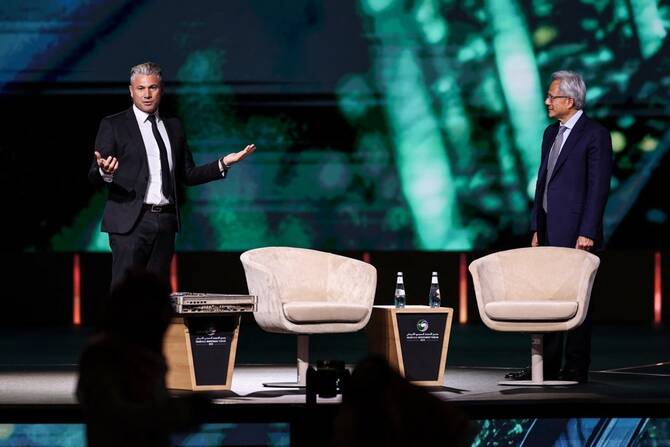
Tareq Amin, CEO of Humain, and Jensen Huang, CEO of NVIDIA, attend the Saudi-U.S. Investment Forum, in Riyadh, Saudi Arabia May 13, 2025. (Reuters)
Short Url
Updated 14 May 2025
Follow

Nvidia to send 18,000 AI chips to Saudi Arabia

  • US chip maker will partner with Saudi Arabia’s AI startup Humain

US chip maker Nvidia will partner with Saudi Arabia’s sovereign wealth fund-owned AI startup Humain and will ship 18,000 chips to the Middle Eastern nation to help power a new data center project.

The partnership was revealed Tuesday as part of a White House trip to Saudi Arabia, Qatar and the United Arab Emirates. Saudi Arabia has been working to develop its artificial intelligence capacity and strengthen its cloud computing infrastructure with the help of foreign investment.

Opinion

This section contains relevant reference points, placed in (Opinion field)

“AI, like electricity and Internet, is essential infrastructure for every nation,” said Jensen Huang, founder of Nvidia. “Together with Humain, we are building AI infrastructure for the people and companies of Saudi Arabia to realize the bold vision of the Kingdom.”

The cutting-edge Blackwell chips will be used in a 500 megawatt data center in Saudi Arabia, according to remarks at the Saudi-US Investment Forum in Riyadh on Tuesday. The California company said its first deployment will use its GB300 Blackwell chips, which are among Nvidia’s most advanced AI chips at the moment, and which were only officially announced earlier this year.


‘Future cities will be built for visitors, not just residents,’ Saudi tourism minister tells Arab News

Updated 10 November 2025
Follow

‘Future cities will be built for visitors, not just residents,’ Saudi tourism minister tells Arab News

RIYADH: Saudi Arabia is positioning itself at the forefront of the global travel evolution by designing destinations that will target the tourists of the future, the Kingdom’s tourism minister has said.

Ahmed Al-Khateeb added that sustainability would serve as the guiding principle behind Saudi Arabia’s role in tomorrow’s global travel landscape.

Travelers’ habits and the tourism industry’s revenue sources have shifted dramatically in recent years, he told Arab News in an interview.

“People used to travel in groups. Today, they are traveling in smaller groups. Hotels used to make most of their revenues from rooms — now, they are making more from lounges and restaurants.”

And younger generations, empowered by technology, are also redefining how travel is planned and experienced, Al-Khateeb added. “They are driving their own itineraries on the go, which puts pressure on traditional travel companies that once organized large group trips. We are witnessing big shifts in the global travel market.”

Among the world’s fastest-growing tourism markets, China and India are reshaping international travel flows. “China has become the most important source market for outbound travelers, while India is expected to double its number of travelers in the coming years,” the minister said. “This opens a major opportunity for the Middle East — and Saudi Arabia in particular — to emerge as a top destination for international tourists.”

Since 2019, Saudi Arabia has recorded the fastest tourism growth among all G20 nations, said Al-Khateeb. “We have a very strong domestic market and a very strong religious market. Now, we have opened our doors for leisure, business and holiday travelers — whether they seek the Red Sea coast, the southern mountains, our major cities or our beautiful islands.”

Yet the Kingdom’s long-term vision for tourism extends far beyond the present, with destinations being built to serve both visitors and residents sustainably, he added.

“In the 1950s and 1960s, cities were built for residents,” Al-Khateeb said. “Today, in places like Greece, visitors outnumber residents three to one. The cities of the future must be designed for visitors as well — and that’s what we are doing in Saudi Arabia.”

Sustainability has become a non-negotiable element of all tourism development in the Kingdom, he added. “In the last two decades, sustainability has become extremely important. As we build new destinations like the Red Sea, we are fully aligned with sustainability regulations. Whatever we build today is environmentally friendly, ensuring not only environmental, but also social and economic sustainability.”

This principle lies at the heart of Vision 2030’s tourism transformation: “Sustainability is at our forefront whenever we build or operate any new destination,” he added.