

UN aid chief slams Israel’s Gaza aid plan as ‘cynical sideshow’

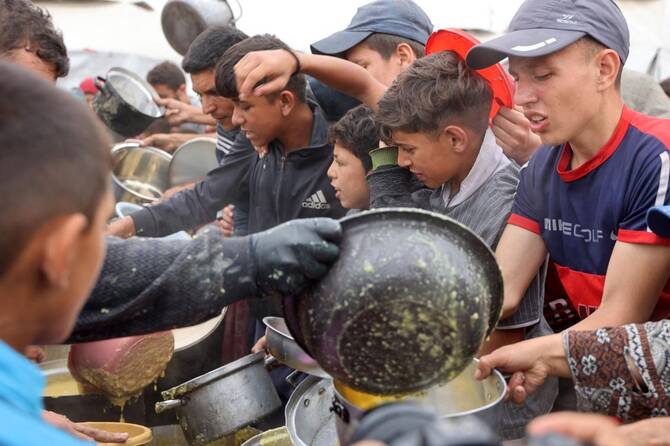
Palestinian youths shove to get a ration of hot food from a charity kitchen set up at the Islamic University campus in Gaza City on May 12, 2025. (AFP)
Short Url
Updated 13 May 2025
Follow

UN aid chief slams Israel’s Gaza aid plan as ‘cynical sideshow’

  • “We have rigorous mechanisms to ensure our aid gets to civilians and not to Hamas, but Israel denies us access,” said Fletcher
  • No aid has been delivered to Gaza since March 2

UNITED NATIONS: United Nations aid chief Tom Fletcher on Tuesday said an Israeli plan aid distribution in the Gaza Strip was a “cynical sideshow, a deliberate distraction, a fig leaf for further violence and displacement” of Palestinians in the enclave.

He told the UN Security Council that no food, medicine, water or tents have entered the war-torn Palestinian enclave for more than 10 weeks.

“We can save hundreds of thousands of survivors. We have rigorous mechanisms to ensure our aid gets to civilians and not to Hamas, but Israel denies us access, placing the objective of depopulating Gaza before the lives of civilians,” said Fletcher.

No aid has been delivered to Gaza since March 2. Israel has said it would not allow the entry of goods and supplies into Gaza until Palestinian militant group Hamas releases all remaining hostages.

At the end of last month the UN World Food Programme said it had run out of food stocks in Gaza, and US President Donald Trump said that he pushed Israeli Prime Minister Benjamin Netanyahu to allow the delivery of food and medicine.

Fletcher said the UN has met more than a dozen times with Israeli authorities to discuss their proposed aid distribution model “to find a way to make it possible,” stressing the minimum conditions needed for UN involvement. Those included the ability to deliver aid to all those in need wherever they are.

“The Israeli-designed distribution modality is not the answer,” he told the 15-member council.

“It forces further displacement. It exposes thousands of people to harm ... It restricts aid to only one part of Gaza while leaving other dire needs unmet. It makes aid conditional on political and military aims. It makes starvation a bargaining chip,” Fletcher said.

COGAT, the Israeli military agency that coordinates aid, met with UN agencies and international aid groups in early April and proposed “a structured monitoring and aid entry mechanism.”

“The mechanism is designed to support aid organizations, enhance oversight and accountability, and ensure that assistance reaches the civilian population in need, rather than being diverted and stolen by Hamas,” COGAT posted on X on April 3.

The war in Gaza was triggered on October 7, 2023, when Hamas killed 1,200 people in southern Israel, and took some 250 hostages, according to Israeli tallies. Since then, more than 52,700 Palestinians have been killed, according to Gaza health authorities.


Iraqis cover soil with clay to curb sandstorms

Updated 4 sec ago
Follow

Iraqis cover soil with clay to curb sandstorms

  • Dust storms have cloaked cities and villages in an endless ochre haze

BAGHDAD: Deep in Iraq’s southern desert, bulldozers and earthmovers spread layers of moist clay over sand dunes as part of a broader effort to fight increasingly frequent sandstorms.

Iraq has long suffered from sand and dust storms, but in recent years they have become more frequent and intense as the country falls prey to the effects of climate change.
Sand and dust storms — driven by severe drought, rising temperatures and deforestation — have cloaked cities and villages in an endless ochre haze, grounded flights and filled hospitals with patients suffering from breathing difficulties.
Iraqi authorities have warned that these suffocating storms will intensify further, adding urgency to address the root of the problem.
In a relatively small area between the cities of Nasiriyah and Samawah, not far from ancient Sumerian ruins, laborers are working hard to stabilize the soil by applying a layer of moist clay 20-25 centimeters thick.
The project also includes planting heat-tolerant seedlings like Prosopis and Conocarpus to further stabilize the soil.
“The main goal is to reduce the impact of transboundary dust storms,” said Udai Taha Lafta from UN-Habitat, which is leading the project to combat sandstorms with Iraqi expertise.
“It is a vital area despite its small size, and will hopefully help reduce dust storms next summer,” Lafta said.
A short-term objective is to shield a southern highway where many traffic accidents have occurred due to poor visibility during dust storms.
The Ministry of Environment estimates that Iraq now faces about 243 storms per year, and the frequency is expected to increase to 300 “dust days” by 2050 unless drastic mitigation measures are adopted.
In 2023, Iraqi authorities teamed up with the UN-Habitat and the Kuwait Fund for Arab Economic Development in areas that have been identified as major sources of sandstorms.
The project has been implementing several methods in three southern areas, including digging water canals and supplying electricity to pump water from the Euphrates river, preparing barren lands for vegetation.
One of the project’s ultimate goals is to increase green spaces and for farmers to eventually sustain the lands after droughts and chronic water shortages have drastically reduced agricultural areas.
Qahtan Al-Mhana, from the Agriculture Ministry, said that stabilising the soil gives agricultural efforts in sandy areas a chance to endure.
He added that Iraq has extensive “successful” experience in combating desertification and dust storms by stabilising sand dunes.
Since the 1970s, the country has implemented such projects, but after decades of turmoil, environmental challenges have largely fallen by the wayside.
With the severe recent impact of climate change, “work has resumed,” said Najm Abed Taresh from Dhi Qar University. “We are making slow but 
steady progress.”