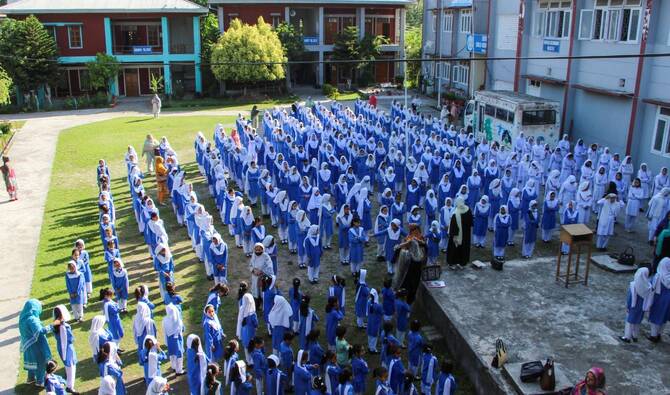
CHAKOTHI: Schools reopened in Pakistan-administered Kashmir on Tuesday after some of the residents of border villages returned home, following a ceasefire between India and Pakistan.
The truce was reached after four days of intense exchanges of fire as the old enemies targeted each other’s military installations with missiles and drones, killing dozens of civilians.
In the border town of Chakothi near Line of Control (LoC), attendance was thin at schools as many people, who had moved to safer places due to Indian shelling, were still slowly coming back to the area.
“For the past many days, my school remained closed due to [cross-border Indian] shelling,” said Junaid Munir, a 6th-grader.
“Today, it is open. I have to study and get ahead [in life].”
The military confrontation began on May 7, when India said it launched strikes on nine “terrorist infrastructure” sites in Pakistan and Azad Kashmir, following an attack on Hindu tourists by militants in Indian-administered Kashmir’s Pahalgam town that killed 26 men last month.
Islamabad denied any links to the attack and called for a neutral investigation.
A local school principal said some residents were waiting for a more definitive peace solution before considering to move back to their border town homes.
“Some of the children, two or three girls, have arrived so far. But [most] parents and the rest of the people have obviously shifted elsewhere,” said Naveed Akhtar, who heads a school in Chakothi.
“That’s why children are not here. The message [about reopening of schools] has been conveyed to them, and, God willing, very soon these children will return to school and our academic system will resume.”
Syeda Zohra Kazmi, who studies in 7th grade, said some mortar shells had partially damaged her home, but she insisted on attending classes as the school reopened on Tuesday.
“There was shelling outside our residence as well, and some shells landed on our house,” she said. “As the schools got reopened today, I said I will go to school. I am not afraid of shelling.”


Schools reopen in Azad Kashmir after Pakistan-India ceasefire
https://arab.news/yv2fc
Schools reopen in Azad Kashmir after Pakistan-India ceasefire

- The truce was reached after four days of intense exchanges of fire as the old enemies targeted each other
- Attendance remained low at schools in border towns of Azad Kashmir where fighting displaced several families

Pakistan says repaid over $13.06 billion domestic debt early in last 14 months
- Finance adviser says repayment shows “decisive shift” toward fiscal discipline, responsible economic management
- Says Pakistan’s total public debt has declined from over $286.6 billion in June 2025 to $284.7 billion in November 2025
KARACHI: Pakistan has repaid Rs3,650 billion [$13.06 billion] in domestic debt before time during the last 14 months, Adviser to the Finance Minister Khurram Schehzad said on Thursday, adding that the achievement reflected a shift in the country’s approach toward fiscal discipline.
Schehzad said Pakistan has been repaying its debt before maturity, owed to the market as well as the State Bank of Pakistan (SBP), since December 2024. He said the government had repaid the central bank Rs300 billion [$1.08 billion] in its latest repayment on Thursday.
“This landmark achievement reflects a decisive shift toward fiscal discipline, credibility, and responsible economic management,” Schehzad wrote on social media platform X.
Giving a breakdown of what he said was Pakistan’s “early debt retirement journey,” the finance official said Pakistan retired Rs1,000 billion [$3.576 billion] in December 2024, Rs500 billion [$1.78 billion] in June 2025, Rs1,160 billion [$4.150 billion] in August 2025, Rs200 billion [$715 million] in October 2025, Rs494 billion [$1.76 billion] in December 2025 and $1.08 billion in January 2026.
He said with the latest debt repaid today, the July to January period of fiscal year 2026 alone recorded Rs2,150 billion [$7.69 billion] in early retirement, which was 44 percent higher than the debt retired in FY25.
He said of the total early repayments, the government has repaid 65 percent of the central bank’s debt, 30 percent of the treasury bills debt and five percent of the Pakistan Investment Bonds (PIBs) debt.
The official said Pakistan’s total public debt has declined from over Rs 80.5 trillion [$286.6 billion] in June 2025 to Rs80 trillion [$284.7 billion] in November 2025.
“Crucially, Pakistan’s debt-to-GDP ratio, around 74 percent in FY22, has declined to around 70 percent, reflecting a broader strengthening of fiscal fundamentals alongside disciplined debt management,” Schehzad wrote.
Pakistan’s government has said the country’s fragile economy is on an upward trajectory. The South Asian country has been trying to navigate a tricky path to economic recovery under a $7 billion loan from the International Monetary Fund.


