


ISLAMABAD: Pakistan’s Information Minister Ataullah Tarar has said that Islamabad will not let India stop its share of water under the Indus Waters Treaty (IWT) and expressed hope that US President Donald Trump will resolve the Kashmir issue between the neighbors, following a ceasefire between them after last week’s military conflict.
India and Pakistan last week attacked each other with fighter jets, missiles and artillery fire, in worst fighting between them in more than two decades that has killed more than 70 people on both sides.
The fighting, which came to an end on Saturday after the US brokered a ceasefire, had erupted amid heightened tensions between the neighbors over an attack in Indian-administered Kashmir on April 22 that India blamed on Pakistan. Islamabad denies involvement.
In an interview with Britain’s Sky News channel, Tarar said since things were moving forward after the ceasefire between the two nations, Pakistan was looking forward to the resolution of its concerns, including India’s suspension of the IWT.
“India has not stopped the water yet and they don’t have the capacity to stop that water,” he said on Monday. “We obviously won’t let India deny the right of water to our people.”
India announced suspending the 1960 World Bank-brokered treaty, which ensures water for 80 percent of Pakistani farms, a day after the April 22 attack in Pahalgam that killed 26 tourists.
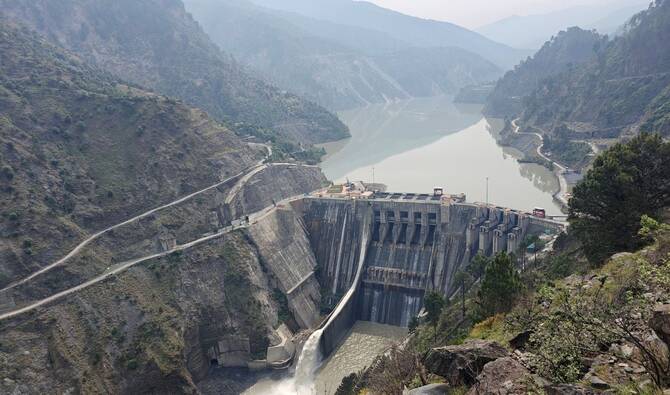
The IWT grants Pakistan rights to the western rivers — Indus, Jhelum, and Chenab — for irrigation, drinking, and non-consumptive uses like hydropower, while India controls the eastern rivers — Ravi, Beas, and Sutlej — for unrestricted use but must not significantly alter their flow. India can use the western rivers for limited purposes such as power generation and irrigation, without storing or diverting large volumes, according to the agreement.
Last week, India’s Foreign Secretary Vikram Misri said the treaty would remain in abeyance, signaling deeper diplomatic rifts between the two nations as they traded fire across several cities.
“The fact is that there have been fundamental changes in the circumstances in which the Indus Waters Treaty was concluded,” Indian Foreign Secretary Misri was quoted as saying by NDTV on Thursday.
He said there is now a need to “reassess the obligations under that treaty.”
But Tarar believed Pakistan’s case on the agreement was “very strong,” adding they would wait to see how things unfold.
“At this point in time, the water is flowing normally and there is no stoppage,” he told Sky News.
Pakistan and India have a history of bitter relations and frequently accuse each other of fomenting militancy in the other’s territory.
Kashmir, which has been divided between Pakistan and India since their independence from Britain in 1947, has been a flashpoint for decades, with the neighbors having fought two of their three wars over the region. Last week’s military conflict also originated from tensions over an assault in the disputed region.
Asked about details of the ceasefire, Tarar said many countries had been speaking to both Pakistan and India, and President Trump had been “pivotal” in securing the truce.
He hoped the US president would also help bring together the two nuclear-armed neighbors to resolve the enduring conflict in Kashmir.
Trump “has made things abundantly clear because he wants a resolution to major issues between us, between India and Pakistan,” Tarar said.
“And he has specifically mentioned Kashmir that he would like to settle.”
On Sunday, Trump said he would try to work with both India and Pakistan to see if they can resolve their dispute over Kashmir.
“I will work with you both to see if, after a ‘thousand years,’ a solution can be arrived at concerning Kashmir,” Trump wrote on his social media platform, Truth Social, referring to India and Pakistan.
But India has for years insisted Kashmir is a bilateral issue and not allowed any third-party mediation.
In his first address to the nation since last week’s conflict, Prime Minister Narendra Modi made clear that militancy was the only issue he wanted to discuss with Pakistan.
“I will tell the global community also, if we talk to Pakistan, it will be about terrorism only,” Modi said on Monday.


