NEW DELHI: India and Pakistan have announced a ceasefire after coming close to all-out conflict, but on social media citizens on both sides are vying to control public perceptions by peddling disinformation.
Platforms such as Facebook and X are still awash with misrepresented footage of the attacks that killed at least 60 people and sent thousands fleeing. AFP fact-checkers have debunked many of the clips, which actually show the Israeli-Palestinian conflict or the war in Ukraine.
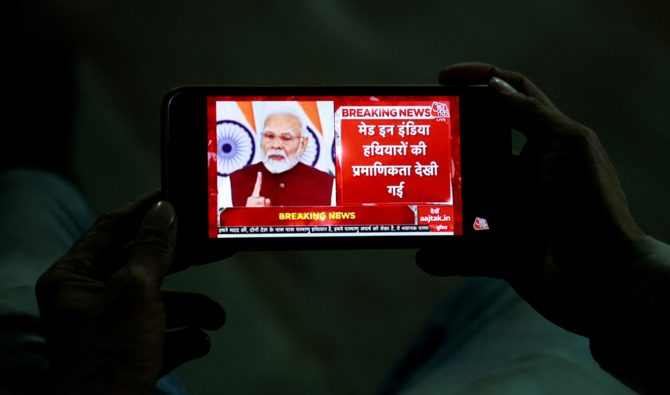
Indian and Pakistani media outlets have also amplified misinformation, including false or unverifiable claims of military victories that experts say have exacerbated tensions and contributed to a flood of hate speech.
“It’s complicated to establish the military facts because, in addition to the reality of strikes that are difficult to ascertain, there’s a communication war going on,” said General Dominique Trinquand, an international relations analyst and former head of the French military mission to the United Nations.
Disinformation peaked when India launched deadly air strikes on Wednesday targeting “terrorist camps” in Pakistan, two weeks after a deadly attack on the Indian-administered side of disputed Kashmir.
New Delhi blames Islamabad for backing the April 22 attack near the tourist town of Pahalgam, which killed 26 people — almost all of them Hindu men. Pakistan denies the claim.
After the first round of Indian air strikes, the Pakistani military shared footage that had previously circulated in reports about a 2023 Israeli air strike in Gaza. The clip quickly appeared on television and social media but was later retracted by numerous media outlets, including AFP.
AI-generated imagery has also muddied the waters, including a video that purportedly shows a Pakistan Army general saying the country lost two of its aircraft. AFP fact-checkers found the clip was altered from a 2024 press conference.
“We have seen a new wave of AI-based content in both video and still images due to increased access to deepfake tools,” said Joyojeet Pal, an associate professor in the School of Information at the University of Michigan.
Both India and Pakistan have taken advantage of the information vacuum to raise alarm bells and promote their own claims and counter-claims.
Pakistan appears to have lifted a more than one-year-old ban on X the same day of the Indian strikes, according to an AFP analysis of data from the nonprofit Open Observatory of Network Interference.
“In a time of crisis, the government needed its people’s voice to be heard all around the world and not to be silenced anymore like it was before for domestic political purposes,” said Usama Khilji, a digital rights expert and activist in Pakistan.
The country’s National Cyber Emergency Response Team (NCERT) on May 8 issued an alert about “increased cyberattacks and misinformation via emails, social media, QR codes, and messaging apps.”
Both Pakistan’s Ministry of Economic Affairs and the Karachi Port Trust later said their X accounts had been hacked.
A post from the latter account said the port — one of South Asia’s busiest — was attacked by the Indian military. The page was later restored and the port authority said no attack had taken place.
India, meanwhile, has executed a sweeping crackdown targeting the social media accounts of Pakistani politicians, celebrities and media organizations.
The government ordered X to block more than 8,000 accounts and banned more than a dozen Pakistani YouTube channels for allegedly spreading “provocative” content, including news outlets.
Press Information Bureau (PIB) Fact Check, a government-run website, has also refuted more than 60 claims about the ongoing crisis, many having to do with supposed Pakistani military victories.
The avalanche of disinformation online has been accompanied by a spike in hate speech offline.
A report from the US-based India Hate Lab documented 64 in-person hate speech events between April 22 and May 2. Most were filmed and later shared on social media.
“There is a cyclical relationship between offline hate speech and the rise of harmful online content,” said Raqib Hameed Naik, executive director of the Center for the Study of Organized Hate.
He said the Pahalgam attack sparked in India a “significant surge in rallies where far-right leaders weaponized the tragedy to incite hate and violence against Muslim Indians and Kashmiris.”
Several clips online show people dressed in Hindu garb calling for economic boycotts of minority Muslims. Rallies in the northern Indian states of Himachal Pradesh and Uttarakhand have seen similar incendiary speeches.
Now that a ceasefire has been declared, Naik warned that hate speech “will once again refocus on religious minorities.”
“The war machine may have paused, but the hate machinery never stops. I worry it might return with a greater force.”


![]()

No truce in India-Pakistan disinformation war
Short Url
https://arab.news/24wau
No truce in India-Pakistan disinformation war
- On social media, citizens on both sides are vying to control public perceptions by peddling disinformation
- Now that ceasefire has been declared, analysts warn hate speech “will once again refocus on religious minorities”
Latest updates


© 2026 SAUDI RESEARCH & PUBLISHING COMPANY, All Rights Reserved And subject to Terms of Use Agreement.