

Pakistan PM prioritizes tax net expansion, vows crackdown on evaders

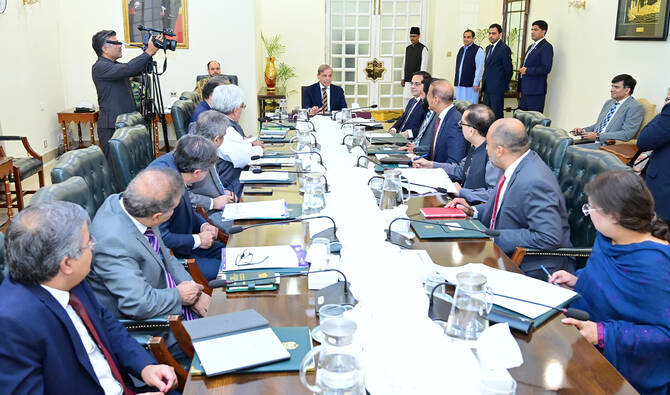
Pakistan Prime Minister Shehbaz Sharif (center) chairs a meeting regarding FBR in Islamabad on May 13, 2025. (Government of Pakistan)
Short Url
Updated 13 May 2025
Follow

Pakistan PM prioritizes tax net expansion, vows crackdown on evaders

  • Tax reform has been a central condition of Pakistan’s ongoing $7 billion IMF loan program
  • Pakistan expects its tax-to-GDP ratio to reach 10.6% by the end of the current fiscal years

ISLAMABAD: Prime Minister Shehbaz Sharif on Tuesday declared the expansion of Pakistan’s tax base as his administration’s foremost priority, emphasizing the need to take decisive action against tax evaders and the officials who enable them.

Sharif’s remarks came during a high-level meeting in Islamabad focused on enhancing tax collection and broadening the tax net, according to a statement from the Prime Minister’s Office.

Tax reform has been a central condition of Pakistan’s ongoing $7 billion loan program with the International Monetary Fund (IMF), which has asked Islamabad to boost revenue collection.

“Expanding the tax net is the government’s top priority,” Sharif said. “We want to reduce the tax rate to ease the burden on the common man.”

“Individuals and sectors capable of paying taxes but currently outside the tax net must be brought within it,” he added. “Comprehensive action should be taken against tax evaders, and strict accountability must be ensured for officials and personnel who assist them.”

The government has implemented several measures to strengthen the tax collection mechanism, including the digitization of tax monitoring systems and the deployment of track-and-trace technology in key industries.

According to the PM Office, the introduction of these systems in cement plants nationwide has led to significant increases in tax revenue, while the sugar sector saw a 35% rise in tax receipts between November 2024 and April 2025.

Pakistan’s tax-to-GDP ratio, historically among the lowest in the region, stood at 8.8% in the 2023-24 fiscal year.

However, Finance Minister Muhammad Aurangzeb projected it would reach 10.6% by June 2025, marking progress toward the government’s target of 13% by the conclusion of the IMF’s 37-month Extended Fund Facility.

The meeting tax collection, attended by key cabinet members and senior officials from the Federal Board of Revenue (FBR), also addressed the need for timely resolution of pending tax litigation and the completion of digital monitoring systems in sectors such as cement and tobacco by June.

“By the grace of God, the national economy is stabilizing and progressing,” Sharif said. “Everyone must fulfill their responsibilities for the country’s development.”


Pakistan bank enables Shariah-compliant digital payment facility for passengers at Islamabad airport

Updated 23 February 2026
Follow

Pakistan bank enables Shariah-compliant digital payment facility for passengers at Islamabad airport

  • Pakistan is a cash-dominated market where a significant portion of transactions in the informal sector are made without any taxes, officials say
  • The move comes amid Pakistan’s efforts to introduce a cashless model at airports under which only digital service providers can provide services

KARACHI: Aik, Pakistan’s first Islamic digital bank, has enabled fully digital payments at Islamabad International Airport to offer travelers and passengers secure, Shariah compliant digital transaction facility.

The development comes amid Pakistan’s efforts to introduce a cashless model at airports across the country, under which only digital service providers can provide services to customers.

Aik, a subsidiary of Bank Islami, said it has onboarded merchants across the Islamabad airport and integrated QR code deployments at key touchpoints to allow passengers and visitors to make secure, seamless, and Shariah-compliant digital transactions at all counters, retail outlets, and service points.

It said the implementation complies with the regulations and framework set by the State Bank of Pakistan (SBP) and is a working model for a large-scale adoption of cashless systems in public infrastructure.

“This deployment reflects our commitment to building practical digital infrastructure that improves everyday transactions,” Aik Chief Officer Ashfaque Ahmed said in a statement.

“By enabling a fully cashless environment at a major national gateway, we are supporting efficiency, transparency, and financial inclusion at scale. This is not only a project; it is a foundation for Pakistan’s cashless future.”

Pakistan is a cash-dominated market where a significant portion of transactions, particularly in the informal sector, are conducted in cash. Officials say many of these transactions are aimed at avoiding taxes.

In recent years, the SBP has taken steps to ensure a transition toward a more cashless economy so that transactions are more traceable, reducing chances of tax evasion and corruption.

By digitizing Islamabad airport, aik said it continues to invest in secure and accessible financial solutions that “expand digital participation and support national economic modernization.”