


ISLAMABAD: Saudi Arabia has “revolutionized” spiritual experience of Hajj pilgrims by means of various mobile applications and digital platforms, Pakistan’s Hajj mission chief said on Monday.
Over the last few years, Saudi Arabia has launched mobile apps like Nusuk, Hajj Navigator, Tawakkalna and Asefny to streamline services, making the Hajj experience smoother by offering real-time guidance and ensuring pilgrim safety.
The Nusuk app offers permit issuance, booking services, interactive maps, real-time updates and health facility access — all in multiple languages. Tawakkalna provides information and services related to the pilgrimage, Hajj Navigator offers real-time maps, crowd updates and traffic alerts. Asefny allows requests for emergency medical services.
“These innovations have made the pilgrimage significantly easier, providing services at the click of a button and eliminating the need to wait in long queues,” Director-General of Pakistan Hajj Mission Abdul Wahab Soomro told Arab News from Makkah.
He said the applications have assisted all foreign missions with early bookings and other arrangements, contributing to better Hajj planning.
“There is an e-Hajj portal where all Hajj contracts, such as those for buildings, camps and service providers are uploaded which has helped complete payments and other formalities through a unified platform,” Soomro said.
About arrangements for Pakistani pilgrims, the official said around 89,000 Pakistani pilgrims are performing Hajj under the government scheme this year and all of them have been accommodated near the Prophet’s Mosque in Madinah.
In Makkah, he said, pilgrims were given residence in the “best hotels and buildings” in Azizia and Batha Quraish neighborhoods.
“For the first time in Pakistan’s history, the Mina arrangements for government scheme pilgrims are done in fully air-conditioned camps, with sofa-cum-beds replacing mattresses and shields provided for bag storage,” he added.
Pakistan’s Hajj medical mission includes one hospital each in Makkah and Madinah, along with two dispensaries in Madinah and nine in Makkah, according to the official. All of these are fully functional.
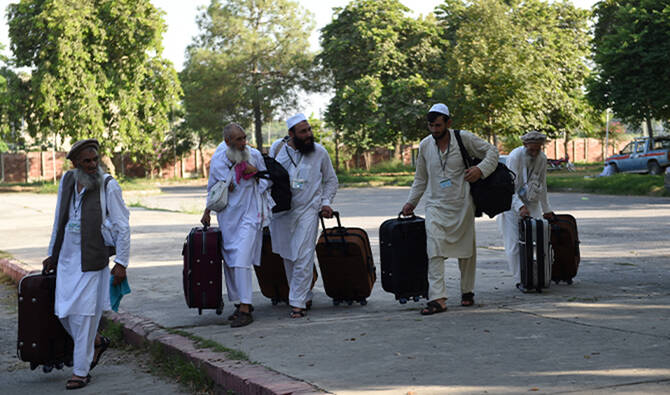
On April 29, Pakistan launched its Hajj flight operation which will continue till May 31. However, the operations witnessed some disruptions last week due to the closure of Pakistani airspace, amid a military standoff with India.
Soomro shared that they were trying to address the flight disruptions by arranging special flights.
“More than 25,000 Pakistani pilgrims have arrived in Saudi Arabia so far; 11,543 in Makkah and 13,477 in Madinah,” he said.
The annual pilgrimage is expected to take place between June 4 and June 9 this year.
Besides the 89,000 individuals performing Hajj under the government scheme, 23,620 Pakistanis will perform the pilgrimage through private tour operators this year.


