Malaysia, Pakistan discuss halal food, energy and tourism to boost cooperation
Malaysia, Pakistan discuss halal food, energy and tourism to boost cooperation/node/2630675/pakistan
Malaysia, Pakistan discuss halal food, energy and tourism to boost cooperation
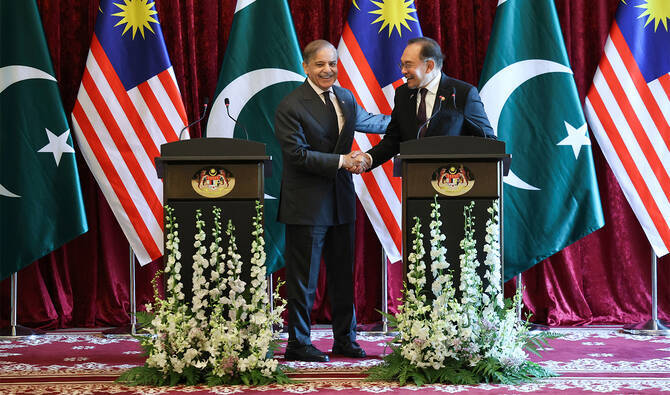
Pakistan's Prime Minister Shehbaz Sharif, left, and Malaysia's Prime Minister Anwar Ibrahim shake hands as they hold a news conference during Sharif's visit in Putrajaya, Malaysia, on October 6, 2025. (AP/File)
ISLAMABAD: Pakistan and Malaysian officials have held talks on halal food, green energy and tourism sectors as part of renewed efforts to expand ties between the two Muslim-majority nations, the Pakistani High Commission in Malaysia on Monday.
The discussions took place during a meeting between Pakistan’s High Commissioner to Malaysia, Syed Ahsan Raza Shah and Tun Pehin Sri Dr. Wan Junaidi Tuanku Jaafar, governor of Malaysia’s Sarawak state.
Bilateral trade between the two countries stands at about $1.4 billion a year, according to official data from both governments. In Oct., both countries announced a new $200 million halal meat trade quota.
“Constructive talks on Pakistan-Malaysia ties in halal [food], palm oil, green energy, rice, labor, tourism, culture & sustainable development,” the Pakistani High Commission in Malaysia said on X.
Malaysia’s exports to Pakistan are led by palm oil and other vegetable fats, followed by machinery, rubber products and organic chemicals. Pakistan’s main exports to Malaysia include rice, textiles, seafood and minerals.
The two countries have also traded under the Malaysia-Pakistan Closer Economic Partnership Agreement since 2008, which provides preferential market access for goods and services.
Pakistan has been rapidly growing its green energy, halal food, and tourism sectors. Its halal food industry is attracting global buyers with Shariah-compliant products, while tourism is leveraging the country’s natural beauty, heritage sites and cultural attractions to draw international visitors.
ISLAMABAD: Pakistan and Qatar on Tuesday agreed to deepen their strategic and economic cooperation during high-level talks between Prime Minister Shehbaz Sharif and his Qatari counterpart Sheikh Mohammed bin Abdulrahman bin Jassim Al Thani, Sharif’s office said.
Sharif visited Qatar along with a high-level delegation on the invitation of Qatari emir Sheikh Tamim bin Hamad Al Thani. The Pakistan premier also held meetings with Qatar’s trade and defense minister to discuss cooperation in various domains.
The visit came at a time when Pakistan is seeking closer economic engagement with Gulf partners amid its broader push to stabilize the economy and attract investment, while maintaining security and defense cooperation with key regional states.
During their meeting in Doha, PM Sharif and Qatar’s Sheikh Mohammed discussed bilateral relations and exchanged views on regional and international developments, according to the Pakistan prime minister’s office.
“They reaffirmed the strong brotherly relations between Pakistan and Qatar and expressed satisfaction at the growing momentum in political, economic and institutional ties,” Sharif’s office said.
“Discussions focused on enhancing cooperation in the fields of trade and investment, energy, defense, manpower and labor and culture, with both sides stressing the importance of their task force to accelerate cooperation in all these areas.”
Pakistan and Qatar maintain strong trade and investment ties. In 2022, the office of Qatar’s emir said the Qatar Investment Authority planned to invest $3 billion in Pakistan, targeting sectors including transport, aviation, education, health, media, technology and labor.
Nearly 300,000 Pakistanis live and work in Qatar, according to Pakistan’s foreign office, with many employed in health, education, engineering and public services, as well as construction and transport. The two countries engage through forums such as the Bilateral Political Consultations and the Joint Ministerial Commission.
Sharif said he had productive discussions with Qatar’s emir Sheikh Tamim bin Hamad Al Thani on how the two sides could transform their brotherly ties into mutually beneficial economic relationships.
“We also took stock of the regional situation,” he said. “Pakistan and Qatar will continue to work together for peace and stability in the region and beyond.”
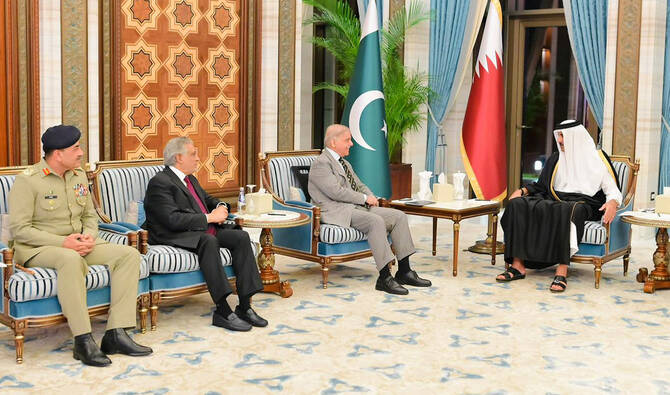
Prime Minister Shehbaz Sharif (second right) meets the Qatari Emir Qatar’s emir Sheikh Tamim bin Hamad Al Thani (left) in Doha, Qatar, on February 24, 2026. (PID)
DIALOGUE WITH AFGHANISTAN
Earlier, Sharif and Qatar’s Deputy PM Sheikh Saoud Al-Thani discussed the situation in Afghanistan and called for dialogue to support regional stability.
The meeting took place amid renewed tensions after Islamabad carried out airstrikes last week on what it described as Tehreek-e-Taliban Pakistan (TTP) targets inside Afghanistan. Kabul said the strikes killed civilians and vowed to respond to what it called a violation of its sovereignty.
“Regional developments were also discussed, in particular the situation in Iran and Afghanistan,” Sharif’s office said in a statement. “Both sides emphasized the importance of dialogue, de-escalation and collective efforts to promote peace and stability in the region.”
This was the second time in less than six months that Pakistan conducted airstrikes in Afghanistan. The last strikes triggered heavy, weeklong clashes between the neighbors along their border before Qatar and Turkiye mediated a ceasefire between them in Oct. last year.
Separately, Sharif held meetings with Qatar’s State Minister for Trade Dr. Ahmed bin Mohammed Al-Sayed and a delegation of the Qatar Businessmen Association (QBA), highlighting Pakistan’s investment-friendly reforms.
He invited QBA members to explore opportunities in infrastructure, logistics, energy, agriculture, technology and export-oriented manufacturing, his office said.