

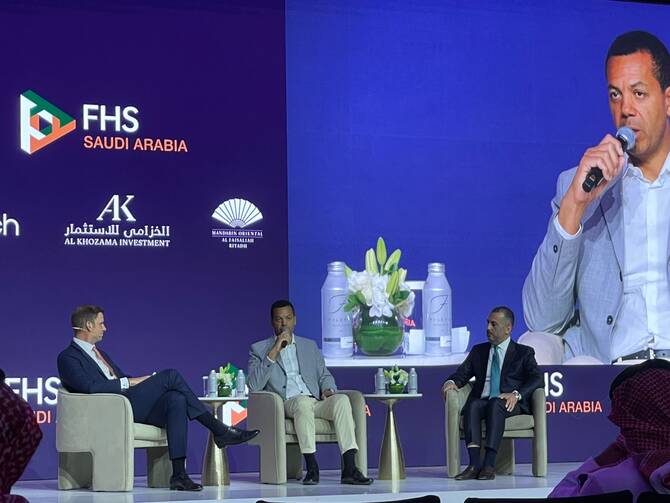

RIYADH: Investor confidence in Saudi Arabia’s hospitality sector is being reinforced by tangible progress on Vision 2030 goals, including accelerating international interest and a surge in hotel signings, a major gathering has heard.
On the second day of the Future Hospitality Summit in Riyadh, global and local executives cited a powerful combination of leadership, domestic demand, and delivery momentum as key factors driving investment decisions.
Vision 2030 is an initiative designed to diversify the Saudi economy away from oil, with ambitious reforms aimed at boosting tourism, entertainment, and non-oil industries.
In a panel discussion, Christophe Beauvilain, managing partner at Pygmalion Capital, said Saudi Arabia presents a compelling opportunity for investors, describing Vision 2030 as “extremely ambitious and exciting.”
He highlighted the rapid achievement of tourism milestones as a key performance signal, saying: “When the Vision was first launched, the goal was to attract 100 million tourists by 2030. That target was reached by 2023, so it was revised upward to 150 million by 2030 — and I wouldn’t be surprised if that figure is raised again.”
Hotel signings, Beauvilain added, are a critical metric for institutional investors.
“There has certainly been a flurry of activity, particularly among international brands signing new projects,” he said.
While macroeconomic and geopolitical risks remain a consideration, Beauvilain noted the decreasing reliance on oil revenues as a positive structural shift.
“The oil sector’s contribution to gross domestic product is declining rapidly, which is a very positive and encouraging sign,” he said.
Amin Ismail, managing director of travel and tourism-focused private equity firm Certares, emphasized the changing global perception of Saudi Arabia.
“The leadership has done a pretty good job marketing the destination and raising global awareness,” he said.
“On a personal note, I was in Miami a couple of months ago, and someone I never expected mentioned they were interested in visiting Riyadh. They even referenced Diriyah by name,” Ismail said.
The managing director believes the country’s cultural depth is emerging as a differentiating factor.
“Saudi Arabia’s strength lies in its culture and heritage. The hospitality, the people, and the unique cultural experience are what really draw visitors,” he said.
Noting the rising interest among global travelers — including his own family — he added, “Today, it’s at the top of their (his family’s) travel bucket list — with Japan coming second.”
On the domestic front, Saudi Arabia’s hospitality development is being backed by robust local demand and substantial government support.
In a separate panel, Naif Al-Madi, chief business officer of the Tourism Development Fund, said: “Saudi Arabia has a unique advantage in that we have a large domestic market,” adding that it accounts for approximately 70 percent of the tourism sector, compared to 30 percent from international tourism.
He added that while global economic fluctuations may affect other markets, “we believe Saudi Arabia will feel only minimal shock.”
The fund has already supported over 2,400 tourism-related projects, and is expected to deliver more than 9,000 rooms.
Luc Delafosse, vice president of Hospitality Management at Al Khozama Investment Co., said the pace and consistency of project execution are setting Saudi Arabia apart.
“What I was very pleased to hear this morning is that 90 percent of the projects within the Kingdom are actually being delivered,” he said.
“Another key figure that stood out was that 50 percent of the development currently underway in Saudi Arabia is being produced and delivered by non-oil sectors.”
Delafosse, who has been in the Kingdom since 2019, noted the transformation firsthand.
“It’s not just about the number of projects, but also the overall evolution of the sector,” he said.
“The Kingdom has truly led the way in hospitality — not just in the region, but globally,” he added.


