

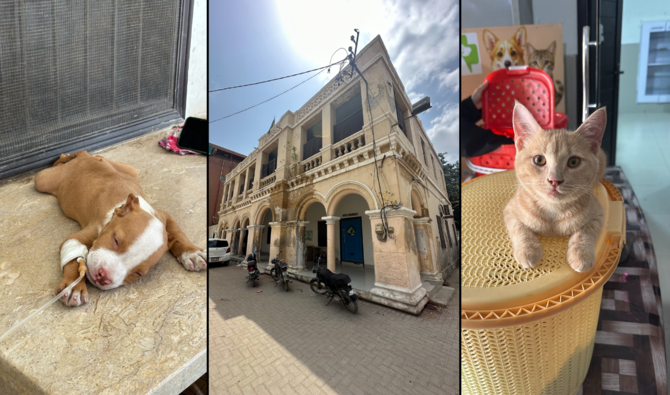

KARACHI: Safia Ahmed sat with her fluffy white Persian cat, Simba, last week in the storied hallway of Karachi’s time-worn Richmond Crawford Veterinary Hospital, waiting for her turn.
A vet soon called her in, examined Simba and administered treatment. He also gave Ahmed medicine to take home for the cat.
While this was a routine visit for Ahmed, a devoted owner of two Persian cats and two parrots, the hospital is anything but ordinary.
Established in 1880, the state-run Richmond Crawford Veterinary Hospital offers free treatment and has a 145-year legacy of animal welfare.
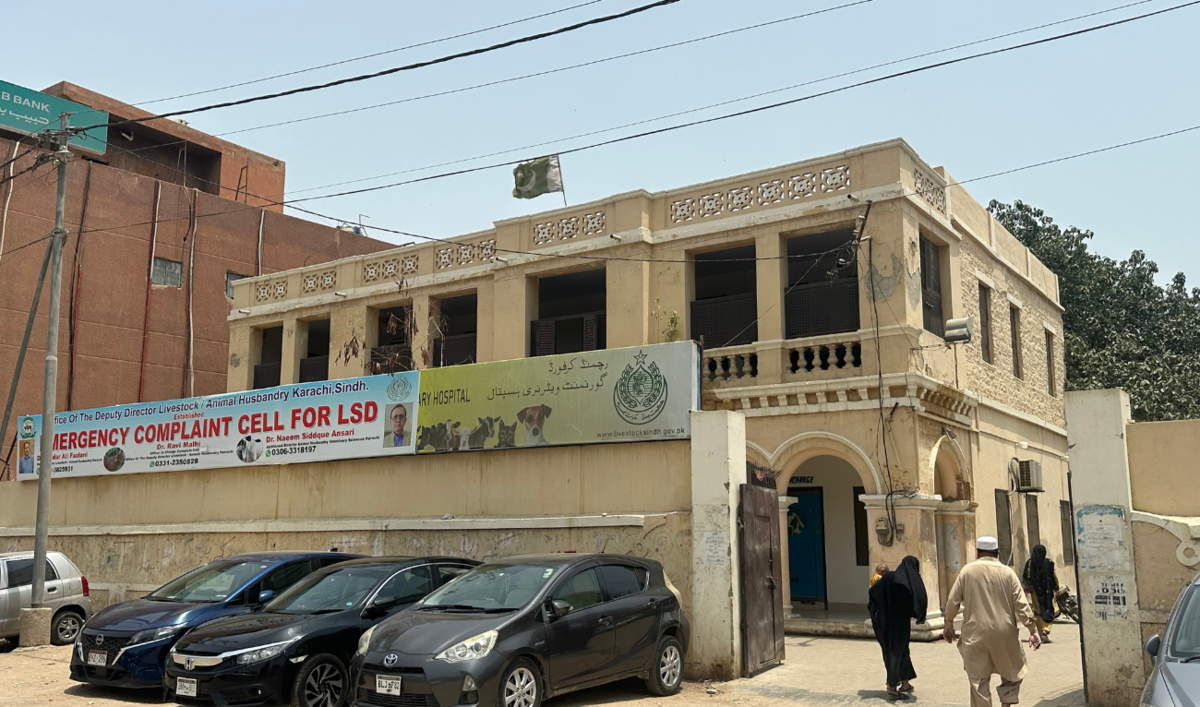
The photo taken on May 9, 2025, shows the building of Richmond Crawford Veterinary Hospital in Karachi, Pakistan. (AN Photo)
The facility, on Karachi’s busy M.A. Jinnah Road, is named after a British commissioner in the southern Sindh province known to hold a deep affection for animals, according to Dr. Chandar Kumar, the veterinary officer currently in charge of the facility, which functions under the Sindh provincial government’s Livestock Department.
“In 1840, Crawford had bought this plot ofland. After that, he left [for Britain]. Later, our respected community elders, including Parsis, Muslims and Hindus, came together and established an institution in his name,” Kumar told Arab News.
“This institution has been providing treatment for animals, working on their health and administering vaccinations ever since.”
Animal rights activists have long raised concerns over routine neglect, abuse and exploitation of domestic animals, livestock, stray populations and wildlife in Pakistan, calling for improved health care facilities.
In Karachi, a city exceeding 20 million, a mere 27 public animal care centers are operational, a majority of them being clinics and dispensaries.
The number of animals that daily pass through the doors of Crawford highlights the important role the hospital plays in trying to bridge this gap, especially for those who cannot afford private clinics.
“We have a daily OPD [Outpatient Department examination] of over 100 animals,” said Dr. Kumar, adding that all kinds of animals, from domestic pets like cats and dogs, small livestock like sheep and goats, and occasionally even larger animals, were daily brought to the facility.
Dr. Shalla Sharon Hayat, a veterinary surgeon at Crawford, said the hospital offered a wide range of facilities, including surgeries and orthopedic treatment for animals with broken bones that required complex procedures.
“It was opened with the vision of providing facilities where even a person from the underprivileged class who loves animals can have their pets cared for as well as an upper-class person who loves animals,” Hayat said.
Ahmed couldn’t agree more.
“This has become a great convenience for us because we can’t really afford to go to private clinics,” she said after Simba’s treatment. “If the government hadn’t set this up, we wouldn’t have been able to afford it.”
Iqbal Masih, who was at the hospital with his dog Lucky, a Maltese mix, concurred.
“I’ve been taking care of him for four years, and I love him very much,” Masih said.
“Whenever he gets a fever or any problem, I immediately take him to the doctor. I had brought another dog to them before as well, they gave the right medicine.”
Apart from animal care, the hospital also has great architectural significance in the Karachi landscape, said Peerzada Salman, the author of ‘Karachi — Legacies of Empires,’ a photographic history of the city.
“It’s a very simple building, built in the style of the renaissance. The ground floor has arches and above it is square windows. Such buildings are rare in Karachi nowadays,” Salman said.
The author commended locals who resisted an attempt to demolish the hospital and build a skyscraper in its place some 20 years ago but added that the historical building currently needed attention.
“If those involved in heritage preservation pay attention to it and renovate it properly, it would be great as it holds dual importance: one as a hospital for animals and the other as a building with historical significance,” Salman added.
Surgeon Hayat described the hospital as a central part of Karachi’s larger ecosystem.
“In any ecosystem, animals play a very significant role,” she said. “And those who care for them and raise them deserve our respect.”


