

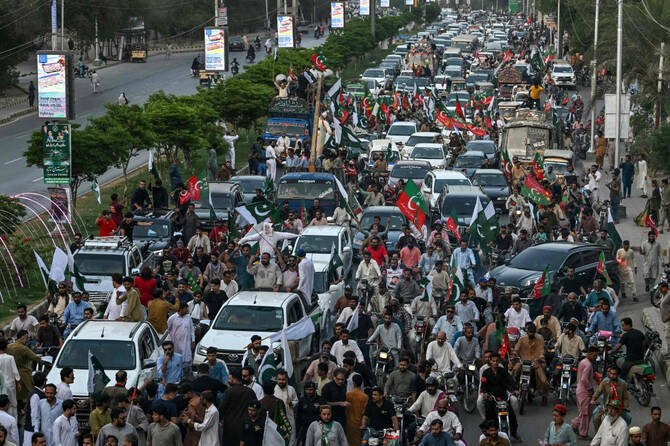

NEW DELHI/ISLAMABAD: India and Pakistan have stepped back from the brink of all-out war, with a nudge from the US, but New Delhi’s aspirations as a global diplomatic power now face a key test after President Donald Trump offered to mediate on the dispute over Kashmir, analysts said.
India’s rapid rise as the world’s fifth-largest economy has boosted its confidence and clout on the world stage, where it has played an important role in addressing regional crises such as Sri Lanka’s economic collapse and the Myanmar earthquake.
But the conflict with Pakistan over Kashmir, which flared up in recent days with exchanges of missiles drones and air strikes that killed at least 66 people, touches a sensitive nerve in Indian politics.

How India threads the diplomatic needle — courting favor with Trump over issues like trade while asserting its own interests in the Kashmir conflict — will depend in large part on domestic politics and could determine the future prospects for conflict in Kashmir.
“India ... is likely not keen on the broader talks (that the ceasefire) calls for. Upholding it will pose challenges,” said Michael Kugelman, a South Asia analyst based in Washington.
In a sign of just how fragile the truce remains, the two governments accused each other of serious violations late on Saturday.
The ceasefire, Kugelman noted, was “cobbled together hastily” when tensions were at their peak.
Trump said on Sunday that, following the ceasefire, “I am going to increase trade, substantially, with both of these great nations.”
Indian Prime Minister Narendra Modi, for his part, has not commented publicly on the conflict since it began.
India considers Kashmir an integral part of its territory and not open for negotiation, least of all through a third-party mediator. India and Pakistan both rule the scenic Himalayan region in part, claim it in full, and have fought two wars and numerous other conflicts over what India says is a Pakistan-backed insurgency there. Pakistan denies it backs insurgency.
“By agreeing to abort under US persuasion ... just three days of military operations, India is drawing international attention to the Kashmir dispute, not to Pakistan’s cross-border terrorism that triggered the crisis,” said Brahma Chellaney, an Indian defense analyst.

For decades after the two countries separated in 1947, the West largely saw India and Pakistan through the same lens as the neighbors fought regularly over Kashmir. That changed in recent years, partly thanks to India’s economic rise while Pakistan languished with an economy less than one-10th India’s size.
But Trump’s proposal to work toward a solution to the Kashmir problem, along with US Secretary of State Marco Rubio’s declaration that India and Pakistan would start talks on their broader issues at a neutral site, has irked many Indians.
Pakistan has repeatedly thanked Trump for his offer on Kashmir, while India has not acknowledged any role played by a third party in the ceasefire, saying it was agreed by the two sides themselves.
Analysts and Indian opposition parties are already questioning whether New Delhi met its strategic objectives by launching missiles into Pakistan on Wednesday last week, which it said were in retaliation for an attack last month on tourists in Kashmir that killed 26 men. It blamed the attack on Pakistan — a charge that Islamabad denied.
By launching missiles deep into Pakistan, Modi showed a much higher appetite for risk than his predecessors. But the sudden ceasefire exposed him to rare criticism at home.
Swapan Dasgupta, a former lawmaker from Modi’s Hindu nationalist Bharatiya Janata Party, said the ceasefire had not gone down well in India partly because “Trump suddenly appeared out of nowhere and pronounced his verdict.”
The main opposition Congress party got in on the act, demanding an explanation from the government on the “ceasefire announcements made from Washington, D.C.”
“Have we opened the doors to third-party mediation?” asked Congress spokesperson Jairam Ramesh.
And while the fighting has stopped, there remain a number of flashpoints in the relationship that will test India’s resolve and may tempt it to adopt a hard-line stance.
The top issue for Pakistan, diplomats and government officials there said, would be the Indus Waters Treaty, which India suspended last month but which is a vital source of water for many of Pakistan’s farms and hydropower plants.
“Pakistan would not have agreed (to a ceasefire) without US guarantees of a broader dialogue,” said Bilawal Bhutto Zardari, a former foreign minister and currently chairman of the People’s Party of Pakistan, which supports the government.
Moeed Yusuf, former Pakistan National Security Adviser, said a broad agreement would be needed to break the cycle of brinksmanship over Kashmir.
“Because the underlying issues remain, and every six months, one year, two years, three years, something like this happens and then you are back at the brink of war in a nuclear environment,” he said.


