ISLAMABAD: A ceasefire to end the conflict between India and Pakistan was shaken by overnight border fighting in the disputed Kashmir region.
People on both sides of the Line of Control, which divides the territory, reported heavy exchanges of fire between Indian and Pakistani troops. The fighting subsided by Sunday morning.
The two countries agreed to a truce a day earlier after talks to defuse the most serious military confrontation between them in decades following a gun massacre of tourists that India blames on Pakistan, which denies the charge.
As part of the ceasefire, the nuclear-armed neighbors agreed to immediately stop all firing and military action on land, in the air and at sea. They accused each other of repeatedly violating the deal just hours later.
Drones were spotted Saturday night over Indian-controlled Kashmir and the western state of Gujarat according to Indian officials.
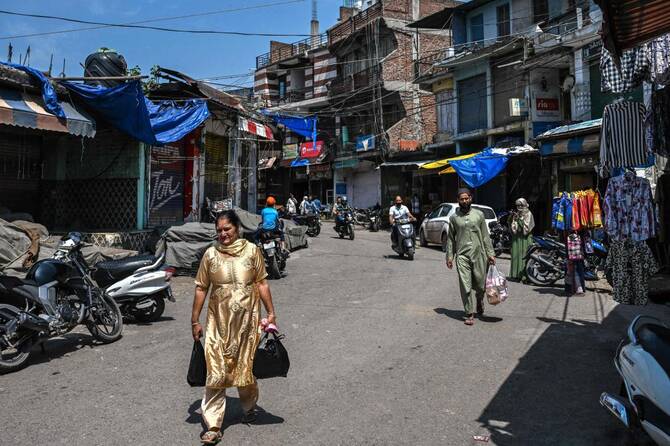
In the Poonch area of Indian-controlled Kashmir, people said the intense shelling from the past few days had traumatized them.
“Most people ran as shells were being fired,” said college student Sosan Zehra who returned home Sunday. “It was completely chaotic.”
In Pakistan-controlled Kashmir’s Neelum Valley, which is three kilometers from the Line of Control, people said there were exchanges of fire and heavy shelling after the ceasefire began.
Resident Mohammad Zahid said: “We were happy about the announcement but, once again, the situation feels uncertain.”
US President Donald Trump was the first to post about the deal, announcing it on his Truth Social platform. Indian and Pakistani officials confirmed the news shortly after.
Indian Prime Minister Narendra Modi chaired a high-level meeting on Sunday with top government and military officials.
India, unlike Pakistan, has not said anything about Trump or the US since the deal was announced. Nor has India acknowledged anyone beyond its military contact with the Pakistanis.
Both armies have engaged in daily fighting since Wednesday along the rugged and mountainous Line of Control, which is marked by razor wire coils, watchtowers and bunkers that snake across foothills populated by villages, tangled bushes and forests.
They have routinely blamed the other for starting the skirmishes while insisting they were only retaliating.
India and Pakistan’s two top military officials are due to speak again on Monday.


India and Pakistan ceasefire shaken by overnight border fighting in disputed Kashmir region
https://arab.news/8p9qn
India and Pakistan ceasefire shaken by overnight border fighting in disputed Kashmir region

- Residents and officials in the disputed Kashmir region say there was overnight border fighting between Pakistani and Indian troops
- As part of the ceasefire, agreed a day earlier, the nuclear-armed neighbors agreed to immediately stop all firing and military action on land, in the air and at sea
- They accused each other of repeatedly violating the deal hours later


From round fruits to lucky charms: How Filipinos invite prosperous New Year
- Lights are lit, doors and windows open to allow good spirits in
- Sticky rice dishes are served to keep family sticking together
MANILA: With the dining table set with symbolic foods, a bit of noise and rituals to invite good luck, Filipinos are ready to welcome the New Year, carefully observing every tradition and superstition to bring prosperity.
Media noche or the midnight dinner on New Year’s Eve is central to the celebration. Besides traditional meats, there will be sticky rice dishes to keep the family sticking together, and pancit or long rice noodles to represent long life.
There should also be 13 round fruits prepared specifically for the occasion, with 12 representing each month of the year, and the 13th adding extra luck. Because they are round like coins, they are believed to invite abundance, wealth and prosperity.
“We cook bilo-bilo (sticky rice balls) with coconut milk and palitaw (sweet rice cakes). It’s something we simply grew up with,” said Cel Reyes from Mabini in Batangas province, south of Manila.
“It’s sticky, so it symbolizes togetherness, and it is also round. Anything that’s round is prepared also as a symbol of prosperity.”
In Malabon, a coastal city in the northern part of Metro Manila, Priam Nepomuceno’s 86-year-old mother-in-law sets unhulled rice on the table.
“Because of the gold color, it’s believed to bring luck and abundance,” he said. “Grapes are also hung on the door. They’re not meant to be eaten and are kept hanging for the whole year as a symbol of prosperity.”
Some people also jump when the clock strikes 12, believing it will help them grow taller.
In many households, all lights are lit before midnight, with doors and windows open to allow good spirits to enter, while noise from firecrackers and party horns keeps the bad ones at bay.
“By nature, Filipinos are superstitious. We believe in good luck, deities. We give in to faith and luck, and it’s tied to deep spirituality,” said Juanita Galang-Trinidad, an 80-year-old editor from Bulacan province north of Manila.
“We also put 12 coins in varying amounts in our pockets and wear polka dot clothing. Rice, cereal, and salt containers should be full.”
New Year’s celebrations, like Christmas, bring families together, but with extra traditions for good luck. Beyond the midnight feast and keeping round objects on the table and at hand, Filipinos try to pay off debts to avoid financial trouble in the coming year.
On New Year’s Eve, they also avoid serving chicken, as chickens are believed to scratch backward when they eat, symbolically scratching away good fortune.
“We hold on to our traditions despite these growing changes, modernity, in our environment,” Trinidad said.
“We still hold on to our traditions and customs because they identify us as a people, as Filipinos.”


