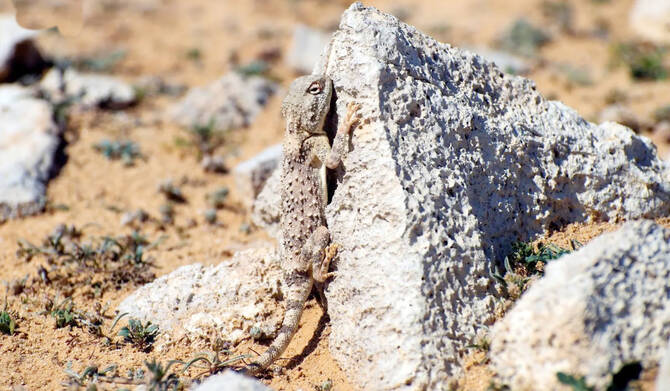
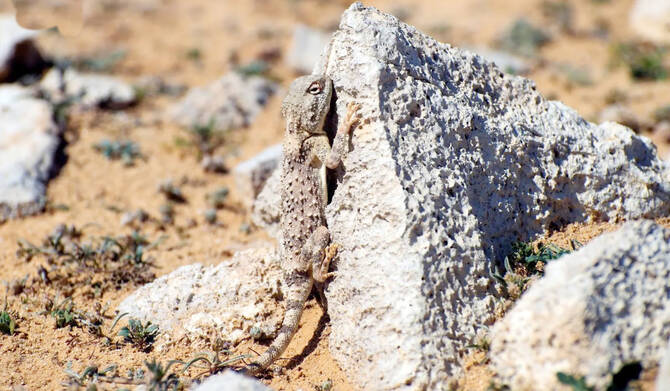
RIYADH: The pale agama (Trapelus agnetae) has been spotted at several natural sites across the Northern Borders, highlighting the rich biodiversity found in the region’s desert and semi-desert landscapes.
The species belongs to the family Agamidae and the genus Trapelus. The medium-sized reptile is distinguished by a relatively flattened body and a light gray color marked with subtle dorsal stripes and dark rings along the tail.
It features a triangular head and long limbs ending in clawed toes that help it move across hard soil and rocky plains. One of its most distinctive characteristics is a row, or sometimes two rows, of small spines above the ear opening.
The pale agama inhabits open arid environments such as rocky plains, volcanic deserts, and dry grasslands. It is also occasionally found in valleys and sandy depressions.
Active during the day, the reptile primarily feeds on small insects, while birds of prey, including owls, are among its natural predators, forming part of the desert’s balanced food chain.
Individuals typically reach a total length of about 19 centimeters, with the body, from snout to vent, measuring around 8.8 centimeters.
Documenting the species in natural habitats across the Northern Borders region serves as a key indicator of healthy and stable ecosystems, highlighting the importance of conserving biodiversity across the Kingdom.