

Riyadh hospital performs first pediatric robotic liver transplant

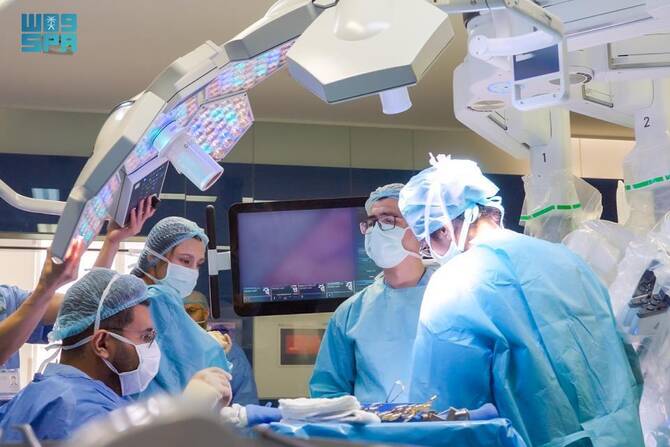
King Faisal Specialist Hospital and Research Centre in Riyadh has performed a liver lobe transplant on a child using an advanced robotic surgical system. (SPA)
Short Url
Updated 11 May 2025
Follow

Riyadh hospital performs first pediatric robotic liver transplant

  • Although procedure was complicated, center’s experience with robotic organ transplants in adults enabled the technology to be adapted

RIYADH: The King Faisal Specialist Hospital and Research Centre in Riyadh has performed a liver lobe transplant on an eight-year-old child using an advanced robotic surgical system, with the patient being discharged after just two weeks.

Although the procedure was complicated due to the child’s small size and limited space for surgical access, the center’s experience with robotic organ transplants in adults enabled the technology to be adapted.

A tailored surgical plan was developed, which involved repositioning the robotic entry points, the Saudi Press Agency reported on Sunday.

Prof. Dieter Broering, executive director of the Organ Transplant Centre of Excellence and lead surgeon, said: “Robotic surgical techniques have traditionally been limited to adults, but we succeeded in adapting them for children, offering exceptional precision and a marked reduction in complications.

“The transplant required redesigning the surgical approach to suit the child’s small body and confined space, which we addressed by meticulously adjusting the entry sites for the robotic tools to ensure maximum safety.”

The operation sets a groundbreaking example for expanding the use of robotic surgery in pediatric care. The technology offers precise control, reduces complications and enhances safety, paving the way for the future development of child-specific robotic surgical systems.

It is the latest milestone that positions King Faisal Centre as a global leader in robotic surgery. The hospital has previously carried out the world’s first fully robotic heart transplant and the first robotic liver transplant.


Saudi Arabia’s Sharaan and Wadi Nakhlah nature reserves win Dark Sky recognition

Updated 58 min 30 sec ago
Follow

Saudi Arabia’s Sharaan and Wadi Nakhlah nature reserves win Dark Sky recognition

  • The two reserves in AlUla join more than 250 locations worldwide that are protected from light pollution
  • AlUla Manara and AlGharameel Nature Reserve, also both in AlUla, received Dark Sky Park designations last year

ALULA: Two more nature reserves in Saudi Arabia’s AlUla have won recognition as Dark Sky Places, joining more than 250 locations worldwide that are protected from light pollution.

The official accreditation of Sharaan National Park and Wadi Nakhlah reserves from the DarkSky International builds on AlUla’s 2024 achievement, when AlUla Manara and AlGharameel Nature Reserve became the first sites in the Kingdom and the Gulf region to receive Dark Sky Park designations.

The latest recognition further strengthens AlUla’s position as a leading global destination for night sky protection and astronomical tourism, said the Royal Commission for AlUla (RCU) in a statement carried by the Saudi Press Agency (SPA).

Dark Sky International also announced the recognition in an earlier report, noting that the Sharaan and Wadi Nakhlah’s combined area of 6,146 square kilometers reflects the “expanded scope of environmental protection efforts aimed at preserving AlUla’s pristine night skies and reducing light pollution across a vast geographical area.”

DarkSky International works to reduce light pollution in both urban and rural areas and to raise global awareness of the importance of protecting the night sky.

AlUla’s natural isolation from urban light sources, combined with ideal atmospheric conditions, makes it a world-class destination for stargazing, astronomy education, and immersive dark-sky experiences.  (SPA)


AlUla’s protected areas are located in the heart of northwest Arabia, near the ancient oasis city of AlUla in Madinah Province.

“Towering sandstone cliffs, labyrinthine canyons, tranquil basins, and volcanic formations create a dramatic setting where geological diversity, cultural heritage, and thriving biodiversity converge beneath exceptionally dark, open skies,” Dark Sky said.

Scientists have noted that AlUla’s natural isolation from urban light sources, combined with ideal atmospheric conditions, makes it a world-class destination for stargazing, astronomy education, and immersive dark-sky experiences. 

With the phased development of its reserves, AlUla is now ranked 3rd globally in the Dark Sky Park category, solidifying its status as one of the world’s premier destinations for astronomical discovery.

The RCU reaffirmed its commitment to protecting the natural environment, preserving the night sky, and promoting sustainable tourism, further positioning AlUla as a leading global destination for astronomy, scientific research, and advanced environmental experiences, in line with AlUla Vision and the Kingdom’s Vision 2030.