US mission in Islamabad eases staff movement curbs after India-Pakistan ceasefire

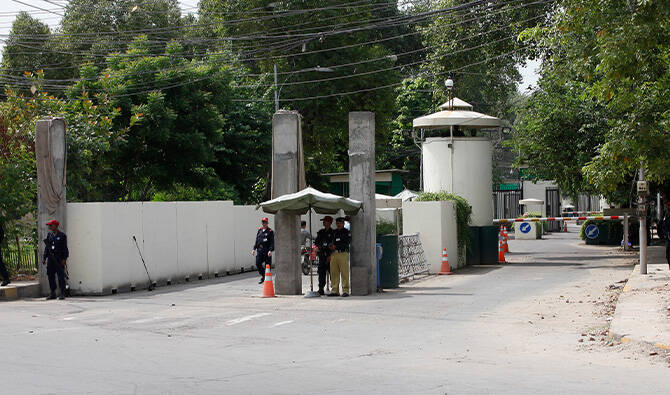
A policeman (2nd R) and private security personnel stand guard at the entrance of a road leading towards the U.S. consulate in Lahore August 9, 2013. (Reuters/File)
Short Url
Updated 10 May 2025
Follow

US mission in Islamabad eases staff movement curbs after India-Pakistan ceasefire

  • The embassy upholds ‘Do Not Travel’ statue for areas near the eastern border
  • It also maintains a ‘Reconsider Travel’ advisory in the country more broadly

ISLAMABAD: The United States eased movement restrictions on its diplomatic personnel in Pakistan on Saturday, following a ceasefire agreement between India and Pakistan that brought a pause to days of cross-border military exchanges.
The conflict was sparked by a deadly attack in Indian-administered Kashmir last month that killed 26 tourists, with New Delhi blaming Pakistan for the incident despite Islamabad’s denial of the allegation.
India launched missile strikes on what it said were “terrorist camps,” prompting Pakistan to respond with attacks on Indian military targets.
A ceasefire brokered by Washington was announced Saturday afternoon by President Donald Trump, with Secretary of State Marco Rubio saying both sides had agreed to hold talks at a neutral venue.
“Movement restrictions on US government personnel in Islamabad, Karachi, and Lahore have been adjusted to allow travel within city limits,” the US mission said in a security alert.
However, it reiterated its “Do Not Travel” advisory for areas near the India-Pakistan border and the Line of Control, citing “terrorism” and the risk of “armed conflict.”
It also maintained a “Reconsider Travel” advisory for Pakistan more broadly, reflecting long-standing US concerns about militant violence and limited consular access in parts of the country.
Earlier this year, the US State Department had cited Pakistan’s deteriorating security conditions, especially in the Khyber Pakhtunkhwa and Balochistan provinces.
In its recent alert, the US embassy advised citizens in Pakistan to review their security plans and stay alert.
It noted that flight availability remained fluid in Pakistan, urging travelers to confirm schedules with their airlines.



Pakistan alleges India behind Balochistan attacks that killed 18 civilians, 15 troops

Updated 6 sec ago
Follow

Pakistan alleges India behind Balochistan attacks that killed 18 civilians, 15 troops

  • Interior Minister Mohsin Naqvi accuses India of planning coordinated attacks across Balochistan this week 
  • Military says it killed 133 militants on Friday and Saturday in separate operations across various areas in Balochistan

ISLAMABAD: Pakistan’s Interior Minister Mohsin Naqvi this week alleged that India was behind the recent coordinated attacks in the southwestern Balochistan province that the military says killed 18 civilians and 15 troops, vowing to go after those responsible for the violence. 

Pakistan’s military said on Saturday that it had killed 133 militants in the past two days in separate operations in Balochistan. The Inter-Services Public Relations (ISPR) said 41 militants were killed in operations in Panjgur and Harnai areas on Friday while 92 militants, including three suicide bombers, were killed on Saturday as security forces repelled coordinated attacks on civilians and law enforcement personnel in Quetta, Gwadar, Mastung, Nushki, Dalbandin, Kharan, Panjgur, Tump and Pasni areas. 

It added that 18 civilians, including women, children, elderly people and laborers, were killed in the attacks in Gwadar and Kharan, while 15 security personnel were also killed during clearance operations and armed standoffs.

“India is behind these attacks,” Naqvi said during a joint press conference in Quetta late Saturday night with Balochistan Chief Minister Sarfraz Bugti. “I can tell you for sure that India planned these attacks along with these terrorists.”

He vowed that Islamabad would go after the militants who carried out these attacks and their “masters.”

“At this time it is very necessary that the world knows that the main country that is behind terrorism is India, who not only financially supports terrorists but also supports them in their planning and strategy as well,” the minister said. 

In its statement on Saturday, the ISPR said the attacks were launched by “Indian sponsored Fitna al Hindustan,” a reference the military frequently uses for the separatist Balochistan Liberation Army (BLA) militant group. 

The BLA also issued a statement on Saturday, saying it had launched what it called “Operation Herof 2.0,” claiming responsibility for attacks in multiple locations across Balochistan. 

The military had said intelligence reports have confirmed the attacks were orchestrated and directed by militant leaders operating from outside Pakistan who were in direct communication with attackers during the assaults.

Pakistan has frequently blamed India for supporting militant attacks in Balochistan and its northwestern Khyber Pakhtunkhwa (KP) provinces, charges that New Delhi has vehemently denied. 

Balochistan, which borders Iran and Afghanistan, has faced a decades-long insurgency by separatist militant groups, with Pakistani authorities frequently accusing foreign actors of backing the violence. India has repeatedly denied such allegations.