

Pakistan reopens airspace, resumes Hajj flights after India ceasefire

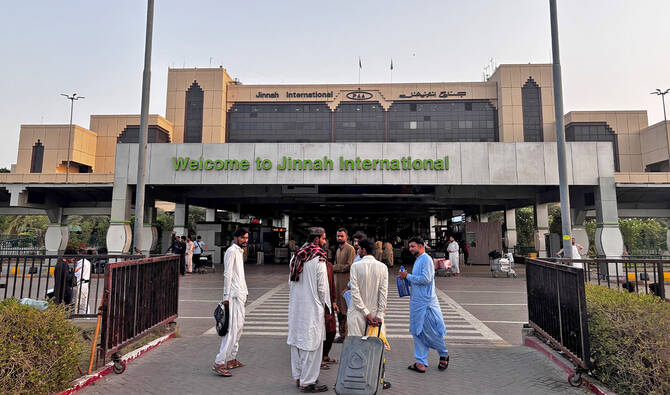
Passengers wait outside at Jinnah International airport after all domestic and international flights were cancelled in Karachi on May 7, 2025. (AFP/File)
Short Url
Updated 10 May 2025
Follow

Pakistan reopens airspace, resumes Hajj flights after India ceasefire

  • Country shut down its airspace following strikes on three of its air bases by Indian forces
  • Ten Hajj flights were canceled due to closure of flight operations since Wednesday this week

ISLAMABAD: Pakistan reopened its airspace to all domestic and international flights on Saturday and resumed Hajj operations after a ceasefire agreement with India put pause to cross-border missile and drone attacks that disrupted regional travel and raised fears of a wider conflict this week. 

The reopening was announced after the two nations agreed to a US-brokered ceasefire deal that came less than 24 hours after Pakistan said India had struck three of its air bases, which led Islamabad to hit multiple bases in India in response, including a missile storage site in India’s north.

“Pakistan’s airspace has been completely restored for all types of flights,” the Pakistan Airports Authority said in a statement. 

“All airports in the country are available for normal flight operations,” it added, asking passengers to contact their airlines for updated schedules.

The religious affairs ministry separately said Hajj flights would now resume as per schedule. 

“A total of 10 Hajj flights were canceled due to the closure of flight operations from time to time,” a spokesman for the ministry said. “Flights cancelation affected the schedule of 2,290 pilgrims.”

So far, 19,669 Pakistani pilgrims had arrived in Saudi Arabia ahead of the Hajj pilgrimage in early June, the spokesman added. 

Flights were grounded, rerouted or delayed across South Asia this past week as tensions between the nuclear-armed neighbors escalated.

Pakistan International Airlines (PIA) suspended operations after halting ground services, while several foreign airlines — including Korean Air, EVA Air, and China Airlines — opted to avoid Pakistani airspace, citing security concerns.

The standoff between the two South Asian nuclear states was sparked by a deadly attack in Indian-administered Kashmir last month that killed 26 people, mostly tourists. India blamed Pakistan for the incident, though officials in Islamabad repeatedly denied any involvement and called for a neutral and impartial probe.

However, New Delhi launched missile strikes on what it called “militant training camps” in at least five Pakistani cities on Wednesday and the two nations have since variously exchanged drone and missile attacks as well as seen increased gunfights on their de facto border at disputed Kashmir. 


Pakistan says repaid over $13.06 billion domestic debt early in last 14 months

Updated 29 January 2026
Follow

Pakistan says repaid over $13.06 billion domestic debt early in last 14 months

  • Finance adviser says repayment shows “decisive shift” toward fiscal discipline, responsible economic management
  • Says Pakistan’s total public debt has declined from over $286.6 billion in June 2025 to $284.7 billion in November 2025

KARACHI: Pakistan has repaid Rs3,650 billion [$13.06 billion] in domestic debt before time during the last 14 months, Adviser to the Finance Minister Khurram Schehzad said on Thursday, adding that the achievement reflected a shift in the country’s approach toward fiscal discipline. 

Schehzad said Pakistan has been repaying its debt before maturity, owed to the market as well as the State Bank of Pakistan (SBP), since December 2024. He said the government had repaid the central bank Rs300 billion [$1.08 billion] in its latest repayment on Thursday. 

“This landmark achievement reflects a decisive shift toward fiscal discipline, credibility, and responsible economic management,” Schehzad wrote on social media platform X. 

Giving a breakdown of what he said was Pakistan’s “early debt retirement journey,” the finance official said Pakistan retired Rs1,000 billion [$3.576 billion] in December 2024, Rs500 billion [$1.78 billion] in June 2025, Rs1,160 billion [$4.150 billion] in August 2025, Rs200 billion [$715 million] in October 2025, Rs494 billion [$1.76 billion] in December 2025 and $1.08 billion in January 2026. 

He said with the latest debt repaid today, the July to January period of fiscal year 2026 alone recorded Rs2,150 billion [$7.69 billion] in early retirement, which was 44 percent higher than the debt retired in FY25.

He said of the total early repayments, the government has repaid 65 percent of the central bank’s debt, 30 percent of the treasury bills debt and five percent of the Pakistan Investment Bonds (PIBs) debt. 

The official said Pakistan’s total public debt has declined from over Rs 80.5 trillion [$286.6 billion] in June 2025 to Rs80 trillion [$284.7 billion] in November 2025. 

“Crucially, Pakistan’s debt-to-GDP ratio, around 74 percent in FY22, has declined to around 70 percent, reflecting a broader strengthening of fiscal fundamentals alongside disciplined debt management,” Schehzad wrote. 

Pakistan’s government has said the country’s fragile economy is on an upward trajectory. The South Asian country has been trying to navigate a tricky path to economic recovery under a $7 billion loan from the International Monetary Fund.