Conflict, extreme weather worsening hunger in West and Central Africa, WFP warns

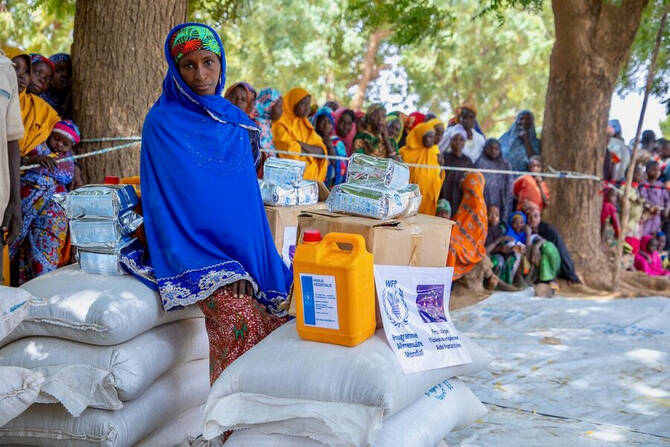
Villagers collect emergency WFP food assistance supported by the European Union in Niger's western Tahoua region. (Photo courtesy of WFP/Amadou Sani Dan Salaou)
Short Url
Updated 10 May 2025
Follow

Conflict, extreme weather worsening hunger in West and Central Africa, WFP warns

  • Report flaggs food inflation, made worse by rising fuel costs and recurrent extreme weather in the central Sahel
  • Conflicts have displaced 10 million people in the region, including 8 million internally displaced inside Nigeria and Cameroon

DAKAR, Senegal: Some 52 million people in West and Central Africa will struggle to meet their basic food and nutrition needs in the upcoming lean season, driven by conflict, extreme weather and economic deterioration, the World Food Programme (WFP) said on Friday.
In the lean season — a period between harvests when food supplies are very low and which runs from June to August — nearly three million of those people throughout the region will face emergency levels of hunger, while 2,600 people in Mali could face catastrophic hunger, the United Nations body said, citing a new food security analysis.
The report flagged food inflation, made worse by rising fuel costs in countries including Ghana, Guinea and Ivory Coast, and recurrent extreme weather in the central Sahel, around the Lake Chad Basin and in the Central African Republic.
Conflicts have displaced 10 million people in the region, the WFP said, including eight million internally displaced inside Nigeria and Cameroon.
The report did not include the Democratic Republic of Congo, where fighting has surged in the east this year as Rwandan-backed M23 rebels have staged a major advance.
Some 28 million people face acute hunger there, a record for the central African country, according to a report released in late March by the WFP and the UN’s Food and Agriculture Organization (FAO).
It said 2.5 million more people had become acutely hungry in Congo since the surge of violence in December.
According to the five-phase classification system used by the WFP, crisis-level hunger (Phase 3) is one step below emergency levels of hunger (Phase 4). Phase 5, the most serious, is classified as catastrophic hunger — or, in some cases, famine.


Filipino typhoon survivors sue Shell over climate change

Updated 7 sec ago
Follow

Filipino typhoon survivors sue Shell over climate change

LONDON: Survivors of a deadly 2021 typhoon in the Philippines have filed a lawsuit against British oil giant Shell, seeking financial compensation for climate-related devastation, three NGOs supporting them said Thursday.
Typhoon Rai struck the southern and central regions of the Philippines in December 2021, toppling power lines and trees and unleashing deadly floods that killed over 400 people and left hundreds of thousands homeless.
The lawsuit on behalf of 103 survivors argues Shell’s carbon emissions contributed to climate change, impacting Philippine communities.
Trixy Elle, a plaintiff from a fishing community whose home and four boats were swept away in the typhoon, told AFP the lawsuit was about getting justice.
“Island residents like us contribute only a small percentage of pollution. But who gets the short stick? The poor like us,” said the 34-year-old, who is still paying off high-interest loans she needed to rebuild.
“I am not speaking only for my community but for all Filipinos who experience the effects of climate crises,” Elle said, adding that her now 13-year-old son still suffers from trauma caused by the storm.
In a joint statement, the NGOs backing the suit said it represents “a decisive step to hold oil giant Shell accountable for the deaths, injuries and destruction left by the climate-fueled storm.”
While typhoons are a regular weather pattern in Southeast Asia, scientists have long warned that climate change is making storms more intense because a warmer atmosphere holds more moisture and warmer seas can turbocharge the systems.
In Manila on Thursday, Greenpeace climate campaigner Virginia Benosa-Llorin called the lawsuit a “test case to hold the corporations accountable.”
The suit will be the “first time claimants in the Global South are bringing action related to significant personal injury and property damage... caused through the alleged acts of common measures in the Global North,” added UK-based lawyer Joe Snape via videolink.

- Lost ‘everything’ -

Plaintiff Rickcel Inting, a fisherman, told AFP his family had lost “everything in an instant” when Typhoon Rai slammed into Bohol province, surviving only because they lashed themselves to a thick column on their rooftop.
“Shell caused what we have suffered because of its actions, causing pollution and harming the environment... they owe poor individuals like us,” said the 46-year-old, adding he had never been able to afford to replace his lost fishing boats.
The lawsuit marks the latest step in a wider international movement to assign responsibility to major companies for climate damage.
A German court in May ruled that firms could, in principle, be held responsible for harm caused by their emissions, fueling hopes that other countries would follow suit.
Shell dismissed the lawsuit as “a baseless claim,” with a spokesperson saying “it will not help tackle climate change or reduce emissions.”
“The suggestion that Shell had unique knowledge about climate change is simply not true,” the firm added.

- Oil profits -

The claimants are seeking financial compensation for “lives lost, injuries sustained and homes destroyed,” NGOs supporting the lawsuit said.
Shell, along with many rival energy giants, has scaled back various climate objectives to focus more on oil and gas in order to raise profits.
The United Nations in 2022 said destruction caused by Typhoon Rai was “badly underestimated” in initial assessments, tripling the number of people “seriously affected” to nine million.
The Philippines — ranked among the most vulnerable nations to the impact of climate change — is hit by an average of 20 storms every year.
The UK lawsuit follows a historic climate ruling by the International Court of Justice in The Hague in July, which declared states had an obligation under international law to address the threat of climate change.
ICJ advisory opinions are not legally enforceable but are seen as highly authoritative in steering national courts, legislation and corporate behavior around the globe.