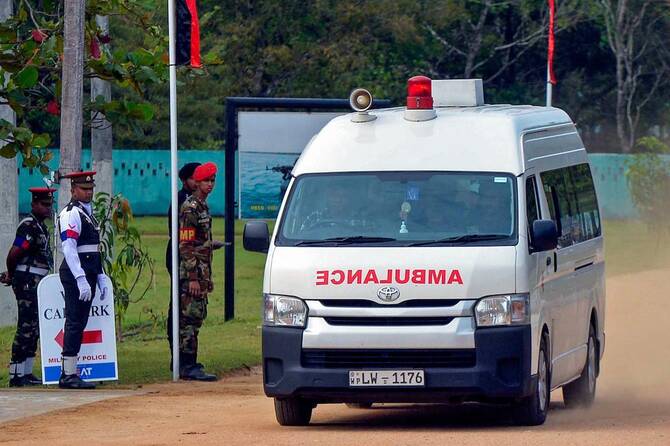
COLOMBO: A Sri Lankan Air Force helicopter crashed during a graduation ceremony on Friday, plunging into a reservoir and killing six of the 12 people on board, a military official said.
The personnel were preparing for a grappling demonstration when their Bell 212 careened into the reservoir at the Maduru Oya national park, the official told AFP.
“There were 12 people on board, and six of them survived with minor injuries,” said the official, who declined to be named.
Those killed included four special forces commandos and two Air Force gunners.
The survivors were admitted to hospital.
The crash took place halfway through the ceremony in Maduru Oya, nearly 300 kilometers (187 miles) east of Colombo.
After a slew of parades, the chopper crew were expected to perform a “fast-roping” maneuver, showcasing their skills in descending from the helicopter while it hovered just above roof height.
After the crash, the graduation ceremony was called off and an investigation into the cause of the incident was launched.
“The Commander of the Air Force has appointed a special nine-member committee to conduct a detailed investigation,” the military said in a statement.
The Air Force operates a small fleet of Bell, Mi-17, and Mi-24 helicopters. Much of the Mi-24 attack helicopter fleet has been grounded since the end of the country’s protracted Tamil separatist war in May 2009.
Friday’s tragedy is the worst for the Air Force since a Chinese-built Y-12 aircraft crashed at Haputale in January 2020, killing all four crew members on board.
In September 2000, an Mi-17 helicopter crashed in central Sri Lanka, killing all 15 people on board — including the country’s then top Muslim political leader — making it the worst helicopter crash in the island’s history.

Sri Lanka helicopter crash kills six military personnel
https://arab.news/rd7qb
Sri Lanka helicopter crash kills six military personnel
- The crash took place halfway through the ceremony in Maduru Oya, nearly 300 kilometers (187 miles) east of Colombo
- Friday’s tragedy is the worst for the Air Force since a Chinese-built Y-12 aircraft crashed at Haputale in January 2020
‘A den of bandits’: Rwanda closes thousands of evangelical churches
- A 2018 law introduced new rules on health, safety, and financial disclosures, and requires all preachers to have theological training
- Observers say the real reason for the closures comes down to control, noting that even those who complied with the law had been shut down
- President Kagame has described the church as a relic of the colonial period, a chapter of its history with which the country is still grappling
KIGALI: Grace Room Ministries once filled giant stadiums in Rwanda three times a week before the evangelical organization was shut down in May.
It is one of the 10,000 churches reportedly closed by the government for failing to comply with a 2018 law designed to regulate places of worship.
The law introduced new rules on health, safety, and financial disclosures, and requires all preachers to have theological training.
President Paul Kagame has been vocal in his criticisms of the evangelical churches that have sprouted across the small country in Africa’s Great Lakes region.
“If it were up to me I wouldn’t even reopen a single church,” Kagame told a news briefing last month.
“In all the development challenges we are dealing with, the wars... our country’s survival — what is the role of these churches? Are they also providing jobs? Many are just thieving... some churches are just a den of bandits,” he said.
The vast majority of Rwandans are Christian according to a 2024 census, with many now traveling long and costly distances to find places to pray.
Observers say the real reason for the closures comes down to control.
Kagame’s government is saying “there’s no rival in terms of influence,” Louis Gitinywa, a lawyer and political analyst based in Kigali, told AFP.
The ruling party “bristles when an organization or individual gains influence,” he said, a view also expressed to AFP by an anonymous government official.
‘Deceived’
The 2018 law requires churches to submit annual action plans stating how they align with “national values.” All donations must be channelled through registered accounts.
Pastor Sam Rugira, whose two church branches were shut down last year for failing to meet fire safety regulations, said the rules mostly affected new evangelical churches that have “mushroomed” in recent years.
But Kagame has described the church as a relic of the colonial period, a chapter of its history with which the country is still grappling.
“You have been deceived by the colonizers and you let yourself be deceived,” he said in November.
The closure of Grace Room Ministries came as a shock to many across the country.
Pastor Julienne Kabanda, had been drawing massive crowds to the shiny new BK Arena in Kigali when the church’s license was revoked.
The government had cited unauthorized evangelical activities and a failure to submit “annual activity and financial reports.”
AFP was unable to reach Kabanda for comment.
‘Open disdain, disgust’
A church leader in Kigali, speaking to AFP on condition of anonymity, said the president’s “open disdain and disgust” for churches “spells tough times ahead.”
“It is unfair that even those that fulfilled all requirements are still closed,” he added.
But some say the clampdown on places of worship is linked to the 1994 Rwandan genocide in which around 800,000 people, mostly ethnic Tutsis, were slaughtered.
Ismael Buchanan a political science lecturer at the National University of Rwanda, told AFP the church could sometimes act as “a conduit of recruitment” for the Democratic Forces for the Liberation of Rwanda (FDLR), the Hutu militia formed in exile in DR Congo by those who committed the genocide.
“I agree religion and faith have played a key role in healing Rwandans from the emotional and psychological wounds after the genocide, but it also makes no sense to have a church every two kilometers instead of hospitals and schools,” he said.
Pastor Rugira meanwhile suggested the government is “regulating what it doesn’t understand.”
It should instead work with churches to weed out “bad apples” and help them meet requirements, especially when it comes to the donations they rely on to survive, he said.


