BRUSSELS: Belgian police were hunting two suspects on Wednesday after a shooting near the Brussels South international railway station, the city’s prosecutor’s office said.
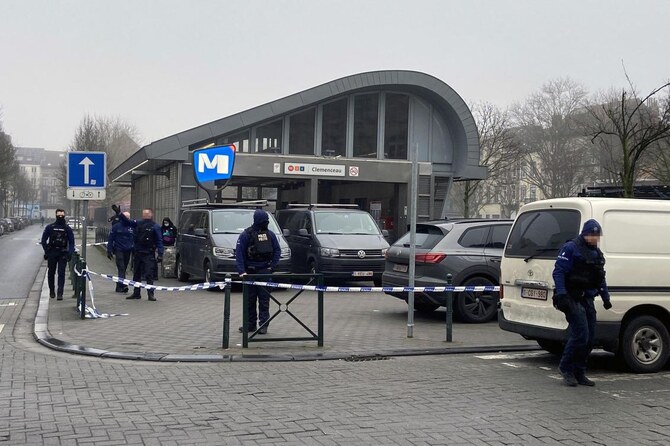
Nobody was injured in the shooting, which happened around 6.00 am (0500 GMT), at the Clemenceau metro station in central Brussels, prosecutors said, adding there were no indications of a terrorist motive in the incident.
Police initially launched a manhunt in the tunnels of the metro system, which was partially closed after two men carrying machine guns were seen fleeing into the Clemenceau station.
Broadcaster VRT said the shooting was probably drug-related and said the shooters had aimed at one person but had missed.
VRT showed on its website images of two people walking into Clemenceau metro station in central Brussels and opening fire with automatic weapons. The station along with several others around the station were shut for hours after the incident.
Another video showed a large group of heavily armed police assembling at the Clemenceau station, as a massive search for the suspects got underway.
The incident crippled traffic on the heavily used metro system in Brussels, which hosts many European Union institutions and NATO’s headquarters.
By 2 p.m. (1300 GMT) the whole city metro system had reopened, including the stations around the Gare du Midi international train station, the arrival point for Eurostar trains from Paris and London.

Belgian police hunting two suspects after Brussels metro shooting
https://arab.news/wrnu6
Belgian police hunting two suspects after Brussels metro shooting
- Police initially launched a manhunt in the tunnels of the metro system
- Broadcaster VRT said the shooting was probably drug-related and said the shooters
UN report says Ugandan troops helped South Sudan with deadly airstrikes
- Ugandan troops are deployed in South Sudan to help the government of President Salva Kiir against forces loyal to opposition figure Riek Machar
- The attacks cited in the UN report involved widespread use of “improvised incendiary devices,” it said
NAIROBI: Uganda helped South Sudan carry out airstrikes that killed and badly burned civilians a year ago, according to a UN inquiry.
Joint aerial bombardments by South Sudan and Uganda “targeted civilian-populated areas predominantly affecting Nuer communities in opposition-affiliated areas,” said the report by the UN Commission on Human Rights in South Sudan, referring to South Sudan’s second-largest ethnic group.
Ugandan troops are deployed in South Sudan to help the government of President Salva Kiir against forces loyal to opposition figure Riek Machar, who was suspended as vice president in September after he faced criminal charges. Ugandan military authorities say troops are in South Sudan at the invitation of the South Sudan government and in accordance with a bilateral security agreement.
While Machar is currently on trial for offenses including treason, fighting has intensified in areas seen as his strongholds, where government troops are trying to disperse the rebels.
The attacks cited in the UN report involved widespread use of “improvised incendiary devices,” it said.
Ugandan forces entered South Sudan in March 2025 with military hardware, including tanks and armored vehicles. That happened shortly after a militia overran a military garrison near the Ethiopian border.
Weeks later, Machar was placed under house arrest for his alleged role in orchestrating the attack, charges that he denies. The government has since relied on aerial attacks to gain the upper hand in a widening conflict with Machar’s forces and other armed groups.
Ugandan President Yoweri Museveni sent his army to intervene in South Sudan’s 2013-2018 civil war on multiple occasions on behalf of Kiir’s forces, helping to turn the tide in his favor. Ongoing fighting threatens a 2018 peace deal.
During one attack in March 2025 in Wunaliet, 15 kilometers (9 miles) from the capital of Juba, homes were engulfed after planes dropped “barrels of liquid that ignited,” witnesses told the UN commission. Survivors said they saw “civilians set alight, including a boy burnt beyond recognition.” A barracks, housing opposition soldiers, was also struck.
A day after the attack, Gen. Muhoozi Kainerugaba, Museveni’s son who also serves as the top military commander, posted on X that Uganda had bombed opposition forces.
“Our air offensive will not stop until Riek Machar makes peace with my uncle Afande Salva,” he wrote. While Kiir is not actually Kainerugaba’s uncle, the term shows the closeness of the two governments.
The post, which was later deleted, accompanied a video appearing to show fiery explosions captured from an in-flight aircraft.
Flight tracking data shows that a turboprop plane that circled the area during the bombing had arrived earlier that day from Uganda and was operated by the Ugandan army, the UN report said.
The report does not state conclusively how many operations Uganda was involved in or the exact nature of their involvement, only that there appeared to be “high degrees of planning, operational integration and command-level authorization.”
In November, Uganda denied participating in any combat operations in South Sudan. It has also denied using “chemical weapons and barrel bombs” and said it does not attack civilians.
Last year, Amnesty International said that Uganda had violated a 2018 UN arms embargo that prohibits member states from providing most forms of military assistance to South Sudan, including weapons and personnel. An UN panel of experts echoed that assessment in November.


