

Pakistan shares concerns with US over India drone strikes it says targeted civilians

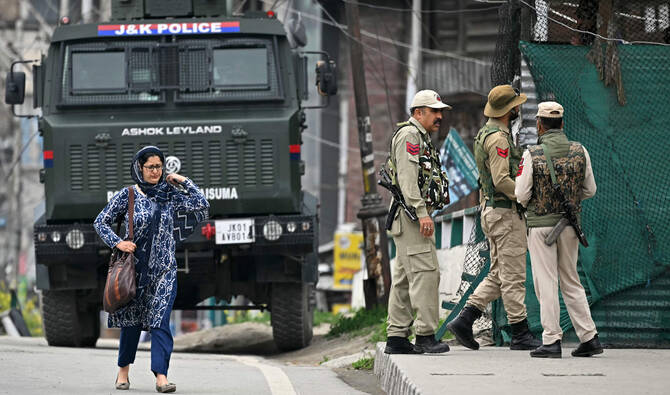
Indian policemen stand guard as a woman walks along a street in Srinagar on May 9, 2025. (AFP)
Short Url
Updated 09 May 2025
Follow

Pakistan shares concerns with US over India drone strikes it says targeted civilians

  • The two neighbors have been on the brink of a full-blown war since India launched missile strikes on multiple Pakistani cities over an attack in Kashmir
  • India is a key US partner, while Pakistan remains a US ally despite its diminished importance after Washington’s withdrawal from Afghanistan in 2021

ISLAMABAD: Pakistan’s Interior Minister Mohsin Naqvi met on Friday the United States (US) Chargé d’Affaires Natalie Baker for the second time in the last 48 hours to discuss escalating tensions between Pakistan and India, Pakistani state media reported, following a series of incursions by the archfoes this week.
Tensions escalated between Pakistan and India after New Delhi blamed an attack in Indian-administered Kashmir, which killed 26 tourists on April 22, on Pakistan. Islamabad denied the claim and called for a credible, international investigation to ascertain facts about the assault that killed 26 tourists.
After initially exchanging diplomatic barbs, India on Wednesday conducted missile strikes in multiple Pakistani cities and killed 31 people, according to Pakistani officials. Pakistan says it has downed five Indian fighter jets and 29 Israel-made drones, launched from India, this week in retaliation to Indian strikes.
New Delhi said it destroyed a Pakistani air defense system in Lahore in response to an air attack. It was difficult to independently verify the claims made by the nuclear-armed arch-foes as the ongoing conflict alarmed the world powers, including China, US and the United Kingdom who all have urged restraint.
“India has brazenly violated all international norms by attempting to target civilian populations using drones,” Naqvi was quoted by the APP news agency as telling the US diplomat. “The region is dangerously close to a conflict, and Pakistan will never allow its security to be compromised.”
Pakistan and India accused each other of launching drone attacks and Islamabad’s defense minister said on Thursday, the second day of major clashes, that further retaliation was “increasingly certain.” Two days of fighting has killed nearly four dozen people on both sides.
Naqvi’s meeting with baker was also attended by US political counselor Zack Harkinrider, according to the report. It came hours after Tammy Bruce said the US had been engaged with both governments and urged India and Pakistan to work toward a “responsible solution” to the issue, which has led to the worst fighting between the two neighbors in decades.
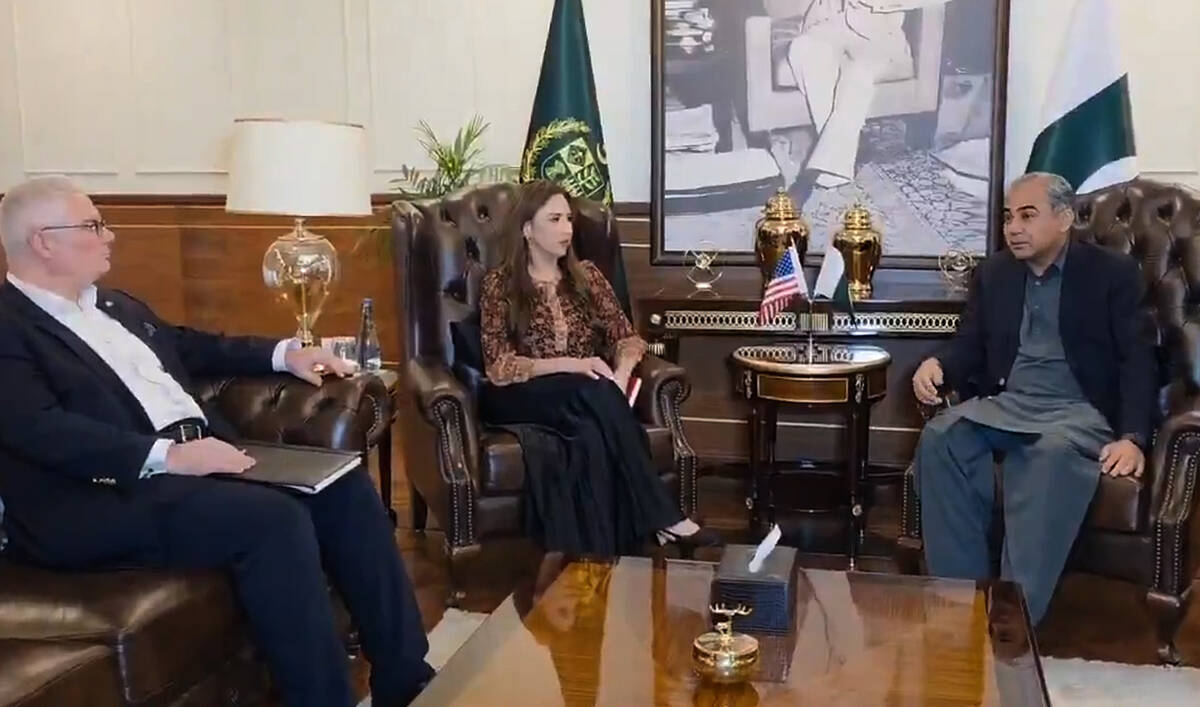


US Chargé d’Affaires Natalie Baker (2R) gestures during a meeting with Pakistan Interior Minsiter Mohsin Naqvi in Islamabad on May 9, 2025. (Screengrab)

“There’s a lot already on the record when it comes to our reaction to what’s been happening here,” Bruce said.
“So, there’s some discussion that Pakistan wants an independent investigation as to what has happened regarding the terrorist attack, and, of course, what we say to that is we want the perpetrators to be held accountable and are supportive of any efforts to that end.”
India is an important partner for Washington, which aims to counter China’s rising influence, while Pakistan remains a US ally despite its diminished importance after Washington’s withdrawal from neighboring Afghanistan in 2021.
Analysts and some former officials have said the US involvement to achieve diplomatic goals in Russia’s war in Ukraine and Israel’s war in Gaza may make Washington leave India and Pakistan on their own in the early days of their tensions, without much direct pressure from the US government.
On Thursday, US Vice President JD Vance said India and Pakistan should de-escalate tensions, but he added that the US could not control the nuclear-armed neighbors and a war between them would be “none of our business.”
“We want this thing to de-escalate as quickly as possible. We can’t control these countries, though,” Vance said in an interview on Fox News.
“What we can do is try to encourage these folks to de-escalate a little bit, but we’re not going to get involved in the middle of war that’s fundamentally none of our business and has nothing to do with America’s ability to control it.”
The escalation began soon after the April 22 attack in Kashmir, reviving the decades-old rivalry between the two neighbors who have fought multiple wars, including two over Kashmir, since their independence from British rule in 1947.
“Our hope and our expectation is that this is not going to spiral into a broader regional war or, God forbid, a nuclear conflict,” Vance said.
Washington has held regular talks with both in recent days, including on Thursday when Secretary of State Marco Rubio held calls with Pakistan’s prime minister and India’s foreign minister while urging them to de-escalate and have direct dialogue.
US President Donald Trump has called rising tensions a shame and said he hoped the two countries will stop now after going “tit-for-tat.”
“This administration has made itself clear, that war, the military, more violence is not a solution,” Bruce added. “Diplomacy is a solution, new ideas to stop generational violence and problems.”


Bangladesh treads carefully as it explores closer defense ties with Pakistan

Updated 13 sec ago
Follow

Bangladesh treads carefully as it explores closer defense ties with Pakistan

  • Air force chiefs of Pakistan and Bangladesh discussed potential defense pact last week
  • Dhaka says plan to procure fighter jets still in early stages, discussions ongoing with several countries

DHAKA: Bangladesh appears to be moving with caution as Dhaka and Islamabad forge closer ties and explore a potential defense deal, experts said on Friday. 

Following decades of acrimonious ties, relations between Bangladesh and Pakistan have been growing since a student-led uprising ousted former Prime Minister Sheikh Hasina in 2024. 

Talks on a potential defense deal covering the sale of Pakistan’s JF-17 fighter jets to Dhaka emerged after Bangladesh’s Air Chief Marshal Hasan Mahmood Khan visit to Rawalpindi last week, where he met with his Pakistani counterpart Air Chief Marshal Zaheer Ahmed Baber Sidhu and Field Marshal Syed Asim Munir, Pakistan’s chief of defense forces. 

Bangladesh’s military media wing, the Inter-Services Public Relations, said the procurement of fighter jets for the Bangladesh Air Force is “in the very rudimentary level,” and currently “under an evaluation process.” 

“The evaluation process will determine which country’s offer proves befitting for us. The Air Chief’s visit to Pakistan is part of the evaluation process … earlier he visited China, Italy (too),” ISPR Director Lt. Col. Sami Ud Dowla Chowdhury told Arab News. 

“Discussions are underway with different countries. Nothing concrete has come yet.” 

Talks between the high-ranking military officials are the latest development in Bangladesh-Pakistan ties, which have included resumption of direct trade for the first time since the 1971 war and the expected launch of a regular route from Dhaka to Karachi at the end of this month, following over a decade of suspension. 

Though efforts to expand relations can be seen from both sides, the current interim government of Bangladesh led by economist and Nobel Prize laureate Muhammad Yunus has been “showing some kind of pragmatism,” said Prof. Delwar Hossain of Dhaka University’s international relations department. 

“Bangladesh is stepping very cautiously in comparison with the advancement from the Pakistan side. Bangladesh is trying to make a balanced approach,” he told Arab News. 

“The present government is always saying that the development of a relationship with Pakistan doesn’t necessarily mean that Bangladesh is moving toward a particular camp. Rather, Bangladesh is interested in having a balanced relationship with all the great powers.” 

Trade and economy are “naturally” more preferable areas of cooperation for Dhaka, Hossain said, adding that “we need more time to determine” how far military cooperation will be expanded. 

Ishfaq Ilahi Choudhury, a defense expert and retired air officer of Bangladesh Air Force, said that Bangladesh is “very much in need of advanced aircraft” because its military has not procured new fighter jets in at least two decades. 

“Air frigate fighters are badly needed for the Bangladesh Air Force. We had some F-7 produced by China, but they stopped producing these fighters nowadays. Here, Pakistan can be a source for our fighter jets, but it involves … geopolitics,” he told Arab News, alluding to how Dhaka’s defense ties with Pakistan may be perceived by its archrival neighbor India. 

Pakistan’s JF-17 fighter jets, a multi-role combat aircraft jointly developed with China, has drawn international interest following its success last May, when Pakistani and Indian forces engaged in their worst fighting since 1999. 

Islamabad said it shot down several Indian fighter jets during the aerial combat, a claim Indian officials later acknowledged after initially denying any losses, but without specifying the number of jets downed. 

“We shouldn’t also forget that both India and Pakistan are at each other’s foot. Here, our friendship with Pakistan shouldn’t go at the cost of our friendship with India,” Choudhury said. 

“With this (potential) defense purchase deal with Pakistan, we have to remain very cautious so that it proves sustainable in the long term.”