

Bangladesh treads carefully as it explores closer defense ties with Pakistan

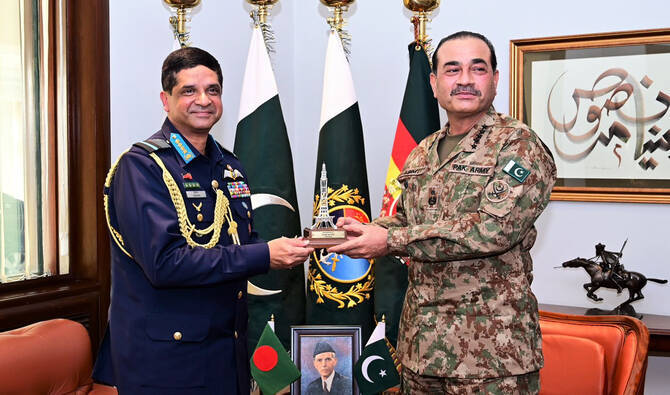
Pakistan’s chief of defense forces, Field Marshal Syed Asim Munir, presents a souvenir to Bangladesh Air Chief Marshal Hasan Mahmood Khan (left) in Rawalpindi, Pakistan, on January 8, 2026. (ISPR/File)
Short Url
Updated 16 January 2026
Follow

Bangladesh treads carefully as it explores closer defense ties with Pakistan

  • Air force chiefs of Pakistan and Bangladesh discussed potential defense pact last week
  • Dhaka says plan to procure fighter jets still in early stages, discussions ongoing with several countries

DHAKA: Bangladesh appears to be moving with caution as Dhaka and Islamabad forge closer ties and explore a potential defense deal, experts said on Friday. 

Following decades of acrimonious ties, relations between Bangladesh and Pakistan have been growing since a student-led uprising ousted former Prime Minister Sheikh Hasina in 2024. 

Talks on a potential defense deal covering the sale of Pakistan’s JF-17 fighter jets to Dhaka emerged after Bangladesh’s Air Chief Marshal Hasan Mahmood Khan visit to Rawalpindi last week, where he met with his Pakistani counterpart Air Chief Marshal Zaheer Ahmed Baber Sidhu and Field Marshal Syed Asim Munir, Pakistan’s chief of defense forces. 

Bangladesh’s military media wing, the Inter-Services Public Relations, said the procurement of fighter jets for the Bangladesh Air Force is “in the very rudimentary level,” and currently “under an evaluation process.” 

“The evaluation process will determine which country’s offer proves befitting for us. The Air Chief’s visit to Pakistan is part of the evaluation process … earlier he visited China, Italy (too),” ISPR Director Lt. Col. Sami Ud Dowla Chowdhury told Arab News. 

“Discussions are underway with different countries. Nothing concrete has come yet.” 

Talks between the high-ranking military officials are the latest development in Bangladesh-Pakistan ties, which have included resumption of direct trade for the first time since the 1971 war and the expected launch of a regular route from Dhaka to Karachi at the end of this month, following over a decade of suspension. 

Though efforts to expand relations can be seen from both sides, the current interim government of Bangladesh led by economist and Nobel Prize laureate Muhammad Yunus has been “showing some kind of pragmatism,” said Prof. Delwar Hossain of Dhaka University’s international relations department. 

“Bangladesh is stepping very cautiously in comparison with the advancement from the Pakistan side. Bangladesh is trying to make a balanced approach,” he told Arab News. 

“The present government is always saying that the development of a relationship with Pakistan doesn’t necessarily mean that Bangladesh is moving toward a particular camp. Rather, Bangladesh is interested in having a balanced relationship with all the great powers.” 

Trade and economy are “naturally” more preferable areas of cooperation for Dhaka, Hossain said, adding that “we need more time to determine” how far military cooperation will be expanded. 

Ishfaq Ilahi Choudhury, a defense expert and retired air officer of Bangladesh Air Force, said that Bangladesh is “very much in need of advanced aircraft” because its military has not procured new fighter jets in at least two decades. 

“Air frigate fighters are badly needed for the Bangladesh Air Force. We had some F-7 produced by China, but they stopped producing these fighters nowadays. Here, Pakistan can be a source for our fighter jets, but it involves … geopolitics,” he told Arab News, alluding to how Dhaka’s defense ties with Pakistan may be perceived by its archrival neighbor India. 

Pakistan’s JF-17 fighter jets, a multi-role combat aircraft jointly developed with China, has drawn international interest following its success last May, when Pakistani and Indian forces engaged in their worst fighting since 1999. 

Islamabad said it shot down several Indian fighter jets during the aerial combat, a claim Indian officials later acknowledged after initially denying any losses, but without specifying the number of jets downed. 

“We shouldn’t also forget that both India and Pakistan are at each other’s foot. Here, our friendship with Pakistan shouldn’t go at the cost of our friendship with India,” Choudhury said. 

“With this (potential) defense purchase deal with Pakistan, we have to remain very cautious so that it proves sustainable in the long term.” 


Pakistan to invest $1 billion in AI by 2030 in push to modernize economy

Updated 5 sec ago
Follow

Pakistan to invest $1 billion in AI by 2030 in push to modernize economy

  • PM says government will introduce AI curriculum in schools nationwide
  • The transformation plan will help train 1 million non-IT professionals in AI

ISLAMABAD: Prime Minister Shehbaz Sharif on Monday announced that Pakistan would invest $1 billion in artificial intelligence (AI) by 2030, in a major step to modernize the South Asian nation’s digital economy.

Pakistan, a country of 240 million people, seeks to become a key participant in the global AI economy, amid growing interest from governments in the Global South to harness AI for productivity, skills development and innovation.

The South Asian nation has been actively developing its AI landscape and approved its National AI Policy in July last year, which was followed by the launch of the country’s sovereign AI cloud and a startup fund.

Speaking at the launch of the Indus AI Week 2026 in Islamabad, Sharif unveiled a multi-pronged roadmap intended to transform Pakistan from a provider of IT technicians into a global hub for AI expertise.

“I am pleased to announce that the Government of Pakistan is committed to invest $1 billion in AI by 2030, which will go a long way in building AI ecosystem in our country,” he told policymakers and international tech experts at Islamabad’s Jinnah Convention Center.

Sharif detailed several flagship initiatives to support this transformation, including a sweeping educational reform, at the event organized by the Information Technology (IT) Ministry, which will be running until Feb. 15, featuring strategic dialogues on sovereign AI and technical showcases.

“AI curriculum will be introduced not only in all federally controlled or run schools, but also in all schools of AJK, that is Azad Jammu and Kashmir, and Gilgit-Baltistan, as well as remote parts of Balochistan,” he said.

The government will provide 1,000 fully funded PhD scholarships in AI to postgraduates to bolster high-level research, according to the PM. It plans to launch a nationwide program to train 1 million “non-IT professionals in AI skills” to enhance productivity and improve livelihoods across traditional sectors of the economy.

Sharif emphasized that the focus would remain on high-impact sectors, including agriculture, mines and minerals, and the empowerment of Pakistan’s youth which makes up 60 percent of its 240 million population.

“We will, God willing, bring in programs to transform them from IT technicians to AI experts, which will lead to our agriculture production in terms of its yield, its quality, its efficiency, like never before,” he said.

Drawing parallels to previous digitization efforts in the Punjab province, such as land record digitization and the establishment of the first IT university in Lahore, Sharif framed the AI push as a “gamechanger” for national governance. He noted the Federal Board of Revenue is already undergoing a digital overhaul to curb smuggling and tax evasion.

“Pakistan is absolutely ready to accept the challenge and walk with our global partners absolutely with great commitment and dedication,” he said. “Our commitment is solid, unwavering. We will never look back.”