



ISLAMABAD: Pakistan categorically rejects the “baseless and irresponsible” Indian accusations of launching attacks in Punjab, Indian-administered Kashmir and Rajasthan, its foreign ministry said on Thursday, after New Delhi said it had repelled attacks in Jammu, Udhampur and Pathankot areas.
Tensions between the two neighbors over an April 22 attack in Indian-administered Kashmir’s Pahalgam have escalated into a limited-scale military conflict when India struck on Wednesday multiple locations in Pakistan after New Delhi blamed the assault on Pakistan. Islamabad has denied involvement.
Pakistan has claimed to have shot down five Indian fighter jets and 29 Israeli-manufactured Harop drones, launched from India, in retaliation to Indian missile and drone strikes this week. India said it had destroyed an air defense system in Lahore in response to a Pakistani air attack.
Both sides have traded heavy fire across their de facto border in the disputed Kashmir region, while a Pakistani minister said on Thursday they had killed several Indian soldiers. It was not possible to immediately verify all of the claims made by both nuclear-armed arch-rivals.
“These claims are entirely unfounded, politically motivated, and part of a reckless propaganda campaign aimed at maligning Pakistan,” the Pakistani foreign ministry said, rejecting Indian accusations of launching attacks in Punjab, Kashmir and Rajasthan.
“The repeated pattern of leveling accusations against Pakistan without any credible investigation reflects a deliberate strategy to manufacture a pretext for aggression and to further destabilize the region. Such actions not only further endanger regional peace but also reveal a disturbing willingness to exploit misinformation for political and military ends.”
Shesh Paul Vaid, a former director-general of police in Indian-administered Kashmir, told The Associated Press that the Jammu airport was also likely under attack and that some of the 50 loud explosions he had heard were likely because “our defense system is at work.”
Sirens blared for more than two hours on Friday in India’s border city of Amritsar, which houses the Golden Temple revered by Sikhs, and residents were asked to remain indoors.
A Pakistani security source said India wanted to justify its military actions against Pakistan by spreading “fabricated and false attack reports” in Kashmir, Rajasthan and other areas.
“India has failed to provide any solid evidence against Pakistan,” the source said.
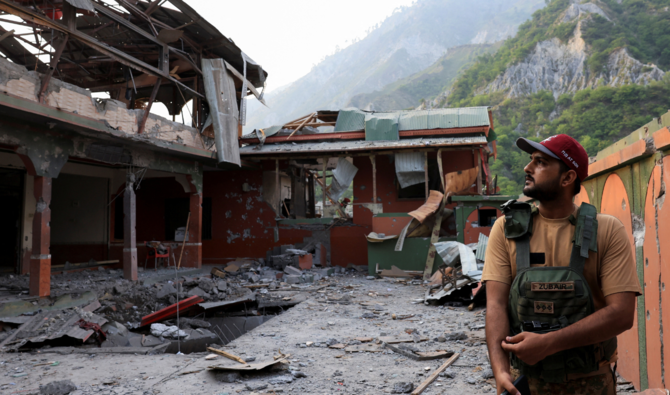
A Pakistan Army soldier stands at the premises of the Bilal Mosque, after it was hit by an Indian strike in Muzaffarabad, Azad Kashmir, on May 7, 2025. (REUTERS)
World powers from the US to China have urged the two countries to calm tensions, and US Vice President JD Vance on Thursday reiterated the call for de-escalation.
“We want this thing to de-escalate as quickly as possible. We can’t control these countries, though,” he said in an interview on Fox News.
Chinese Foreign Ministry spokesperson Lin Jian said Beijing was concerned over the developments and urged both sides to exercise restraint.
“We stand ready to work with the rest of the international community to continue playing a constructive role in easing the current tensions,” Lin told a press briefing.
The relationship between Hindu-majority India and Islamic republic Pakistan has been fraught with tension since they became separate countries after attaining independence from colonial British rule in 1947. Kashmir, a Muslim-majority region, has been at the heart of the hostility and they have fought two of their three wars over the region.


