

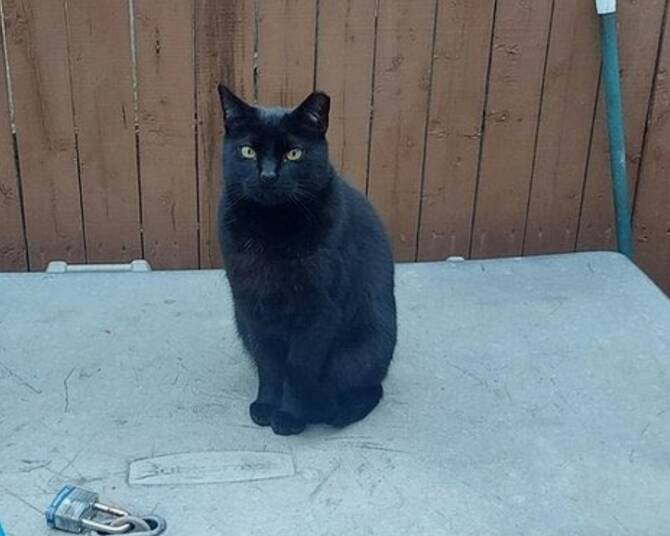
New York man charged after nearly 70 live cats and two dozen dead kittens are found in his home

A suburban New York man has been charged with animal cruelty after authorities say they found nearly 100 cats in his home, including about two dozen dead kittens in a freezer. (X/@longisland)
Short Url
Updated 08 May 2025
Follow

New York man charged after nearly 70 live cats and two dozen dead kittens are found in his home

  • His house also was condemned as uninhabitable
  • He was charged with 18 misdemeanor counts of cruelty to animals and animal neglect and ordered to appear in court on May 23

NEW YORK: A suburban New York man has been charged with animal cruelty after authorities say they found nearly 100 cats in his home, including about two dozen dead kittens in a freezer.
The man, 75, surrendered Wednesday to detectives with the Suffolk County Society for the Prevention of Cruelty to Animals at a local police precinct, the nonprofit organization said. He was charged with 18 misdemeanor counts of cruelty to animals and animal neglect and ordered to appear in court on May 23.
His house, which is about 50 miles (80 kilometers) east of Manhattan, also was condemned as uninhabitable because of overpowering odors of feces and urine, authorities said.

The man didn’t immediately respond to a Thursday phone message seeking comment. Court records don’t list a lawyer for him.
Authorities found 69 living cats, many of which had medical ailments including respiratory infections and eye disease, and 28 dead cats at Glantz’s home on Saturday while investigating a complaint about dozens of cats living in squalid conditions, the county SPCA said. About two dozen dead kittens were wrapped up in a freezer and the other deceased animals were found in other parts of the house, according to the group.
Three of the living cats taken from the home later had to be euthanized because they were in such bad shape, the SPCA said.
The surviving cats are being treated at the Islip town animal shelter with the help of the SPCA’s mobile animal and surgical hospital. Officials are working to find new homes for them and seeking donations to help pay for their care. More than two dozen will be brought to upstate New York to be made available for adoption, the SPCA said.
“The house was in absolute deplorable condition,” said Roy Gross, chief of the Suffolk County SPCA. “Feces covered the floors, sprayed on the walls, saturated in urine. The floors were spongy, most likely from the urine. And the ammonia was so extremely high — the ammonia smell from the urine — that the town of Islip fire marshal condemned the house.”
It isn’t clear why the man had so many cats. Gross said the man’s wife died last month and they had lived in the home for more than 30 years.
It has been a busy and trying month for the animal welfare organization, which also has been helping to care for dozens of cats that were injured in a cat sanctuary fire in the nearby hamlet of Medford on March 31. The shelter’s owner was killed in the blaze.


These shy, scaly anteaters are the most trafficked mammals in the world

Updated 21 February 2026
Follow

These shy, scaly anteaters are the most trafficked mammals in the world

CAPE TOWN, South Africa: They are hunted for their unique scales, and the demand makes them the most trafficked mammal in the world.
Wildlife conservationists are again raising the plight of pangolins, the shy, scaly anteaters found in parts of Africa and Asia, on World Pangolin Day on Saturday.
Pangolins or pangolin products outstrip any other mammal when it comes to wildlife smuggling, with more than half a million pangolins seized in anti-trafficking operations between 2016 and 2024, according to a report last year by CITES, the global authority on the trading of endangered plant and animal species.
The World Wildlife Fund estimates that over a million pangolins were taken from the wild over the last decade, including those that were never intercepted.
Pangolins meat is a delicacy in places, but the driving force behind the illegal trade is their scales, which are made of keratin, the protein also found in human hair and fingernails. The scales are in high demand in China and other parts of Asia due to the unproven belief that they cure a range of ailments when made into traditional medicine.
There are eight pangolin species, four in Africa and four in Asia. All of them face a high, very high or extremely high risk of extinction.
While they’re sometimes known as scaly anteaters, pangolins are not related in any way to anteaters or armadillos.
They are unique in that they are the only mammals covered completely in keratin scales, which overlap and have sharp edges. They are the perfect defense mechanism, allowing a pangolin to roll up into an armored ball that even lions struggle to get to grip with, leaving the nocturnal ant and termite eaters with few natural predators.
But they have no real defense against human hunters. And in conservation terms, they don’t resonate in the way that elephants, rhinos or tigers do despite their fascinating intricacies — like their sticky insect-nabbing tongues being almost as long as their bodies.
While some reports indicate a downward trend in pangolin trafficking since the COVID-19 pandemic, they are still being poached at an alarming rate across parts of Africa, according to conservationists.
Nigeria is one of the global hot spots. There, Dr. Mark Ofua, a wildlife veterinarian and the West Africa representative for the Wild Africa conservation group, has rescued pangolins for more than a decade, which started with him scouring bushmeat markets for animals he could buy and save. He runs an animal rescue center and a pangolin orphanage in Lagos.
His mission is to raise awareness of pangolins in Nigeria through a wildlife show for kids and a tactic of convincing entertainers, musicians and other celebrities with millions of social media followers to be involved in conservation campaigns — or just be seen with a pangolin.
Nigeria is home to three of the four African pangolin species, but they are not well known among the country’s 240 million people.
Ofua’s drive for pangolin publicity stems from an encounter with a group of well-dressed young men while he was once transporting pangolins he had rescued in a cage. The men pointed at them and asked him what they were, Ofua said.
“Oh, those are baby dragons,” he joked. But it got him thinking.
“There is a dark side to that admission,” Ofua said. “If people do not even know what a pangolin looks like, how do you protect them?”