

Rat traps, hunting cats, more funds: Pakistan National Assembly moves against pest infestation

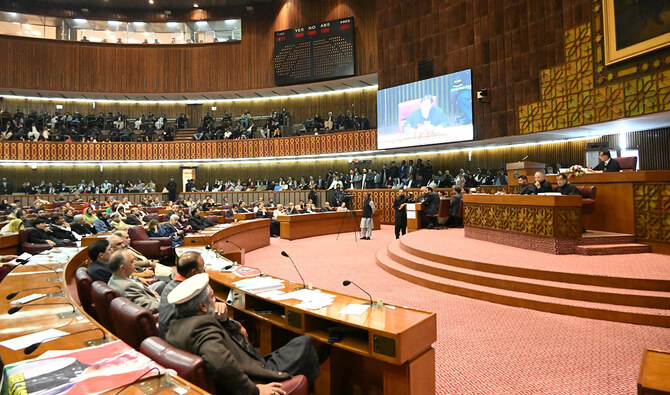
In this handout photo, taken and released by the Government of Pakistan, members of Pakistan’s lower house of parliament attend the National Assembly meeting in Islamabad on March 1, 2024. (Photo courtesy: X/@NAofPakistan/File)
Short Url
Updated 23 August 2024
Follow

Rat traps, hunting cats, more funds: Pakistan National Assembly moves against pest infestation

  • Assembly official says ‘marathon’ of rats had chewed up official documents, damaged CCTV, Internet cables 
  • Parliament has begun digitizing archives after important documents were found to have been badly gnawed 

ISLAMABAD: A spokesperson for the National Assembly of Pakistan said this week parliament would deploy rat traps and had allocated a budget and begun digitizing its archives to protect important official documents from rats that had overrun the building.

The latest rat problem at the National Assembly building came to light after an official committee recently asked to see the records of meetings from 2008, which were found to have been badly gnawed by rats. The pests had also caused damage to CCTV and Internet cables and usually appeared at night when the building was vacant.

Authorities subsequently allocated Rs1.2 million ($4,320) to combat the problem and published newspaper advertisements to identify pest control companies, receiving interest from two firms.

“To safeguard records, the National Assembly has initiated the digitization of its archives,” Zafar Sultan, the director general of media at the assembly, told Arab News, saying the rat infestation was a years-long problem. 

“A tender [for pest companies] is floated every year, this year’s tender was awarded in July,” he added. “The National Assembly administration contacted the Capital Development Authority (CDA), which is responsible for providing services in the Parliament.”

Sultan confirmed that a budget of Rs1.2 million had been allocated for removing rats from the building and a two-person team would handle the task using bait-fillefd rat-catching nets. 

Earlier this week, Sultan told the BBC the rats were “so huge that even cats might be afraid of them.” He said most of the rats could be found on the first floor, which houses the building’s food hall as well as the office of the senate opposition leader. Most meetings of political parties and standing committees also take place here.

“When there are usually no people here in the evening, the rats run around in there like it’s a marathon,” the BBC quoted Sultan as saying. “The staff posted there are now used to this, but if someone comes here for the first time, they get scared.”

Pakistani TV channel Geo News reported that the Capital Development Authority was mulling employing hunting cats to catch rats in parliament.


Pakistan plans 3,000 EV charging stations as green mobility push gathers pace

Updated 14 January 2026
Follow

Pakistan plans 3,000 EV charging stations as green mobility push gathers pace

  • Roadmap unveiled by energy efficiency regulator and a private conglomerate amid early-stage EV rollout
  • New EV Policy and related plans aim to install 3,000 EV stations by 2030, including 240 stations in current fiscal year

ISLAMABAD: Pakistan’s energy efficiency regulator and a private conglomerate have unveiled an approved roadmap to establish 3,000 electric vehicle (EV) charging stations across the country, state-run Associated Press of Pakistan (APP) reported on Tuesday.

The announcement comes as Pakistan looks to build out basic EV charging infrastructure, which remains limited and unevenly distributed, largely concentrated in major cities. Despite policy commitments to promote electric mobility as part of climate and energy-efficiency goals, the absence of a nationwide charging network has slowed broader EV adoption.

Pakistan’s EV ecosystem is still at a formative stage, with progress constrained by regulatory approvals, grid connectivity issues and coordination challenges among utilities, regulators and fuel retailers. Expanding charging infrastructure is widely seen as a prerequisite for scaling electric transport for both private and commercial use.

According to APP, the roadmap was presented during a meeting between Malik Group Chief Executive Officer Malik Khuda Baksh and National Energy Efficiency and Conservation Authority Managing Director and Additional Secretary Humayon Khan.

“Baksh ... in a meeting with Khan, unveiled the approved roadmap for establishing 3,000 electric vehicle charging stations across Pakistan,” APP reported. “Khan reaffirmed the authority’s full institutional backing and pledged to expand the initiative to 6,000 EV charging stations nationwide.”

The discussion reviewed hurdles delaying the rollout, including EV charger imports, customs duties, regulatory documentation and inter-agency coordination.

APP said Khan welcomed the proposal and sought recommendations for “internationally compliant EV charger brands,” while asking for a detailed “issue-and-solutions report within three days” to facilitate timely implementation of the national green mobility initiative.

Despite the issuance of 13 licenses by NEECA and the arrival of five EV charging units at designated sites, progress has been slowed by procedural bottlenecks, officials said. These include delays in electricity connections, prolonged installation of separate meters and pending no-objection certificates from power distribution companies and oil marketing firms, which continue to stall operational readiness.

Pakistan’s electric vehicle ecosystem is still in its early stages, with charging infrastructure far behind levels seen in more advanced markets. The government’s New Energy Vehicle Policy and related plans aim to install 3,000 EV charging stations by 2030, including 240 stations planned in the current fiscal year, but actual deployment remains limited and uneven, mostly clustered in major cities and along key urban corridors.

Despite regulatory backing, including the 2024 Electric Vehicles Charging Infrastructure and Battery Swapping Stations framework, progress has been slow. Many proposed stations have yet to become operational due to delays in grid connections and approvals, and public maps of nationwide charging coverage are not yet available.

Private players are beginning to install more chargers, and there are over 20 public EV charging points reported in urban centers, offering both slower AC chargers and faster DC options. However, such infrastructure is still sparse compared with the growing number of electric vehicles and the government’s long-term targets.