US Fed sees rising risks to economy as it leaves rates unchanged

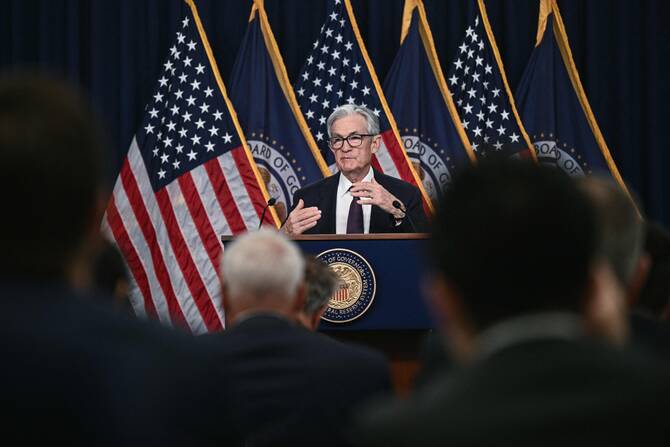
Fed Chair Jerome Powell holds press conference at end of Monetary Policy Committee meeting. AFP
Short Url
Updated 08 May 2025
Follow

US Fed sees rising risks to economy as it leaves rates unchanged

WASHINGTON: The Federal Reserve held interest rates steady on Wednesday but said the risks of higher inflation and unemployment had risen, further clouding the US economic outlook as its policymakers grapple with the impact of President Donald Trump’s tariffs.

At this point, Fed Chair Jerome Powell said, it isn’t clear if the economy will continue its steady pace of growth, or wilt under mounting uncertainty and a possible coming spike in inflation.

With so much unsettled about what Trump will ultimately decide and what of that survives possible court and political battles, “the scope, the scale, the persistence of those effects are very, very uncertain,” Powell said in a press conference at the end of a two-day policy meeting.

“So it’s not at all clear what the appropriate response for monetary policy is at this time ... It’s really not at all clear what it is we should do,” he said, adding: “I don’t think we can say which way this will shake out.”

It was Powell’s subtle way of saying the US central bank, a key actor in shaping the economy, was effectively sidelined until Trump’s sweeping policy agenda takes full effect.

The Fed’s policy statement, which held the benchmark overnight rate steady in the 4.25 percent-4.50 percent range, noted that since the central bank’s last meeting in March “uncertainty about the economic outlook has increased further,” and that risks were increasing that both inflation and unemployment could increase.

Thomas Simons, chief US economist at Jefferies, said the language downplayed just how much disruption had occurred since the Fed’s March 18-19 meeting, and how unpredictable the outlook had become.

“All of the ‘Liberation Day’ tariff news, the April 9 announcement of a 90-day delay, the back and forth on trade deals and tariff exemptions in the headlines, and the resultant negativity expressed in business and consumer surveys make it impossible to judge what the economic outlook is, let alone whether the skew of risks around it has changed,” Simons wrote, calling Powell “predictably noncommittal” given the situation.

Risks to dual mandate

The Fed’s statement, and much of Powell’s comments to reporters as well, vouched for the economy’s continued resilience, with job gains continuing and the economy still growing at a “solid pace.”

The recently reported decline in gross domestic product in the first quarter, Powell said, was skewed by a record rush of imports as businesses and households tried to front-run expected import taxes, with measures of domestic demand still growing. But even that data demonstrated the dilemma facing the Fed. The rush of front-loading to buy goods and stock shelves won’t likely be repeated, and it

is unclear whether underneath it all demand and investment are starting to weaken — and how that will eventually express itself in “hard” data on inflation and jobs. The Fed’s own “Beige Book” of anecdotal reports about the economy recently gave a dour picture of suspended business deals, falling demand, and rising prices.

“Businesses and households are concerned ... and postponing economic decisions of various kinds,” Powell said. “If that continues and nothing happens to alleviate those concerns, you would expect that to show up in economic data.” The Fed can’t respond, however, until it is clear which way the economy pivots, and how it assesses the risks to its two goals of holding inflation to 2 percent and sustaining maximum employment.

“The current stance of monetary policy leaves us well positioned to respond in a timely way to potential economic developments,” Powell said, affirming a wait-and-see approach that has become the central bank’s calling card in the first months of the Trump administration.

US stock prices extended gains after the release of the Fed’s unanimous policy decision and ended higher on the day. Treasury yields fell, while the dollar gained against a basket of currencies.

Holding pattern

The direction of Fed policy will depend on which of the job and inflation risks develop, or, in the more difficult outcome, whether inflation and unemployment increase together and force the central bank to choose which risk is more important to try to offset with monetary policy.

A weaker job market would typically strengthen the case for rate cuts; higher inflation would call for monetary policy to remain tight.

“For the time being the Fed remains in a holding pattern as it waits for uncertainty to clear,” said Ashish Shah, chief investment officer of public investing at Goldman Sachs Asset Management, adding that “recent better-than-feared jobs data has supported the Fed’s on-hold stance, and the onus is on the labor market to weaken sufficiently to bring a resumption of its easing cycle.”

The Fed’s policy rate has been unchanged since December as officials struggle to estimate the impact of Trump’s tariffs, which have raised the prospect of higher inflation and slower economic growth this year.

When policymakers last updated their economic and policy projections in March, they anticipated reducing the benchmark rate by half a percentage point by the end of this year. 


Accelerating growth boosts investor confidence

Updated 06 December 2025
Follow

Accelerating growth boosts investor confidence

  • Startups attract fresh capital to scale AI, health tech, and infrastructure

RIYADH: Startups across the Middle East and North Africa are accelerating growth through strategic funding rounds, partnerships, and technological innovation. 

From agriculture tech and AI-led cybersecurity to digital health and home renovation, this week’s developments reflect the region’s expanding startup ecosystem and investor confidence across key verticals.  

Saudi agritech startup Nabt has raised $3.4 million in a seed extension round, bringing its total funding to $5 million.  

The round was led by SHG Group, with participation from Merak Capital and several angel investors, signaling strong investor confidence in the company’s long-term growth strategy.  

The funding announcement took place during a signing ceremony at the Sunbola program event under the Ministry of Environment, Water, and Agriculture.  

Founded to build both physical and digital infrastructure for the fresh-produce sector, Nabt connects farmers directly with commercial buyers through fulfillment centers that handle sorting, cold storage, and last-mile logistics.  

The company recently launched the Nabt Online Auction to support large-scale produce trading across the Kingdom, and Nabt Intel, which provides real-time pricing and market-demand data. 

CEO Abdullah Al-Otaibi said: “In just two years, Nabt has proven that building transparent and efficient infrastructure for fresh produce is not only possible but essential.”  

The new capital will support expansion into additional Saudi cities and further develop Nabt’s infrastructure and services to boost food security and farmer profitability across the country.   

COGNNA raises $9.2m 

COGNNA, a Saudi cybersecurity company founded in 2022, has closed a $9.2 million series A round led by Impact46 and co-led by BNVT Capital, with participation from Vision Ventures and Tali Ventures.  

The company offers AI-driven security operations tailored for enterprises and SMEs through its Agentic SOC platform.  

Combining AI automation with human oversight, COGNNA’s platform helps organizations simplify compliance and proactively defend against cyber threats. 

Chief Technology Officer Ziyad Al-Sheri stated: “Through our AI-led platform, we are building an Agentic SOC that doesn’t just respond to threats — it anticipates them.”  

The funding will be used to accelerate global expansion, enhance R&D in AI automation, and scale operational teams and infrastructure to meet growing demand. 

The company plans to allocate capital across product development, marketing, hiring, and international operations.  

Funch raises $500k 

Funch, a Dubai-based AI-native lunch subscription startup, has secured $500,000 in a pre-seed round led by Angelspark, with participation from investors including Mostafa Kandil, Mahesh Murthy, and Tushar F.  

Founded in 2025 by Ahmad Joehnny and Ghada Zanaty, the platform offers flexible, credit-based lunch subscriptions for 19 Emirati dirhams per day with no delivery fees. 

Founded in 2025 by Ahmad Joehnny and Ghada Zanaty, Funch offers flexible, credit-based lunch subscriptions with no delivery fees. (Supplied)

Funch replaces traditional meal plans with a system where users can pause, skip, or cancel orders while using credits only when meals are delivered.

“Our model is built around pre-planned orders, enabling us to operate with higher efficiency, reduce waste, and cut emissions with fewer trips,” said co-founder and chief operating officer Ghada Zanaty.  

The company leverages AI to forecast demand, optimize routes, rotate menus, and streamline logistics, and will use the funding to scale across Dubai and develop its AI systems further. 

Paymob teams up with Robusta 

Egyptian fintech Paymob and software development firm Robusta Technology Group have announced a strategic partnership to accelerate digital transformation across Egypt and the wider region.  

The collaboration will integrate Paymob’s digital payments infrastructure with Robusta’s AI-driven product development and analytics capabilities.  

The joint initiative aims to deliver intelligent digital experiences for SMEs and enterprises, supporting Egypt’s Vision 2030 goals. 

Both companies plan to expand regionally and develop future offerings combining automation, analytics, and seamless payment systems to improve operational efficiency for merchants and startups.  

Reno raises $4m

UAE-based renovation technology platform Reno has raised $4 million in a mix of equity and debt funding.  

The round included investments from Sanabil 500, Hub71, and Plus VC, as well as Zero 100 VC, FlyerOne Ventures,  and Sandstorm VC. AngelSpark and Swiss Founders Fund also invested.

Founded in 2024 by Marc Michel, Amr Hosny, and Farah Karabeg, Reno offers a tech-enabled, end-to-end solution for interior design and renovation services in both residential and commercial sectors.  

Reno aims to streamline the renovation process through a unified digital platform, allowing customers to manage projects from planning through execution.  

The company plans to use the new capital to expand across the GCC region, enhance its technological infrastructure, and further develop its customer experience. 

Glenwood PE and Mubadala invest in Korean desalination firm NanoH2O

Glenwood Private Equity and Abu Dhabi’s Mubadala Investment Company, along with co-investors, have completed a co-investment in NanoH2O, a Seoul-based reverse osmosis membrane manufacturer previously operating as LG Water Solutions under LG Chem.  

All closing conditions and regulatory approvals for the investment have been fulfilled.  

NanoH2O, which became an independent entity in 2024, supplies desalination and brackish water treatment solutions to municipal and industrial clients worldwide. More than 95 percent of its revenue is generated outside South Korea. 

“We have strong conviction in NanoH2O’s technology leadership and long-term growth potential,” said Mohamed Al-Badr, head of Asia at Mubadala.  

The firm aims to support NanoH2O’s global expansion, particularly in the MENA region, amid growing concerns over water security and decarbonization.