

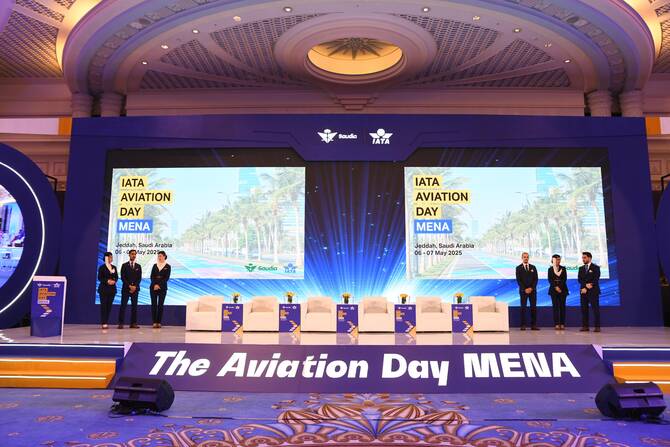

JEDDAH: The Middle East’s aviation sector is pushing toward greater integration and collaborative innovation, with Saudi Arabia’s rapid expansion positioning it as the region’s benchmark, according to a senior International Air Transport Association official.
Kamil Al-Awadhi, IATA’s regional vice president for Africa and the Middle East, told Arab News that growth in the Gulf Cooperation Council is outpacing all other regions — and the Middle East could soon lead the global aviation industry.
His remarks came during IATA Aviation Day MENA 2025 — held for the first time in Saudi Arabia in Jeddah from May 6 to 7 — where industry leaders gathered to explore how regional collaboration and harmonized regulation can unlock aviation’s full potential.
Al-Awadhi credited the region’s resilience to unified political leadership and coordinated aviation strategies.
“After the COVID-19 pandemic subsided in 2022, airlines in the Middle East resumed smooth operations, as if airports had not been closed at all. In contrast, carriers in Europe and the US struggled for several months to return to normal operations,” he said.
Al-Awadhi added: “Saudi Arabia is not only expanding its aviation infrastructure, but it is also investing in its people. This is vital to meet the immediate skills requirements while developing a professional workforce able to deliver on Vision 2030.”
The official acknowledged the region’s operational strength but pointed to the lack of sufficient stakeholder dialogue. “The main goal of this event is to bring the region’s aviation sectors together to discuss their challenges and collectively work toward improvement,” the IATA official said.
Nick Careen, IATA’s senior vice president for operations, safety, and security, said the Middle East was poised to outpace global air traffic growth over the next two decades. “Looking ahead, global air travel is set to grow at 3.3 percent per year for the next 20 years. But the Middle East will grow faster at 4.8 percent,” he said during his keynote.
The event took place just days after IATA released its latest global passenger traffic data, showing industry-wide revenue passenger kilometers rose 3.3 percent year-on-year in March, reaching 738.8 billion — continuing the trend of subdued single-digit growth seen since 2023.

Nick Careen, IATA’s senior vice president for operations, safety, and security. Supplied
Careen emphasized Saudi Arabia’s pivotal role in the region’s aviation transformation. “The sector is not just moving forward — it’s moving forward at speed. And that should make everyone in this room take notice.”
He noted that aviation and aviation-related tourism contributed $90.6 billion to the Kingdom’s gross domestic product — representing 8.5 percent — and supported 1.4 million jobs. “More than 62,000 people are directly employed by airlines, and another 79,000 are working in the broader aviation ecosystem. In 2023, Saudi Arabia handled over 713,000 tonnes of air cargo,” he said.
According to Careen, this progress is being driven by Crown Prince Mohammed bin Salman’s Vision 2030 plan, which places aviation at the heart of economic diversification and international connectivity. “We have seen it in the development of new airports, the digital push, the workforce development, and the launch of national carriers like Riyadh Air,” he said.
Abdulaziz bin Al-Duailej, president of the General Authority of Civil Aviation, described the Middle East as an economy worth $9.48 trillion powered by a young population, adding: “Aviation here is not only enabling growth; it is leading transformation through strategic investment and collaboration.”
He continued: “By 2024, passenger traffic across the Middle East exceeded pre-pandemic levels by 9 percent — more than double the global growth rate. While Saudi Arabia’s civil aviation sector recorded a remarkable increase of over 24 percent compared to pre-pandemic levels.”

Industry leaders gathered in Jeddah. Supplied
The Kingdom’s growth has been marked by major achievements. In 2024 alone, Saudi Arabia handled 128 million passengers, more than 900,000 flights, and 1.2 million tonnes of cargo. The government has ordered 500 new aircraft and attracted 21 new international airlines into its market.
“The Kingdom’s aviation market is opening rapidly. In the past year alone, 21 new international airlines have entered the Saudi market, and in the first quarter of 2025, foreign carriers carried 63 percent of international passengers,” Al-Duailej said, reaffirming the Kingdom’s willingness to engage globally to shape the sector’s future.
In its latest press release, IATA outlined three strategic priorities to help Saudi Arabia sustain its aviation gains: improving coordination with stakeholders, ensuring cost-effective infrastructure development, and building national talent.
“Given Saudi Arabia’s important role in shaping regional aviation policies, continued collaboration and consultation with users and stakeholders, along with alignment to global standards and best practices, are vital,” the organization said.
It also emphasized the need for cost-competitiveness. “As Saudi Arabia makes significant investments in airport infrastructure and digitalization, it is critical to work with the industry to ensure cost competitiveness,” IATA added.
On workforce development, the group noted: “Ensuring a skilled workforce across all areas of aviation will enable the Kingdom to fulfill its potential as a regional and global aviation hub.”
On the sidelines of the forum, IATA announced new training agreements with Saudi airlines, airports, and academic institutions. In the first phase, more than 1,000 graduates and aviation professionals will be trained in areas such as airport operations, safety, airline management, and ground handling.
Riyadh Airports Co. and Qassim University joined IATA’s network of regional training partners, alongside long-time collaborator Prince Sultan Aviation Academy. Together, the three will deliver over 60 programs covering technical, commercial, and interpersonal skills.
“The renewed agreement enables the academy to offer IATA training courses within the Kingdom and across the GCC region. All operational aviation requirements — including cabin crew, maintenance, ground services, and business training — are provided by PSAA,” said Khalid Bawazeer, the academy’s director of continuous studies, to Arab News.
“This requires preparation to meet the demand for increased training programs, whether conducted internally by the academy or through external courses such as those offered by IATA,” he added.
As part of the deal, sector awareness courses will also be offered to graduates of Riyadh Air and Saudia to nurture national talent for future leadership. Specialized Dangerous Goods training will be provided to operational staff from the Saudi Civil Aviation Academy.

SAL Logistics Services Co. marks its new agreement at the event. Supplied
In addition, SAL Logistics Services Co. has been accredited as a competency-based training and assessment center, and Saudi Ground Services has renewed its CBTA accreditation.
The IATA’s Careen acknowledged that despite the Kingdom’s progress, aviation development remains uneven across the Middle East due to persistent geopolitical instability.
He pointed to challenges in Yemen, Syria, Iraq, and Lebanon, where conflict and sanctions have suppressed growth. “Where aviation continues to demonstrate remarkable resilience in the face of political instability, it does far better in countries that are stable, peaceful and open,” the official said.
Careen called on governments and regulators to align efforts toward a more integrated and forward-looking aviation environment. “A Middle East characterized by open skies, harmonized regulations, and shared innovation,” he said, is critical to long-term success.
“To every government, airline, and civil aviation authority in this room, your success is everyone’s success. A rising tide lifts all boats, and in this case, all planes,” he said.
Ibrahim Al-Omar, director general of Saudia Group, the host of the event, said the forum was a valuable opportunity to showcase how Vision 2030 is reshaping regional aviation.
“With safety, innovation, and sustainability driving our progress, IATA Aviation Day MENA is a valuable platform to showcase how the Kingdom’s Saudi Vision 2030 is shaping the future of aviation not only across the Kingdom but the region and beyond,” he said in a statement released a day prior to the event.


