

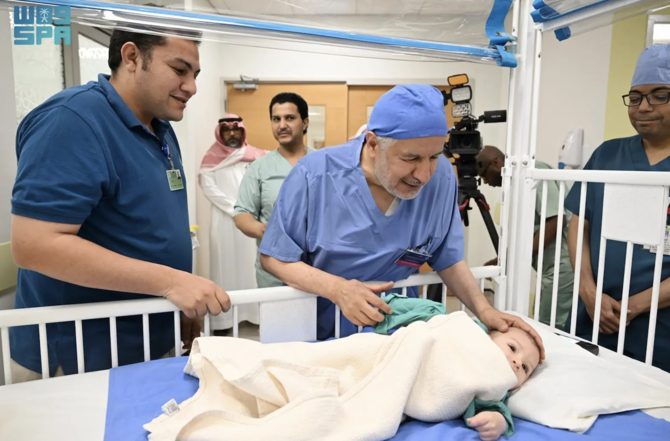
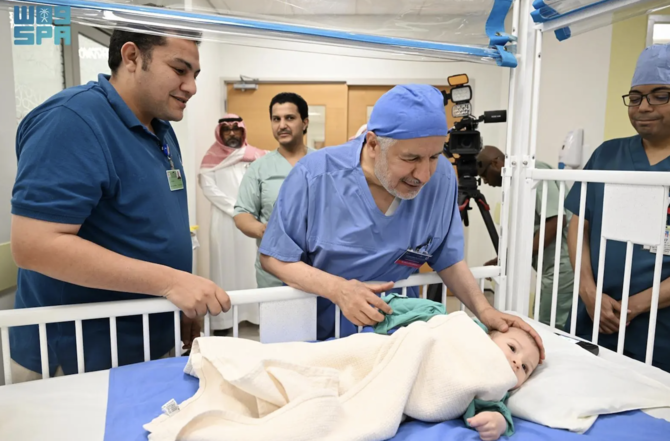
Saudi medical team begins to separate Egyptian conjoined twins

The complex operation is expected to last approximately 11 hours and will proceed in six stages. (SPA)
Short Url
Updated 07 May 2025
Follow

Saudi medical team begins to separate Egyptian conjoined twins

  • Most delicate case ever undertaken by his team, says surgeon Dr. Abdullah Al-Rabeeah

DUBAI: A medical team of the Saudi Conjoined Twins Program began on Wednesday to separate Egyptian twins at King Abdullah Specialist Children’s Hospital in Riyadh.

Dr. Abdullah Al-Rabeeah, advisor at the royal court and supervisor general of the Kingdom’s aid agency KSrelief, who heads the team, said the twins are joined at the back, lower chest, abdomen and pelvis, the Saudi Press Agency reported.

One of the twins lacks essential organs, including a heart and head, and suffers from severe congenital defects, making survival impossible.

The complex operation is expected to last approximately 11 hours and will proceed in six stages.

It involves a multidisciplinary team of 26 consultants, specialists, and support staff in fields including anesthesia, neurosurgery, pediatric surgery, and plastic surgery.

Al-Rabeeah described the case as one of the most delicate the team has undertaken, noting the shared spinal canal as a major surgical challenge.

Advanced imaging and surgical microscopes will be used to ensure precision, he said.

This marks the 63rd separation procedure under the Saudi Conjoined Twins Program, which has reviewed 149 cases from 27 countries since its inception in 1990.


Rare exhibits on display at King Abdulaziz Palace

Updated 30 January 2026
Follow

Rare exhibits on display at King Abdulaziz Palace

  • The piece reflects the precision of traditional craftsmanship and its social symbolism tied to strength and horsemanship

RIYADH: Exhibits on display at the King Abdulaziz Palace in the historic village of Laynah highlight rich aspects of human history and environmental change in the Arabian Peninsula as part of a series of palace activation events organized by the Imam Turki bin Abdullah Royal Nature Reserve Development Authority during the Darb Zubaida Winter Season.

The exhibits feature rare historical artifacts carrying cultural and scientific significance that document different lifestyles and environmental shifts in the region over the centuries.

Among the most notable pieces is a traditional rifle crafted from natural wood and fitted with a handwoven leather strap, historically used for hunting and protection.

The piece reflects the precision of traditional craftsmanship and its social symbolism tied to strength and horsemanship.

The authority stated that the palace welcomes visitors daily until Feb. 15, from 3:00 p.m. to 10:00 p.m., as part of unified tourism programs aimed at organizing visitor flow and providing opportunities to explore historical sites in a safe and engaging environment.