

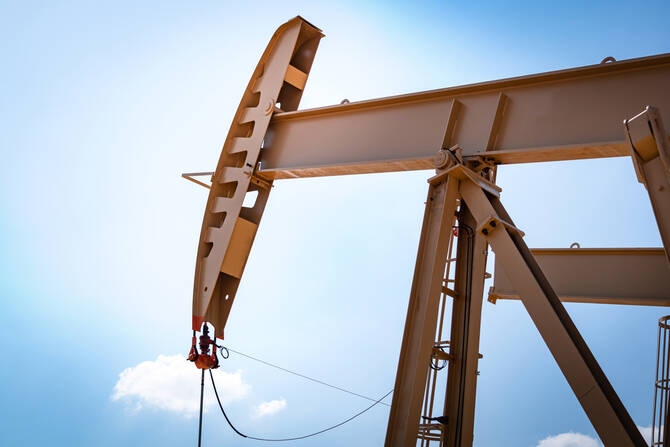
Oil Updates — crude rises as market eyes US-China trade talks, lower US output

Brent crude futures gained 76 cents a barrel, or 1.22 percent, to $62.91 a barrel by 10:08 a.m. Saudi time. Shutterstock
Short Url
Updated 07 May 2025
Follow

Oil Updates — crude rises as market eyes US-China trade talks, lower US output

SINGAPORE: Oil prices rose on Wednesday, holding slightly above recent four-year lows, as investors focused on US-China trade talks and signs of lower US production.

Brent crude futures climbed 61 cents a barrel, or around 1 percent, to $62.76 a barrel by 12:09 p.m. Saudi time, while US West Texas Intermediate crude was up 71 cents, or 1.2 percent, at $59.8 a barrel. 

Both benchmarks plunged to a four-year low recently after OPEC+’s decision to speed up output increases, stoking fears of oversupply at a time when US tariffs have increased concerns about demand.

“News that the US and China will start trade talks this weekend has Brent crude trading higher, extending a relief rally in oil,” said commodities strategists at ING on Wednesday.

“Yet while negotiations would help improve sentiment in the oil market, we’ll need to see significant progress on lowering tariffs to improve the demand outlook,” ING added.

Meanwhile, lower oil prices in recent weeks have prompted some US energy firms including Diamondback Energy and Coterra Energy to announce rig reductions, which analysts said should support prices over time by reducing output.

The latest announcements suggested output will weaken in the coming months, said ANZ Bank senior commodity strategist Daniel Hynes. “We warned last month that falling prices and declining drilling activity was raising the risk of US oil output falling.”

Crude stocks fell by 4.5 million barrels in the week ended May 2, market sources said, citing American Petroleum Institute figures on Tuesday.

US government data on stockpiles is due at 5:30 p.m. Saudi time. Analysts polled by Reuters expect, on average, an 800,000 barrel decline in US crude oil stocks for last week.

Prices also drew support from signs of demand improving. Consumers in China increased spending during the May Day celebration and as market participants returned after the five-day holiday.

In Europe, companies are expected to report growth of 0.4 percent in first-quarter earnings, an improvement over the 1.7 percent drop analysts had expected a week ago.

The Federal Reserve is widely expected to leave US interest rates unchanged on Wednesday as tariffs roil the economic outlook.


Emerging markets should depend less on external funding, says Nigeria finance minister

Updated 10 February 2026
Follow

Emerging markets should depend less on external funding, says Nigeria finance minister

RIYADH: Developing economies must rely less on external financing as high global interest rates and geopolitical tensions continue to strain public finances, Nigeria’s finance minister told Al-Eqtisadiah.

Asked how Nigeria is responding to rising global interest rates and conflicts between major powers such as the US and China, Wale Edun said that current conditions require developing countries to rethink traditional financing models.

“I think what it means for countries like Nigeria, other African countries, and even other developing countries is that we have to rely less on others and more on our own resources, on our own devices,” he said on the sidelines of the AlUla Conference for Emerging Market Economies.

He added: “We have to trade more with each other, we have to cooperate and invest in each other.” 

Edun emphasized the importance of mobilizing domestic resources, particularly savings, to support investment and long-term economic development.

According to Edun, rising debt servicing costs are placing an increasing burden on developing economies, limiting their ability to fund growth and social programs.

“In an environment where developing countries as a whole — what we are paying in debt service, what we are paying in terms of interest costs and repayments of our debt — is more than we are receiving in what we call overseas development assistance, and it is more than even investments by wealthy countries in our economies,” he said.

Edun added that countries in the Global South are increasingly recognizing the need for deeper regional integration.

His comments reflect growing concern among developing nations that elevated borrowing costs and global instability are reshaping development finance, accelerating a shift toward domestic resource mobilization and stronger economic ties among emerging markets.