

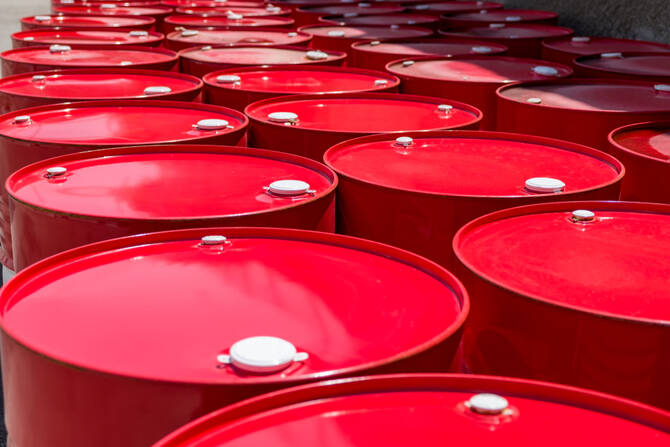
Oil Updates — crude climbs $1 as price drop triggers buying; oversupply worries weigh

Brent crude futures rose $1.15 to $61.38 a barrel by 9:23 a.m. Saudi time. Shutterstock
Short Url
Updated 06 May 2025
Follow

Oil Updates — crude climbs $1 as price drop triggers buying; oversupply worries weigh

SINGAPORE: Oil gained more than $1 per barrel on Tuesday, rebounding on technical factors and bargain hunting after a decision by OPEC+ to boost output sent prices down the previous session, although concerns about the market surplus outlook persisted.

Brent crude futures rose $1.15 to $61.38 a barrel by 9:23 a.m. Saudi time, the first time gain after six consecutive declines, while US West Texas Intermediate crude added $1.11 to $58.24 a barrel.

Both benchmarks had settled at their lowest since February 2021 on Monday, driven by an OPEC+ decision over the weekend to further speed up oil production hikes for a second consecutive month.

“Today’s slight rebound in oil prices appears more technical than fundamental,” said Yeap Jun Rong, a market strategist at IG. “Persistent headwinds including a pivotal shift in OPEC+ production strategy, uncertain demand amid US tariff risks, and price forecast downgrades are continuing to weigh on the broader price movement.”

Driven by expectations that production will exceed consumption, oil has lost over 10 percent in six straight sessions and dipped over 20 percent since April when US President Donald Trump’s tariff shocks prompted increased bets on a slowdown in the global economy.

The return of Chinese market participants after a five-day public holiday since May 1 was seen supporting prices on Tuesday.

“China also reopened today, and being the largest importer, buyers would have likely jumped to secure oil at current low levels,” said Priyanka Sachdeva, senior market analyst at Phillip Nova.

Also lending some support was data showing a pick-up in services sector’s growth in the US, the world’s major oil consumer, as orders increased.

The Institute for Supply Management said on Monday its nonmanufacturing purchasing managers index  increased to 51.6 last month from 50.8 in March. Economists polled by Reuters had forecast the services PMI dipping to 50.2.

The US Federal Reserve will likely leave interest rates unchanged on Wednesday as tariffs roil the economic outlook.

Barclays lowered its Brent crude forecast on Monday by $4 to $70 a barrel for 2025 and set its 2026 estimate at $62 a barrel, citing “a rocky road ahead for fundamentals” amid escalating trade tensions and OPEC+’s pivot in its production strategy.

Goldman Sachs also lowered its oil price forecast on Monday by $2-3 per barrel, as they now expect another 400,000 barrels per day production increase by OPEC+ in July. 


Education spending surges 251% as students return from autumn break: SAMA

Updated 12 December 2025
Follow

Education spending surges 251% as students return from autumn break: SAMA

RIYADH: Education spending in Saudi Arabia surged 251.3 percent in the week ending Dec. 6, reflecting the sharp uptick in purchases as students returned from the autumn break.

According to the latest data from the Saudi Central Bank, expenditure in the sector reached SR218.73 million ($58.2 million), with the number of transactions increasing by 61 percent to 233,000.

Despite this surge, overall point-of-sale spending fell 4.3 percent to SR14.45 billion, while the number of transactions dipped 1.7 percent to 236.18 million week on week.

The week saw mixed changes between the sectors. Spending on freight transport, postal and courier services saw the second-biggest uptick at 33.3 percent to SR60.93 million, followed by medical services, which saw an 8.1 percent increase to SR505.35 million.

Expenditure on apparel and clothing saw a decrease of 16.3 percent, followed by a 2 percent reduction in spending on telecommunication.

Jewelry outlays witnessed an 8.1 percent decline to reach SR325.90 million. Data revealed decreases across many other sectors, led by hotels, which saw the largest dip at 24.5 percent to reach SR335.98 million. 

Spending on car rentals in the Kingdom fell by 12.6 percent, while airlines saw a 3.7 percent increase to SR46.28 million.

Expenditure on food and beverages saw a 1.7 percent increase to SR2.35 billion, claiming the largest share of the POS. Restaurants and cafes retained the second position despite a 12.6 percent dip to SR1.66 billion.

Saudi Arabia’s key urban centers mirrored the national decline. Riyadh, which accounted for the largest share of total POS spending, saw a 3.9 percent dip to SR4.89 billion, down from SR5.08 billion the previous week.

The number of transactions in the capital settled at 74.16 million, down 1.4 percent week on week.

In Jeddah, transaction values decreased by 5.9 percent to SR1.91 billion, while Dammam reported a 0.8 percent surge to SR713.71 million.

POS data, tracked weekly by SAMA, provides an indicator of consumer spending trends and the ongoing growth of digital payments in Saudi Arabia. 

The data also highlights the expanding reach of POS infrastructure, extending beyond major retail hubs to smaller cities and service sectors, supporting broader digital inclusion initiatives. 

The growth of digital payment technologies aligns with the Kingdom’s Vision 2030 objectives, promoting electronic transactions and contributing to the nation’s broader digital economy.