

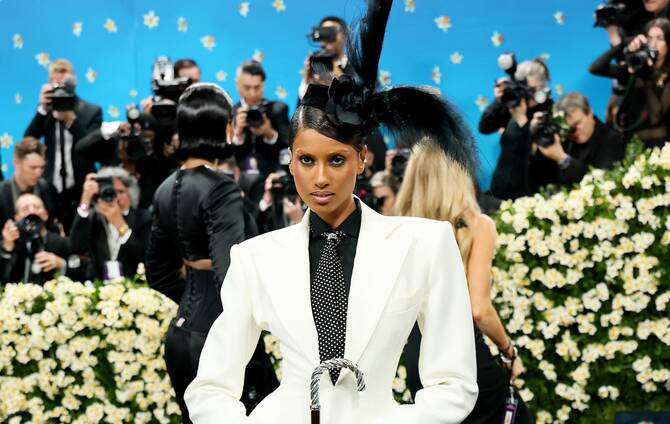
Imaan Hammam suits up for 2025 Met Gala

Imaan Hammam appeared at the 2025 Met Gala. (Getty Images)
Short Url
Updated 06 May 2025
Follow

Imaan Hammam suits up for 2025 Met Gala

DUBAI: Fashion’s biggest night got underway this week at the Met Gala in a rainy Manhattan, and part-Arab celebrities turned heads with their looks. 

Dutch Egyptian Moroccan model Imaan Hammam donned a white tailored suit by Polish designer Magda Butrym, featuring a fitted waist, structured shoulders and wide-leg trousers. She paired it with a black shirt and a polka dot tie. 

Her look included a black cane with a silver handle and silver pointed-toe heels. She topped off the outfit with a black headpiece made of flowers and long feathers.


Dutch Egyptian Moroccan model Imaan Hammam donned a white tailored suit by Polish designer Magda Butrym. (Getty Images)

Among the guests was, of course, US Dutch Palestinian model Gigi Hadid.

The runway star wore a metallic gold halter-neck gown with a fitted silhouette and a gathered waist. The dress featured sequins and embellishments throughout, along with a slight train that extended behind her. 

She completed the look with statement earrings and styled her hair in soft vintage waves with a rolled front section.


Among the guests was, of course, US Dutch Palestinian model Gigi Hadid. (Getty Images)

Saudi Arabia-based Argentine model Georgina Rodriguez wore a black satin gown with lace detailing along the neckline and waist. The dress featured a thigh-high slit and a floor-length train. She accessorized her look with pointed black heels and a diamond necklace. 

This year’s Met Gala marks two major milestones: it is the first to spotlight Black designers, and the first in over two decades to center on menswear. The theme was inspired by the Metropolitan Museum of Art’s spring exhibition, “Superfine: Tailoring Black Style.”


Saudi Arabia-based Argentine model Georgina Rodriguez wore a black satin gown with lace detailing along the neckline and waist. (Getty Images)

The event was co-hosted by Pharrell Williams, Lewis Hamilton, Colman Domingo and A$AP Rocky.

Rihanna closed out the evening in signature fashion, revealing her newly announced baby bump. Her Marc Jacobs look included tied sleeves of a men’s suit that served as a bustle behind her as she posed for the cameras.

A$AP Rocky, who is both co-chair and the father of Rihanna’s child, responded to congratulations on the carpet. “It feels amazing. It’s time that we show the people what we was cooking up. And I’m glad everybody’s happy for us ‘cause we definitely happy, you know,” he told reporters on the red carpet. 


Daniel Boulud on creating a French menu with Saudi soul 

Updated 12 December 2025
Follow

Daniel Boulud on creating a French menu with Saudi soul 

  • The acclaimed French chef discusses ‘building on a legacy’ with Riyadh’s Café Boulud  

RIYADH: Daniel Boulud was in a reflective, quietly excited mood when we met at his Riyadh outpost of Café Boulud during the restaurant’s first anniversary at the end of October.  

“We’re building on a legacy that started in my village in France and continued with Café Boulud in New York 28 years ago,” he told Arab News. The touchpoints are classic: tradition, seasonality, and French technique. But our conversation quickly turned to how those ideas breathe in Riyadh. 

“The promise was always to be very French, but also current and global,” Boulud said. In practice then, “there is the DNA of the original Café Boulud,” but local preferences mean the menu is lighter and brighter — more raw preparations, a Mediterranean lift, and more space for produce.  

Seasonal truffles at Cafe Boulud. (Supplied)

For Boulud, recipes aren’t static; techniques and flavors adapt to their new place. So in Riyadh he’s created dishes using “local spices, local ingredients — inspirations from the warm weather.” Those local ingredients, he said, include “dates, dried fruits, certain local dairy — like the cream — and of course cardamom and coffee.”  

Boulud is no stranger to the Saudi palate. In the early Eighties, he was employed as a cook by a Saudi family. That’s when he first fell for Arabian coffee. Now he folds that memory into a pot de crème made with coffee, cardamom, and caramel. It tastes like a postcard from then to now. 

Topian Amberjack at Cafe Boulud. (Supplied)

But Boulud remains flexible about his ingredients’ origins. “I want the tomato to be local, but whether it’s from Syria, Lebanon, Egypt, or France, as long as it’s a good tomato, I’m happy,” he explained. Essentially, integrity outranks origin. Consistency is the key. 

Boulud said that many of his restaurants’ regulars skip the menu altogether. They already know the path they want their meal to take. One that Boulud recommends: a crudo or ceviche to open — “something crisp, fresh, refreshing, light” — then shellfish, if the supply is good, or a fish course (Dover sole, tuna, salmon, striped bass, daurade, or cod). And finally meat, something cooked over a wood fire for depth, or long, slow braises “with the meat falling off the bone.” 

Cafe Boulud Riyadh. (Supplied)

And Boulud said he still loves the ritual of a cheese course, preferably “an incredible selection,” often shared — before dessert. The latter could go one of two ways: chocolate (sometimes with nuts, spice, or that Saudi-accented coffee and cardamom), or fruit-led finales that track the seasons, with the occasional preserve or dried fruit such as dates and figs. 

With the Kingdom’s dining scene booming, it seems likely that an increasing number of young Saudis will now see becoming a chef as a viable career option. For those that do, Boulud’s advice is to stay close to home for inspiration.  

“The first skill is to know where you’re from,” he said. “Do you know your own cuisine?” He recommended mastering family flavors, seeking mentors with “discipline and ethics,” and then travelling to expand both culinary and cultural literacy.  

Boulud also stressed the need for clarity in cooking. (“Fusion is very confusing,” he warned.) Seasoning and techniques can be adapted, ideas can be combined, but there’s one question he wants chefs to be able to answer: “What are the roots of your dish?”