Pakistan says wants peace, promises ‘befitting reply’ in case of any aggression by India

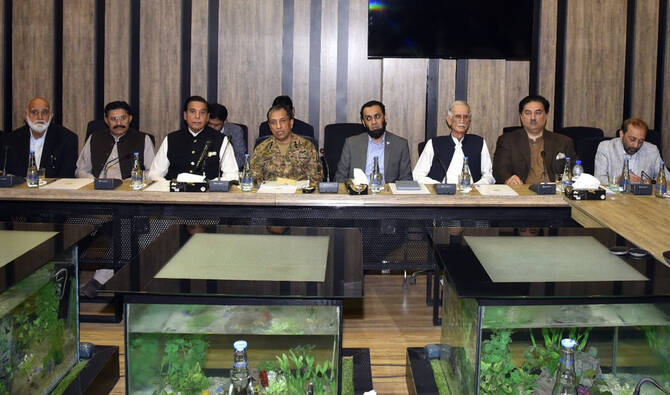
Pakistan’s Information Minister Attaullah Tarar (fourth right) and military spokesman Lt. Gen. Ahmed Sharif Chaudhry (fourth left) attends a meeting with political leaders on national security affairs in Islamabad on May 4, 2025. (Govt. of Pakistan)
Short Url
Updated 04 May 2025
Follow

Pakistan says wants peace, promises ‘befitting reply’ in case of any aggression by India

  • Relations between the nuclear-armed neighbors have plummeted after India accused Pakistan of backing an attack in Kashmir that killed 26 tourists
  • There have been fears that New Delhi may carry out limited airstrikes or special forces raids near the border with Pakistan, leading to a wider conflict

ISLAMABAD: Pakistan wants peace in the region, but it will give a “befitting reply” if a war was imposed by India, security sources said on Sunday, citing a Pakistani military spokesman.
The statement came amid heightened tensions between India and Pakistan over an attack in Indian-administered Kashmir’s Pahalgam town that killed 26 tourists on April 22. New Delhi has blamed the assault on Pakistan, Islamabad denies involvement and calls for a credible international probe into it.
Prime Minister Narendra Modi has vowed to pursue the attackers “to the ends of the earth” and there have been fears that India may carry out limited airstrikes or special forces raids near the border with Pakistan. A Pakistani minister said this week Islamabad had “credible intelligence” India was planning to attack Pakistan.
Pakistani Information Minister Attaullah Tarar and military spokesman Lt. Gen. Ahmed Sharif Chaudhry held a closed-door meeting with Pakistani political leaders on Monday, wherein the participants pondered over national security affairs in view of the “Pahalgam false flag operation,” according to security sources.
“Pakistan is a peaceful country and wants peace in the region,” the sources quoted Lt. Gen. Chaudhry as telling the participants. “But if aggression is imposed on Pakistan, then the Pakistani forces are ready to give a befitting reply to the enemy.”
During the meeting, Information Minister Tarar informed the participants about the government’s diplomatic measures after India’s accusations, while Lt. Gen. Chaudhry gave a briefing about the Pakistan’s preparations to thwart any possible Indian military action.
Top Pakistani leaders have reached out to foreign capitals and senior officials in China, United States, Russia, United Kingdom, Saudi Arabia, Iran and other countries, amid fears that India’s possible action over the April 22 attack may lead to a wider conflict in the region.
On Monday, Pakistan’s deputy prime minister and foreign minister, Ishaq Dar, spoke with Russian FM Sergey Lavrov and apprised him of the recent regional developments.
“He [Dar] rejected India’s baseless allegations and inflammatory rhetoric against Pakistan, and condemned India’s unilateral & illegal move to hold the IWT [Indus Waters Treaty] in abeyance which is a violation of its international obligations,” the Pakistani foreign ministry said.
“DPM/FM emphasized that Pakistan would resolutely safeguard its sovereignty and national interests.”
India suspended the 1960 World Bank-mediated treaty a day after the Pahalgam attack, saying the suspension would last until “Pakistan credibly and irrevocably abjures its support for cross-border terrorism.” Pakistan has described the suspension of treat as an “act of war.”
There have been reports of skirmishes between Pakistani and Indian troops along their de facto border in Kashmir since the April 22 attack. The disputed region is split between India and Pakistan and claimed by both in its entirety. The two countries have fought two wars and one limited conflict over the Himalayan territory.
“FM Lavrov expressed concern over the situation and stressed the importance of diplomacy to resolve issues. He emphasized that both sides should exercise restraint and avoid escalation,” the Pakistani foreign ministry added.


Government to move Imran Khan to hospital as lawyers seek his release from jail on health grounds

Updated 8 sec ago
Follow

Government to move Imran Khan to hospital as lawyers seek his release from jail on health grounds

  • Minister says the government is fulfilling its legal duty, urges against politicizing the matter
  • Khan’s family says the ex-PM spoke to sons for 20 minutes, calls for urgent eye treatment

ISLAMABAD: Pakistan’s government said on Saturday it has decided to transfer jailed former prime minister Imran Khan to a hospital and form a medical board for his eye treatment, as opposition protests over the issue entered a second day and his lawyers moved a high court to seek his release on health grounds.

The developments follow a report submitted to the Supreme Court by a lawyer appointed as amicus curiae who was asked to visit Khan at Rawalpindi’s Adiala jail earlier this month. The report said the 73-year-old had suffered severe vision loss in his right eye due to central retinal vein occlusion, leaving him with only 15 percent sight in the affected eye.

The findings triggered a sit-in by an opposition alliance, including members of Khan’s Pakistan Tehreek-e-Insaf (PTI) party, demanding his immediate transfer to Islamabad’s Al-Shifa Hospital. Khan was also allowed to speak to his sons for about 20 minutes, according to his family, despite the former premier’s limited interactions with his family and legal team in recent months due to restrictions that the PTI has challenged in court.

In a social media post, Parliamentary Affairs Minister Tariq Fazal Chaudhry announced the government’s decision.

“Imran Khan has been provided the facility to speak with his sons on the phone and, in view of his health, it has also been decided to transfer him to hospital and constitute a medical board,” he said.

“The government gives priority to humanitarian considerations and legal requirements,” he continued. “Providing facilities to every prisoner in accordance with the law is the government’s responsibility.”

Chaudhry urged that sensitive health matters should not be politicized and said the government was fulfilling its responsibilities, calling for restraint and seriousness instead of what he described as baseless propaganda.

Earlier in the day, Khan’s lawyers filed a petition in the Islamabad High Court seeking suspension of a Dec. 20, 2025 conviction in a graft case involving state gifts, arguing that continued incarceration during the pendency of the appeal would result in a grave miscarriage of justice.

The petition says the judgment is under substantive legal challenge and requests suspension of the sentence until the appeal is decided, a remedy available under Pakistani law when serious questions are raised about a conviction.

According to medical documents cited in the filing, a specialist at the Pakistan Institute of Medical Sciences diagnosed severe damage to Khan’s right eye caused by a blood clot, stating the condition could not be adequately treated inside prison.

Meanwhile, the opposition alliance vowed to continue its sit-in outside Parliament House until Khan was shifted to hospital.

Mustafa Nawaz Khokhar, an opposition politician, told a news conference at the National Press Club that the opposition’s only demand was that Khan be granted full access to the required medical facilities.

“He has already lost vision in one eye,” he told the media.

“His treatment should take place in the presence of his family,” he continued. “Until this demand is met, we will not step back.”

Khan’s sister, Aleema Khan, also confirmed in a post on X that the former premier had spoken to his sons for about 20 minutes following a direction from the chief justice of Pakistan and that the family was now awaiting urgent treatment at Shifa International Hospital under the supervision of his personal doctors.

“We cannot and will not tolerate any further delay,” she said.