US vice president hopes Kashmir attack won’t spark wider conflict

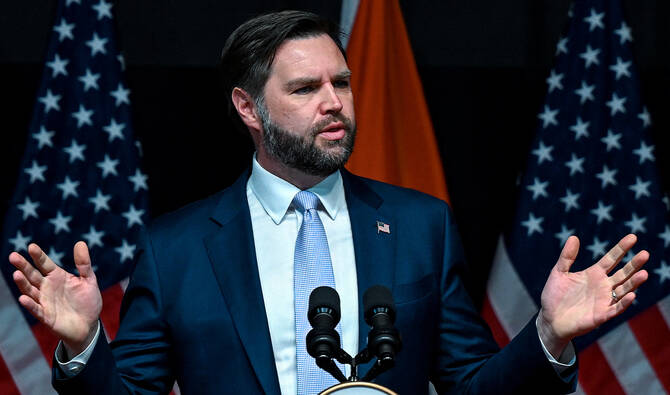
US Vice President JD Vance delivers remarks at the Rajasthan International Center in Jaipur, India, on April 22, 2025. (REUTERS/File)
Short Url
Updated 02 May 2025
Follow

US vice president hopes Kashmir attack won’t spark wider conflict

  • JD Vance says Pakistan should deal with militants that ‘sometimes operate’ in its territory
  • US has expressed support for India after the April 22 attack without directly blaming Pakistan

WASHINGTON: US Vice President JD Vance said on Thursday Washington hoped Pakistan would cooperate with India to hunt down Pakistan-based militants, and that India’s response to the recent Islamist militant attack in India-administered Kashmir does not lead to a broader regional conflict.
“Our hope here is that India responds to this terrorist attack in a way that doesn’t lead to a broader regional conflict,” Vance said in an interview on Fox News’ “Special Report with Bret Baier” show.
“And we hope, frankly, that Pakistan, to the extent that they’re responsible, cooperates with India to make sure that the terrorists sometimes operating in their territory are hunted down and dealt with,” Vance added.
Vance’s comments are the closest the US government has come since the April 22 attack — in which 26 people were killed — to potentially linking Pakistan to extremism in India.
Top US leaders, including President Donald Trump, have condemned the attack, calling it “terror” and “unconscionable,” while expressing support for India without directly blaming Pakistan.
India is an important US partner as Washington aims to counter China’s rising influence. Pakistan remains Washington’s ally even as its importance diminished after the 2021 US withdrawal from neighboring Afghanistan.
In recent days, Washington urged India and Pakistan to work with each other to de-escalate tensions and arrive at a “responsible solution.”
India has blamed Pakistan for the attack. Islamabad denies responsibility and is calling for a neutral probe.
The US State Department has said it was in touch with the nuclear-armed Asian neighbors at multiple levels and Secretary of State Marco Rubio held calls on Wednesday with Indian Foreign Minister Subrahmanyam Jaishankar and Pakistani Prime Minister Shehbaz Sharif.
Hindu nationalist Indian Prime Minister Narendra Modi vowed to punish those responsible and Jaishankar has told Rubio that the perpetrators should be brought to justice. Pakistan says military action by India was imminent.
Muslim-majority Kashmir is claimed in full by both Hindu-majority India and Islamic Pakistan, with each controlling only part of it and having fought wars over it.
After the attack, India suspended a treaty regulating water-sharing, and both countries closed airspace to each other’s airlines. They also exchanged fire across their border.


Pakistan assembly speaker, Indian FM shake hands in first high-level contact since May

Updated 5 sec ago
Follow

Pakistan assembly speaker, Indian FM shake hands in first high-level contact since May

  • Tensions persist between India and Pakistan after they engaged in brief military conflict in May this year
  • Pakistan assembly speaker, Indian FM both attend former Bangladesh PM Khaleda Zia’s funeral in Dhaka

ISLAMABAD: Pakistan’s National Assembly Speaker Sardar Ayaz Sadiq and India’s External Affairs Minister Subrahmanyam Jaishankar shook hands in Dhaka on Wednesday, establishing the first high-level contact between officials of both countries since their brief military conflict in May. 

Sadiq and Jaishankar arrived in Dhaka to attend the funeral of Bangladesh’s first female prime minister Khaleda Zia, who passed away earlier this week at the age of 80 after prolonged illness. Diplomats from several countries attended Zia’s funeral on Wednesday, which drew large crowds to the Bangladeshi capital. 

Tensions persist between nuclear-armed neighbors India and Pakistan, who engaged in a four-day military conflict in May this year. The conflict was triggered when India blamed Pakistan for supporting a militant attack in Indian-administered Kashmir in April that killed over 20 tourists. Pakistan denied involvement and called for a transparent probe into the incident. 

“Sardar Ayaz Sadiq, Speaker of the National Assembly of Pakistan, exchanges greetings with Indian External Affairs Minister S. Jaishankar in Dhaka on Wednesday ahead of the funeral program of former Bangladesh Prime Minister Khaleda Zia,” the official X account of Bangladesh’s Chief Adviser Muhammad Younus wrote. 

https://x.com/ChiefAdviserGoB/status/2006340330585833665

Sadiq also met Zia’s son Tarique Rahman, the acting chairperson of the Bangladesh Nationalist Party (BNP), to convey condolences over his mother’s demise from the people and government of Pakistan, the Pakistan High Commission in Bangladesh said.

“During the meeting, he recalled Begum Zia’s remarkable political leadership and noted her pivotal role in promoting historical affinities, mutual respect and cooperation between our two nations,” the high commission wrote on social media platform X.

https://x.com/PakinBangladesh/status/2006313161088204976

Senior officials from both India and Pakistan have refrained from shaking hands or exchanging pleasantries since the May conflict, as tensions persist between the two sides. 

The May conflict saw both countries exchange artillery fire, pound each other with fighter jets and trade missiles and drone strikes before Washington brokered a ceasefire on May 10. 

Sadiq is expected to meet senior officials of Bangladesh’s interim government during his trip, according to an earlier statement issued by his office.

Prime Minister Shehbaz Sharif had described Zia as a “committed friend of Pakistan” on Tuesday, praising her role in Bangladesh’s political life and expressing solidarity with the Bangladeshi people during what he called a difficult moment.

Zia, who served three terms as prime minister, led the BNP and remained a central figure in Bangladeshi politics despite years of ill health and imprisonment under the government of her longtime rival, Sheikh Hasina. She was released last year following Hasina’s ouster after a violent uprising.

Pakistan and Bangladesh were part of the same country until Bangladesh’s secession following a bloody civil war in 1971, an event that has long cast a shadow over bilateral ties. Relations remained largely strained for decades, shaped by historical grievances and political mistrust.

However, Islamabad enjoyed comparatively warmer ties with Dhaka during Zia’s tenure than under Hasina.

Engagement between Islamabad and Dhaka has increased since Hasina’s removal and the formation of an interim administration, with both sides signaling interest in improving political, diplomatic, economic and security ties.