

Pakistan seeks Saudi, UAE and Kuwaiti mediation to de-escalate tensions with India

Pakistan Prime Minister Shehbaz Sharif meets Saudi Ambassador Nawaf bin Said Al-Malki at the Prime Minister Office in Islamabad on May 2, 2025. (Photo courtesy: Handout/PMO)
Short Url
Updated 03 May 2025
Follow

Pakistan seeks Saudi, UAE and Kuwaiti mediation to de-escalate tensions with India

  • PM Sharif says it’s inconceivable Pakistan will jeopardize its achievements by backing militant attacks
  • He maintains that his country will never take any action that could ‘imperil regional peace and security’

ISLAMABAD: Prime Minister Shehbaz Sharif on Friday sought the assistance of Saudi Arabia, the United Arab Emirates (UAE) and Kuwait in de-escalating tensions with India over an attack that killed 26 tourists in the disputed Kashmir region, his office said.
New Delhi has accused Pakistan of backing one of the deadliest attacks in Indian-administered Kashmir in decades, though Islamabad has denied the allegation and suggested a neutral and credible international probe. The two nuclear-armed neighbors have also exchanged gunfire, traded diplomatic barbs, expelled each other’s citizens and closed their border as part of a series of punitive and reciprocal measures.
Sharif met with Saudi Ambassador to Pakistan Nawaf bin Said Al-Malki, UAE Ambassador Hamad Obaid Ibrahim Salem Al-Zaabi and Kuwaiti Ambassador Nasser Abdulrahman Jasser during the day amid growing concerns of a wider regional conflict following potential Indian actions in response to the Pahalgam attack.
Sharif shared Pakistan’s perspective on recent developments in South Asia following the Kashmir incident, highlighting that his country has made significant sacrifices in its counter-terrorism efforts over the years, not only to safeguard itself but also to contribute to global security. He also rejected the “baseless Indian accusations” linking Islamabad to the April 22 attack.
“The prime minister said it was inconceivable for Pakistan to act in an irresponsible manner to jeopardize its achievements and derail the country from the path of economic progress,” the PM Office said in a statement. “He urged brotherly countries, including Saudi Arabia, to impress upon India to de-escalate and defuse tensions. He reaffirmed Pakistan’s desire for peace and stability in South Asia.”
During his conversation with the Middle Eastern envoys, the Pakistan premier reiterated his call for a transparent and neutral international investigation into the April 22 incident.
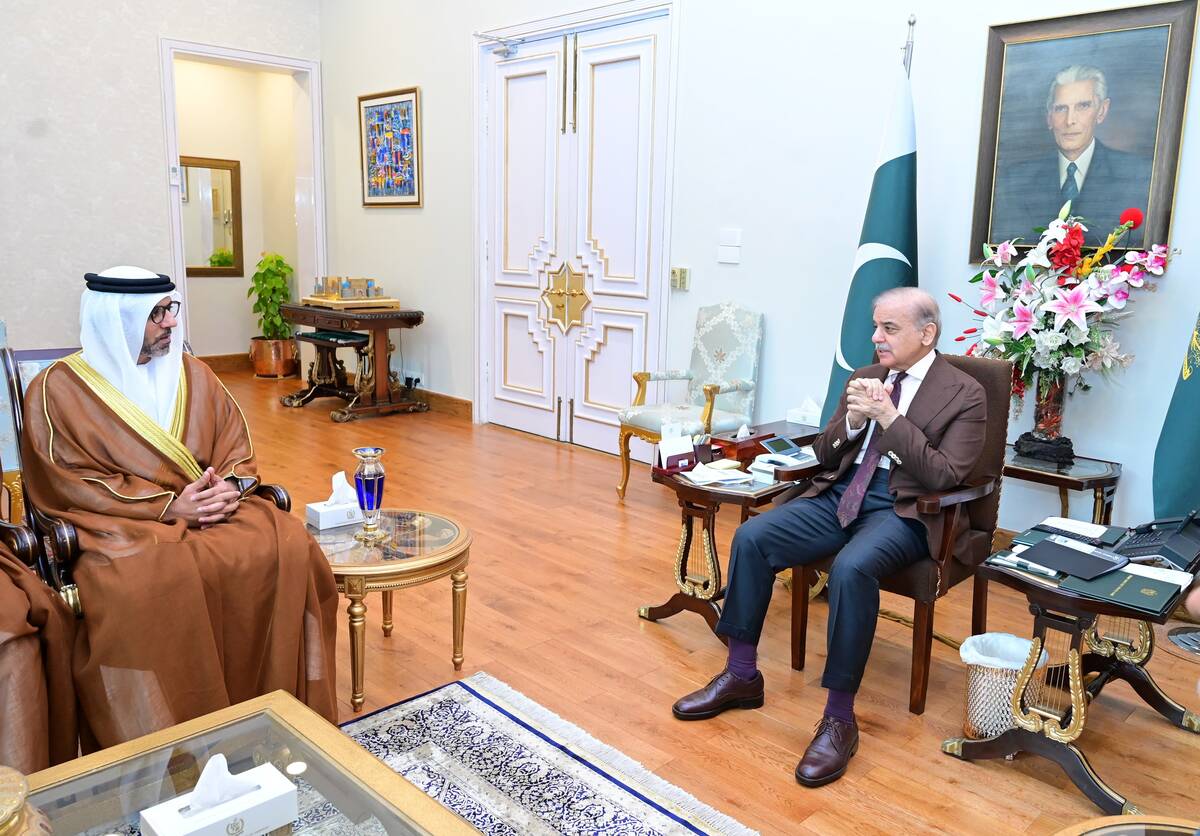


Pakistan Prime Minister Shehbaz Sharif meets UAE Ambassador Hamad Obaid Ibrahim Salem Al-Zaabi at the Prime Minister Office in Islamabad on May 2, 2025. (Photo courtesy: Handout/PMO)

He highlighted how Pakistan has been the biggest victim of militant violence and suffered 90,000 casualties with over $152 billion in economic losses.
Sharif said Pakistan would never take any action that could “imperil regional peace and security,” highlighting that his government was focused on consolidating the hard-earned economic gains of the past fifteen months that were achieved with the support of friendly countries like Saudi Arabia and the UAE.


PM Sharif meets Kuwaiti ambassador, Nasser Abdulrahman Jasser, at the Prime Minister Office in Islamabad on May 2, 2025. (Photo courtesy: Handout/PMO)

The Saudi, UAE and Kuwaiti ambassadors thanked Sharif for sharing Pakistan’s stance and reaffirmed their support for maintaining regional peace and security, the PM Office added.
Since last week, top Pakistani leaders have also reached out to senior officials in China, Iran, Egypt and other countries regarding the recent South Asian developments.
The disputed Himalayan region of Kashmir is split between India and Pakistan and claimed by both in its entirety. The two countries have fought two wars and one limited conflict over the territory.
The United Nations has urged the two arch-rivals to talk to each other, while China, which shares a border with both India and Pakistan, and other countries have called on both sides to “exercise restraint.”



Imran Khan not a ‘national security threat,’ ex-PM’s party responds to Pakistan military

Updated 4 sec ago
Follow

Imran Khan not a ‘national security threat,’ ex-PM’s party responds to Pakistan military

  • Pakistan’s military spokesperson on Friday described Khan’s anti-army narrative as a “national security threat”
  • PTI Chairman Gohar Ali Khan says words used by military spokesperson for Khan were “not appropriate”

ISLAMABAD: Former prime minister Imran Khan’s Pakistan Tehreek-e-Insaf (PTI) party on Saturday responded to allegations by Pakistan military spokesperson Lt. Gen. Ahmed Sharif Chaudhry from a day earlier, saying that he was not a “national security threat.”

Chaudhry, who heads the military’s media wing as director general of the Inter-Services Public Relations (ISPR), spoke to journalists on Friday, in which he referred to Khan as a “mentally ill” person several times during the press interaction. Chaudhry described Khan’s anti-army narrative as a “national security threat.”

The military spokesperson was responding to Khan’s social media post this week in which he accused Chief of Defense Forces Field Marshal Asim Munir of being responsible for “the complete collapse of the constitution and rule of law in Pakistan.” 

“The people of Pakistan stand with Imran Khan, they stand with PTI,” the party’s secretary-general, Salman Akram Raja, told reporters during a news conference. 

“Imran Khan is not a national security threat. Imran Khan has kept the people of this country united.”

Raja said there were several narratives in the country, including those that created tensions along ethnic and sectarian lines, but Khan had rejected all of them and stood with one that the people of Pakistan supported. 

PTI Chairman Gohar Ali Khan, flanked by Raja, criticized the military spokesperson as well, saying his press talk on Thursday had “severely disappointed” him. 

“The words that were used [by the military spokesperson] were not appropriate,” Gohar said. “Those words were wrong.”

NATURAL OUTCOME’

Speaking to reporters earlier on Saturday, Pakistan’s Defense Minister Khawaja Asif defended the military spokesperson’s remarks against Khan.

“When this kind of language is used for individuals as well as for institutions, then a reaction is a natural outcome,” he said. 

“The same thing is happening on the Twitter accounts being run in his [Khan’s] name. If the DG ISPR has given any reaction to it, then I believe it was a very measured reaction.”

Khan, who was ousted after a parliamentary vote of confidence in April 2022, blames the country’s powerful military for removing him from power by colluding with his political opponents. Both deny the allegations. 

The former prime minister, who has been in prison since August 2023 on a slew of charges he says are politically motivated, also alleges his party was denied victory by the army and his political rivals in the 2024 general election through rigging. 

The army and the government both deny his allegations.