

Pakistan’s Sindh orders inquiry after clashes at Imran Khan party rally in Karachi

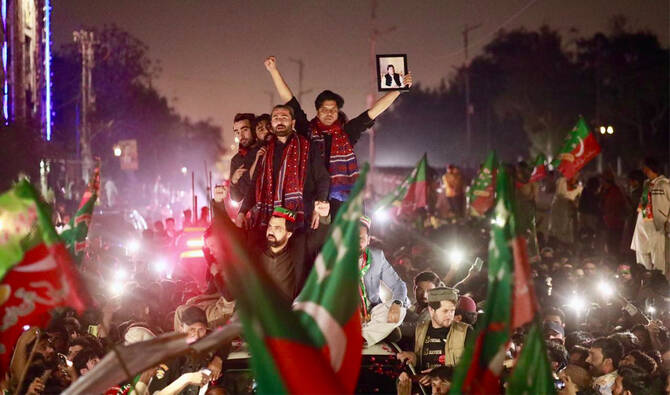
Supporters of former Prime Minister Imran Khan holds rally in Karachi, Pakistan, on January 11, 2026. (PTI)
Short Url
Updated 12 January 2026
Follow

Pakistan’s Sindh orders inquiry after clashes at Imran Khan party rally in Karachi

  • Khan’s PTI party accuses police of shelling to disperse its protesters, placing hurdles to hinder rally in Karachi 
  • Sindh Local Government Minister Nasir Hussain Shah vows all those found guilty in the inquiry will be punished

ISLAMABAD: The government in Pakistan’s southern Sindh province has ordered an inquiry into clashes that took place between police and supporters of former prime minister Imran Khan’s Pakistan Tehreek-e-Insaf (PTI) party in Karachi on Sunday, as it held a rally to demand his release from prison. 

The provincial government had granted PTI permission to hold a public gathering at Karachi’s Bagh-i-Jinnah Park and had also welcomed Sohail Afridi, the chief minister of Khyber Pakhtunkhwa province where Khan’s party is in power, when he arrived in the city last week. However, the PTI cited a delay in receiving a permit and announced a last-minute change to a gate of Mazar-i-Quaid, the mausoleum of the nation’s founder. 

Despite the change, PTI supporters congregated at the originally advertised venue. PTI officials claimed the party faced obstacles in reaching the venue and that its supporters were met with police intervention. Footage of police officers arresting Khan supporters in Karachi were shared widely on social media platforms. 

“A complete inquiry is being held and whoever is found guilty in this, he will be punished,” Sindh Local Government Minister Nasir Hussain Shah said while speaking to a local news channel on Sunday. 

Shah said the PTI had sought permission to hold its rally at Bagh-i-Jinnah in Karachi from the Sindh government, even though the venue’s administration falls under the federal government’s jurisdiction. 

He said problems arose when the no objection certificate to hold the rally was delayed for a few hours and the party announced it would hold the rally “on the road.”

The rally took place amid rising tensions between the PTI and Pakistan’s military and government. Khan, who remains in jail on a slew of charges he says are politically motivated since August 2023, blames the military and the government for colluding to keep him away from power by rigging the 2024 general election and implicating him in false cases. Both deny his allegations. 

Since Khan was ousted in a parliamentary vote in April 2022, the PTI has complained of a widespread state crackdown, while Khan and his senior party colleagues have been embroiled in dozens of legal cases.


Pakistan’s Mahnoor Omer named among TIME’s ‘Women of the Year’ for 2026

Updated 01 March 2026
Follow

Pakistan’s Mahnoor Omer named among TIME’s ‘Women of the Year’ for 2026

  • Omer moved a Pakistani court against the so-called ‘period tax’ in Sept. 2025 which has since sparked a national debate
  • Taxes on sanitary pads in Pakistan can add up to 40 percent to retail price, UNICEF says only around 12 percent women use such products

ISLAMABAD: Pakistani women’s rights activist Mahnoor Omer, who fought against taxes on menstrual products, has been named among the TIME magazine’s ‘Women of the Year’ for 2026.

Omer’s efforts have been recognized alongside 16 activists, artists, athletes and businesswomen in the TIME’s Women of the Year 2026 list, including Olympic gold medalist Sydney McLaughlin-Levrone and Oscar-nominated filmmaker Chloe Zhao.

Dissatisfied with the efforts to educate Pakistani girls about sexual violence, Omer founded the Noor Foundation at the age of 14 and held her own workshops with village girls about everything from climate change to menstruation, according to the TIME magazine.

Two years later, a conversation with a domestic worker about the price of pads made her realize that not everyone could afford these essentials. She moved a court against the so-called “period tax” in Sept. 2025 and the case has sparked a national debate on the subject, considered a taboo by many in Pakistan, since its first hearing late last year.

“A decade and one law degree after her interest in activism was sparked, Omer, now 25, is putting her passion and expertise to work in the name of gender equity,” TIME wrote about Omer on its website.

Taxes imposed on sanitary products in Pakistan can add up to 40 percent to the retail price. UNICEF estimates just 12 percent of women in the country use commercially produced pads or tampons. The alternative, using cloth, risks health impacts including rashes and infections, and can make it impossible for girls to attend school while menstruating.

Omer’s suit, which awaits the government response, has sparked a national discussion. She says she spoke about menstruation to her father and male cousins, who thanked her for standing up for their daughters.
The 25-year-old, who is currently enrolled in a master’s degree in gender, peace, and security at the London School of Economics, sees this case as just the first of many.

“I’m not free until every woman is free,” she was quoted as saying by TIME. “I want to leave no stones unturned in terms of what I can do with the next few decades, as a lawyer for the women in my country and gender minorities in general.”