

Prince Harry ‘devastated’ after losing legal fight with UK government over police protection

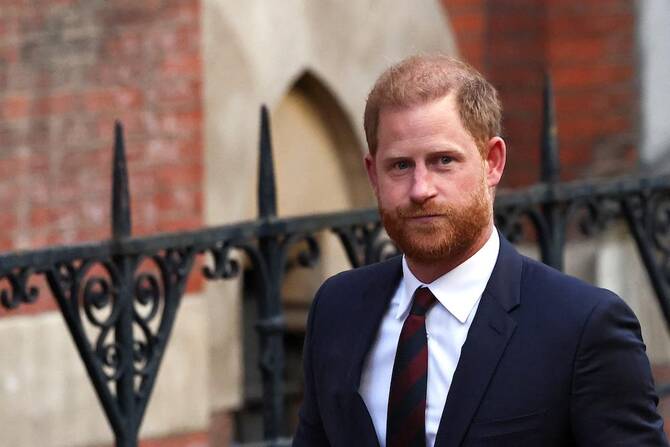
Prince Harry’s fraught ties with his family have worsened after various public allegations he and Meghan made against the royals. (AFP)
Short Url
Updated 02 May 2025
Follow

Prince Harry ‘devastated’ after losing legal fight with UK government over police protection

  • Prince Harry says security concerns have hampered his ability to visit the UK and bring his family with him
  • Harry’s fraught ties with his family have worsened after various public allegations he and Meghan made against the royals

LONDON: Prince Harry said he was “devastated” after he lost his legal challenge on Friday to Britain changing his security arrangements after he stepped down from royal duties, telling the BBC he could not safely bring his family to Britain.

Harry, King Charles’ younger son who has moved to the United States with his wife Meghan, had sought to overturn a decision by the Home Office, the ministry responsible for policing.

A specialist body decided in February 2020 that Harry would not automatically receive personal police protection while in Britain, which London’s High Court last year ruled was lawful.

On Friday, that decision was upheld by three Court of Appeal judges who said that, while Harry understandably felt aggrieved, that did not amount to an error of law.

“Obviously, pretty gutted about the decision,” Harry, who now lives in California with Meghan and their two children, told the BBC.

“We thought it was going to go our way, but it certainly has proven that there was no way to win this through the courts.”

He added: “My status hasn’t changed — it can’t change. I am who I am, I am part of what I am part of, I can’t escape that.”

Judge Geoffrey Vos said in the court’s ruling that Harry’s lawyer had made “powerful and moving arguments” about the impact of the security change.

“It was plain that the Duke of Sussex felt badly treated by the system, but ... I could not say that the Duke’s sense of grievance translated into a legal argument for the challenge to RAVEC’s decision,” he told the court.

Harry, 40, attended two days of hearings in April, when his lawyer told the court that he had been singled out for different, unjustified and inferior treatment.

LIFE AT STAKE
His lawyer Shaheed Fatima said Harry’s “life was stake,” citing that Al-Qaeda had recently called for him to be murdered, and he and Meghan had been involved in “a dangerous car pursuit with paparazzi in New York City” in 2023.

However, the government’s legal team said the bespoke arrangement for the prince had positive advantages from a security assessment point of view.

Harry, along with other senior royals, had received full publicly-funded security protection provided by the state before his high-profile exit from official royal life in March 2020.

The Executive Committee for the Protection of Royalty and Public Figures, known as RAVEC, then decided Harry would no longer receive the same level of protection, a decision Vos said was “an understandable and perhaps predictable reaction” to him stepping down from royal duties and moving abroad.

Harry, who has been involved in a number of court cases with tabloid papers, told the Daily Telegraph newspaper after the April hearings that this case “mattered the most” and evidence heard in secret had confirmed his “worst fears.”

The prince has often spoken out about his concerns, referring back to the death of his mother, Princess Diana, who was killed when her chauffeur-driven car crashed as it sped away from chasing paparazzi in Paris in 1997.

Next week, Harry’s legal team will be back at the High Court as part of the lawsuit he has brought with singer Elton John and other against Associated Newspapers, publisher of the Daily Mail and MailOnline, over alleged widespread unlawful activities.

In January, he was paid substantial damages by Rupert Murdoch’s British newspaper group after it settled a claim he had brought against its titles and admitted it had intruded into his private life. 

Journalists in Bangladesh demand protection amid rising attacks

Updated 5 sec ago
Follow

Journalists in Bangladesh demand protection amid rising attacks

  • Media industry in the South Asian country is being systematically targeted
  • Interim government blamed for failing to adequately respond to the incidents
DHAKA: Journalists, editors and owners of media outlets in Bangladesh on Saturday demanded that authorities protect them following recent attacks on two leading national dailies by mobs.
They said the media industry in the South Asian country is being systematically targeted in the interim government headed by Nobel Peace Prize laureate Muhammad Yunus. They said the administration failed to prevent attacks on the Daily Star, the country’s leading English-language daily, and the Prothom Alo, the largest Bengali-language newspaper, both based in Dhaka, the capital.
In December, angry mobs stormed the offices of the two newspapers and set fire to the buildings, trapping journalists and other staff inside, shortly after the death of a prominent Islamist activist.
The newspaper authorities blamed the authorities under the interim government for failing to adequately respond to the incidents despite repeated requests for help to disperse the mobs. Hours later, the trapped journalists who took shelter on the roof of the Daily Star newspaper were rescued. The buildings were looted. A leader of the Editors Council, an independent body of newspaper editors, was manhandled by the attackers when he arrived at the scene.
On the same day, liberal cultural centers were also attacked in Dhaka.
It was not clear why the protesters attacked the newspapers, whose editors are known to be closely connected with Yunus. Protests had been organized in recent months outside the offices of the dailies by Islamists who accused the newspapers of links with India.
On Saturday, the Editors Council and the Newspapers Owners Association of Bangladesh jointly organized a conference where editors, journalist union leaders and journalists from across the country demanded that the authorities uphold the free press amid rising tensions ahead of elections in February.
Nurul Kabir, President of the Editors Council, said attempts to silence media and democratic institutions reflect a dangerous pattern.
Kabir, also the editor of the English-language New Age daily, said unity among journalists should be upheld to fight such a trend.
“Those who want to suppress institutions that act as vehicles of democratic aspirations are doing so through laws, force and intimidation,” he said.
After the attacks on the two dailies in December, an expert of the United Nations said that mob attacks on leading media outlets and cultural centers in Bangladesh were deeply alarming and must be investigated promptly and effectively.
“The weaponization of public anger against journalists and artists is dangerous at any time, and especially now as the country prepares for elections. It could have a chilling effect on media freedom, minority voices and dissenting views with serious consequences for democracy,” Irene Khan said in a statement.
Yunus came to power after former Prime Minister Sheikh Hasina fled the country amid a mass uprising in August, 2024. Yunus had promised stability in the country, but global human rights groups including Human Rights Watch and Amnesty International have blamed the government for its failure to uphold human and other civil rights. The Yunus-led regime has also been blamed for the rise of the radicals and Islamists.
Dozens of journalists are facing murder charges linked to the uprising on the grounds that they encouraged the government of Hasina to use lethal weapons against the protesters. Several journalists who are known to have close links with Hasina have been arrested and jailed under Yunus.