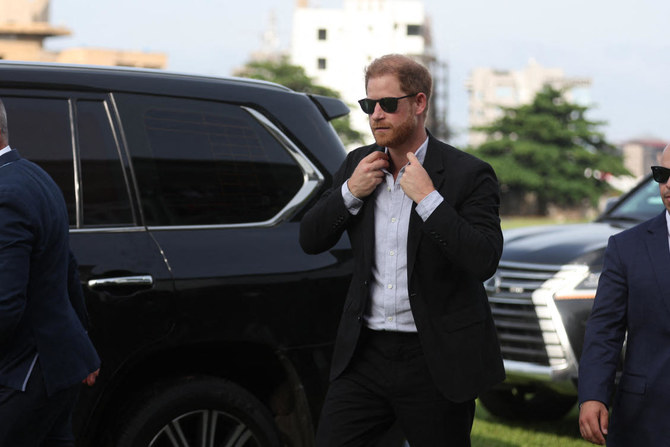
LONDON: Prince Harry has been given permission to appeal the British government’s rejection to provide him with publicly funded police protection in the UK
The Court of Appeal gave the Duke of Sussex the go-ahead to challenge a ruling earlier this year in the High Court. The permission was granted in May but only reported Thursday.
Judge Peter Lane ruled in February that a government panel’s decision to provide “bespoke” security on an as-needed basis after Harry quit as a working member of the royal family was not unlawful, irrational or unjustified.
“Insofar as the case-by-case approach may otherwise have caused difficulties, they have not been shown to be such as to overcome the high hurdle so as to render the decision-making irrational,” Lane wrote.
The long-running fight began more than four years ago when Harry first challenged the panel’s decision, arguing that he and his family need an armed security detail because of hostility directed toward him and his wife Meghan, Duchess of Sussex, on social media and relentless hounding by the news media.
Harry, 39, the younger son of King Charles III, has bucked royal family convention to challenge the government in court and sue the tabloid press.
He won a big victory in December after a judge found phone hacking at Mirror Group Newspapers was “widespread and habitual.” He has two similar cases remaining against the publishers of The Sun and Daily Mail.
The security case appeared to be dead after the High Court in April rejected his first request to appeal Lane’s decision. But Justice David Bean on the Court of Appeal said on May 23 that he could challenge the lower court decision.

Prince Harry wins right to appeal rejection of publicly funded security detail in UK
Short Url
https://arab.news/zexmf
Prince Harry wins right to appeal rejection of publicly funded security detail in UK
- The Court of Appeal gave the Duke of Sussex the go-ahead to challenge a ruling earlier this year in the High Court
US NATO envoy says allies must ‘pull weight’ after Czech defense cut
PRAGUE, March 12 : The United States’ ambassador to NATO said on Thursday that all allies must “pull their weight,” after Czech lawmakers approved a 2026 budget that cuts defense outlays.
Czech Prime Minister Andrej Babis’ government, in power since December, pushed a revamped budget through the lower house on Wednesday evening which cut the defense ministry’s allocation versus a previous proposal to 154.8 billion crowns ($7.31 billion), or 1.73 percent of gross domestic product.
That is below a NATO target of 2 percent of GDP already expected before alliance members pledged last year in the Hague to raise defense spending to 3.5 percent of GDP plus 1.5 percent on other defense-relevant investments over the next decade.
The Czech Finance Ministry says total defense spending in the budget will reach 2.07 percent of GDP, but the country’s budget watchdog has warned that includes money earmarked elsewhere, like for the transport ministry for road projects, that may not be recognized by NATO.
“All Allies must pull their weight and honor The Hague Defense Commitment,” US Ambassador to NATO Matthew Whitaker said on X on Thursday with a picture of a news headline on the Czech budget approval.
“These numbers are not arbitrary. They are about meeting the moment — and the moment requires 5 percent as the standard. No excuses, no opt-outs.”
European NATO countries are under pressure to raise defense spending amid the Ukraine-Russia war and at US President Donald Trump’s urging.
Babis, whose populist ANO party won elections last year, said in February the country was “certainly not” on the path to raising core defense spending to the 3.5 percent target, saying there was a different focus, like on health care.
The budget watchdog on Thursday reiterated “strong doubts” that some spending deemed defense in this year’s budget would meet NATO’s definition.
President Petr Pavel, a former NATO official, has also said defense cuts risked a loss of trust from allies — but has signalled he would not veto the budget.
US Ambassador to Prague Nicholas Merrick said last week the Czech Republic may slip to the bottom of NATO’s defense-spending ranks.
Czech Prime Minister Andrej Babis’ government, in power since December, pushed a revamped budget through the lower house on Wednesday evening which cut the defense ministry’s allocation versus a previous proposal to 154.8 billion crowns ($7.31 billion), or 1.73 percent of gross domestic product.
That is below a NATO target of 2 percent of GDP already expected before alliance members pledged last year in the Hague to raise defense spending to 3.5 percent of GDP plus 1.5 percent on other defense-relevant investments over the next decade.
The Czech Finance Ministry says total defense spending in the budget will reach 2.07 percent of GDP, but the country’s budget watchdog has warned that includes money earmarked elsewhere, like for the transport ministry for road projects, that may not be recognized by NATO.
“All Allies must pull their weight and honor The Hague Defense Commitment,” US Ambassador to NATO Matthew Whitaker said on X on Thursday with a picture of a news headline on the Czech budget approval.
“These numbers are not arbitrary. They are about meeting the moment — and the moment requires 5 percent as the standard. No excuses, no opt-outs.”
European NATO countries are under pressure to raise defense spending amid the Ukraine-Russia war and at US President Donald Trump’s urging.
Babis, whose populist ANO party won elections last year, said in February the country was “certainly not” on the path to raising core defense spending to the 3.5 percent target, saying there was a different focus, like on health care.
The budget watchdog on Thursday reiterated “strong doubts” that some spending deemed defense in this year’s budget would meet NATO’s definition.
President Petr Pavel, a former NATO official, has also said defense cuts risked a loss of trust from allies — but has signalled he would not veto the budget.
US Ambassador to Prague Nicholas Merrick said last week the Czech Republic may slip to the bottom of NATO’s defense-spending ranks.
© 2026 SAUDI RESEARCH & PUBLISHING COMPANY, All Rights Reserved And subject to Terms of Use Agreement.


