

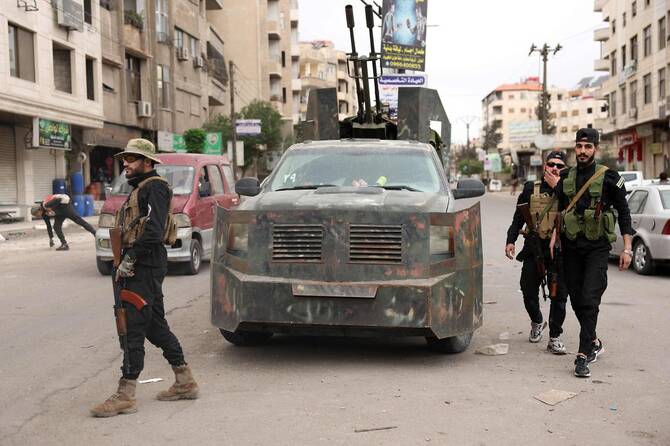
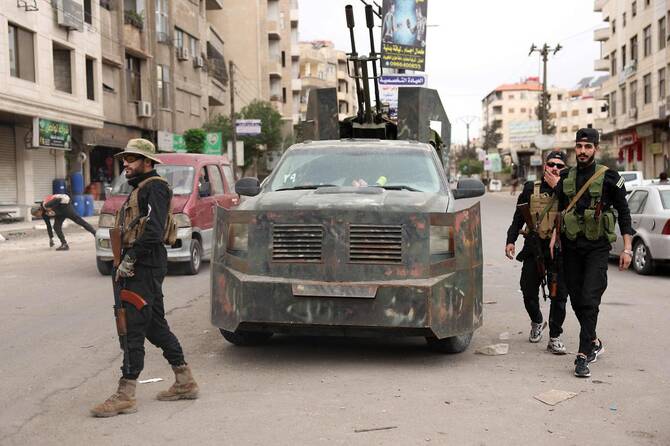
DAMASCUS: Syrian Druze spiritual leader Sheikh Hikmat Al-Hijri on Thursday condemned what he called a “genocidal campaign” against his community after two days of sectarian clashes left 101 people dead.
Israeli Defense Minister Israel Katz warned his country would respond “with significant force” if Syria’s new authorities fail to protect the Druze minority.
The violence poses a serious challenge to the new Syrian authorities who ousted longtime ruler Bashar Assad in December.
It comes after a wave of massacres in March in Syria’s Alawite heartland on the Mediterranean coast in which security forces and allied groups killed more than 1,700 civilians, mostly Alawites, according to rights groups.
It was the worst bloodshed since the ouster of Assad, who is from the minority community.
The government (should) protect its people
Sheikh Hikmat Al-Hijri, Druze spiritual leader
Hijri in a statement on Thursday denounced the latest violence in Jaramana and Sahnaya near Damascus as an “unjustifiable genocidal campaign” against the Druze.
He called for immediate intervention by “international forces to maintain peace and prevent the continuation of these crimes.”
Israel has ramped up its support for Syria’s Druze, with Foreign Minister Gideon Saar on Thursday urging the international community to “fulfil its role in protecting the minorities in Syria — especially the Druze — from the regime and its gangs of terror.”
In a later statement, Katz said: “Should the attacks on the Druze resume and the Syrian regime fail to prevent them, Israel will respond with significant force.”
The fighting involved security forces, allied fighters, and local Druze groups. It resulted in the deaths of 30 government loyalists, 21 Druze fighters, and 10 civilians, including Sahnaya’s former mayor, Husam Warwar.
In the southern province of Sweida, which is the heartland of the Druze minority, 40 Druze gunmen were killed, 35 of them in an ambush on the Sweida-Damascus road on Wednesday.
Blasphemous audio
The violence was sparked by the circulation of an audio recording attributed to a Druze citizen and deemed blasphemous.
AFP was unable to confirm the recording’s authenticity.
Truces was reached in Jaramana on Tuesday and in Sahnaya on Wednesday.
The government announced it was deploying forces in Sahnaya to ensure security, and accused “outlaw groups” of instigating the clashes.
However, Hijri said he no longer trusts “an entity pretending to be a government... because the government does not kill its people through its extremist militias... and then claim they were unruly elements after the massacres.”
Should the attacks on the Druze resume and the Syrian regime fail to prevent them, Israel will respond with significant force
Israeli Defense Minister Israel Katz
“The government (should) protect its people,” he said.
Syria’s new authorities, who have roots in the Al-Qaeda jihadist network, have vowed inclusive rule in the multi-confessional, multi-ethnic country, but must also contend with pressures from radical Islamists.
On Wednesday, a foreign ministry statement vowed to “protect all components” of Syrian society, including the Druze, and rejected “foreign interference.”
Israeli air strikes
Foreign Minister Asaad Al-Shaibani on Thursday reiterated Syria’s rejection of demands for international intervention, posting on X that “national unity is the solid foundation for any process of stability or revival.”
“Any call for external intervention, under any pretext or slogan, only leads to further deterioration and division,” he added.
Israel sees the new forces in Syria as jihadists and carried out strikes near Damascus on Wednesday. Israel said its forces were ordered to hit Syrian government targets “should the violence against Druze communities continue.”
“A stern message was conveyed to the Syrian regime — Israel expects them to act to prevent harm to the Druze community,” a statement from Israeli Prime Minister Benjamin Netanyahu’s office said.
Israel has attacked hundreds of military sites in Syria since Assad’s overthrow.
It has also sent troops into the demilitarised buffer zone that used to separate Israeli and Syrian forces on the Golan Heights and voiced support for Syria’s Druze.
Israel’s military said Thursday two injured Syrian Druze had been evacuated to northern Israel for treatment.
A United Nations statement urged “all parties to exercise maximum restraint” and “uphold their obligations under international humanitarian and human rights law.”


