

Measles jumps borders in North America with outbreaks in Canada, Mexico and US

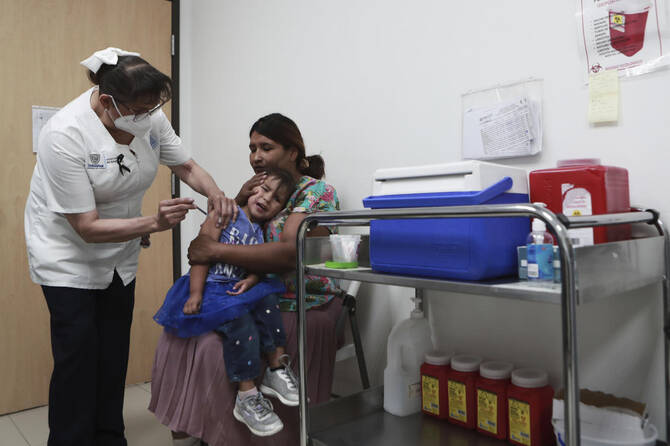
A health worker gives a child a measles vaccine at the health center in Ciudad Juarez, Chihuahua state, Mexico, Apr. 30, 2025. (AP)
Short Url
Updated 01 May 2025
Follow

Measles jumps borders in North America with outbreaks in Canada, Mexico and US

  • North America’s three biggest measles outbreaks continue to balloon, with more than 2,500 known cases
  • Mexican and US officials also say the genetic strains of measles spreading in Canada match the other large outbreaks

NEW MEXICO: Dr. Hector Ocaranza knew El Paso would see measles the moment it began spreading in West Texas and eastern New Mexico.
Highways connect his border city with the epicenter of Texas’ massive outbreak, which is up to 663 cases. They’re the same roads used by thousands of families and commercial truckers who cross into Mexico and back each day.
“Diseases know no borders,” said Ocaranza, El Paso’s top public health doctor, “so as people are mobile, they’re going to be coming and receiving medical attention in El Paso but they may be living in Juarez.” It took a couple of months, but El Paso now has the highest measles case count in the state outside of West Texas with 38. Neighboring Ciudad Juarez has 14 cases as of Monday.
North America’s three biggest measles outbreaks continue to balloon, with more than 2,500 known cases; three people have died in the US and one in Mexico. It started in the fall in Ontario, Canada; then took off in late January in Texas and New Mexico; and has rapidly spread in Chihuahua state, which is up to 786 cases since mid-February.
These outbreaks are in areas with a notable population of certain Mennonite Christian communities who trace their migration over generations from Canada to Mexico to Seminole, Texas. Chihuahua health officials trace their first case to an 8-year-old Mennonite child who visited family in Seminole, got sick and spread the virus at school. And Ontario officials say their outbreak started at a large gathering in New Brunswick involving Mennonite communities.
Mexican and US officials also say the genetic strains of measles spreading in Canada match the other large outbreaks.
“This virus was imported, traveling country to country,” said Leticia Ruíz, director of prevention and disease control in Chihuahua.
North and South American countries have struggled to maintain the 95 percent measles vaccination rate needed to prevent outbreaks, said Dr. Jarbas Barbosa, director of the Pan American Health Organization. And a recent World Health Organization report said measles activity in the Americas region is up elevenfold from the same time last year and that the risk level is “high” compared to the rest of the world’s “moderate” level.
Measles cases have been confirmed in six of the region’s countries — Argentina, Belize, Brazil, Canada, the United States and Mexico — and investigating the disease’s spread is labor-intensive and pricey. The response to each measles case in the US costs an estimated $30,000 to $50,000, according to Dr. David Sugerman, a US Centers for Disease Control and Prevention scientist.
Measles at the US-Mexico border

The cases in Ciudad Juarez have no direct connection to the Mennonite settlement in Chihuahua, said Rogelio Covarrubias, a health official in the border city. The first measles case in El Paso was in a child at Fort Bliss, Ocaranza said.
More than half of El Paso’s cases are in adults, which is unusually high, and three people have been hospitalized. The health department is holding vaccination clinics in malls and parks and says hundreds have gotten a shot. The vaccines are free — no questions asked, no matter which side of the border you live on.
Communication about measles between the two health departments is “informal” but “very good,” Ocaranza said. Covarrubias said his team was alerted last week to a case of someone who became sick in El Paso and returned home to Juarez.
“There is constant concern in Ciudad Juarez … because we have travelers that pass through from across the world,” Covarrubias said. “With a possible case of measles without taking precautions, many, many people could be infected.”
Measles at the US-Canada border
Michigan health officials said the outbreak of four cases in Montcalm County are linked to Ontario.
The state’s chief medical executive, Dr. Natasha Bagdasarian, expects to see more cases. Michigan has a 95 percent vaccination rate for measles, mumps and rubella, but it hides weak spots — counties with 70 percent vaccination rates and individual schools where just 30 percent of kids vaccinated.
“If we think about measles as a forest fire, we’ve got these burning embers that are floating in the air right now,” Bagdasarian said. “Whether those embers result in another wildfire just depends on where they land.”
In Canada, six out of 10 provinces have reported measles cases. Alberta has the second-most with 83 as of April 12, according to government data.
Case counts in Ontario reached 1,020 as of Wednesday, mostly in the southwest part that borders Michigan. In one of the hardest-hit regions, Chatham-Kent Public Health officials announced a public exposure at a Mennonite church on Easter Sunday.
“It sometimes feels like we’re just behind, always trying to catch up to measles,” Dr. Sarah Wilson, a public health physician for Public Health Ontario. “It’s always moving somewhere.”


Trump says Zelensky ‘isn’t ready’ yet to accept US-authored proposal to end Russia-Ukraine war

Updated 4 sec ago
Follow

Trump says Zelensky ‘isn’t ready’ yet to accept US-authored proposal to end Russia-Ukraine war

  • Trump said he was “disappointed” and suggested that the Ukrainian leader is holding up the talks from moving forward
  • He also claimed Russia is “fine with it” even though Putin last week had said that aspects of Trump’s proposal were unworkable

KYIV, Ukraine: President Donald Trump on Sunday claimed Ukrainian President Volodymyr Zelensky “isn’t ready” to sign off on a US-authored peace proposal aimed at ending the Russia-Ukraine war.
Trump was critical of Zelensky after US and Ukrainian negotiators completed three days of talks on Saturday aimed at trying to narrow differences on the US administration’s proposal. But in an exchange with reporters on Sunday night, Trump suggested that the Ukrainian leader is holding up the talks from moving forward.
“I’m a little bit disappointed that President Zelensky hasn’t yet read the proposal, that was as of a few hours ago. His people love it, but he hasn’t,” Trump claimed in an exchange with reporters before taking part in the Kennedy Center Honors. The president added, “Russia is, I believe, fine with it, but I’m not sure that Zelensky’s fine with it. His people love it it. But he isn’t ready.”
To be certain, Russian President Vladimir Putin hasn’t publicly expressed approval for the White House plan. In fact, Putin last week had said that aspects of Trump’s proposal were unworkable, even though the original draft heavily favored Moscow.
Trump has had a hot-and-cold relationship with Zelensky since riding into a second White House term insisting that the war was a waste of US taxpayer money. Trump has also repeatedly urged the Ukrainians to cede land to Russia to bring an end to a now nearly four-year conflict he says has cost far too many lives.
Zelensky said Saturday he had a “substantive phone call” with the American officials engaged in the talks with a Ukrainian delegation in Florida. He said he had been given an update over the phone by US and Ukrainian officials at the talks.
“Ukraine is determined to keep working in good faith with the American side to genuinely achieve peace,” Zelensky wrote on social media.
Trump’s criticism of Zelensky came as Russia on Sunday welcomed the Trump administration’s new national security strategy in comments by the Kremlin spokesman published by Russia’s Tass news agency.

Dmitry Peskov said the updated strategic document, which spells out the administration’s core foreign policy interests, was largely in line with Moscow’s vision.
“There are statements there against confrontation and in favor of dialogue and building good relations,” he said, adding that Russia hopes this would lead to “further constructive cooperation with Washington on the Ukrainian settlement.”
The document released Friday by the White House said the US wants to improve its relationship with Russia after years of Moscow being treated as a global pariah and that ending the war is a core US interest to “reestablish strategic stability with Russia.”
Speaking on Saturday at the Reagan National Defense Forum, Trump’s outgoing Ukraine envoy, Keith Kellogg, said efforts to end the war were in “the last 10 meters.”
He said a deal depended on the two outstanding issues of “terrain, primarily the Donbas,” and the Zaporizhzhia Nuclear Power Plant.
Russia controls most of Donbas, its name for the Donetsk and neighboring Luhansk regions, which, along with two southern regions, it illegally annexed three years ago. The Zaporizhzhia Nuclear Power Plant is in an area that has been under Russian control since early in Moscow’s invasion of Ukraine and is not in service. It needs reliable power to cool its six shutdown reactors and spent fuel, to avoid any catastrophic nuclear incidents.
Kellogg, who is due to leave his post in January, was not present at the talks in Florida.
Separately, officials said the leaders of the United Kingdom, France and Germany would participate in a meeting with Zelensky in London on Monday.
As the three days of talks wrapped up, Russian missile, drone and shelling attacks overnight and Sunday killed at least four people in Ukraine.
A man was killed in a drone attack on Ukraine’s northern Chernihiv region Saturday night, local officials said, while a combined missile and drone attack on infrastructure in the central city of Kremenchuk caused power and water outages. Kremenchuk is home to one of Ukraine’s biggest oil refineries and is an industrial hub.
Kyiv and its Western allies say Russia is trying to cripple the Ukrainian power grid and deny civilians access to heat, light and running water for a fourth consecutive winter, in what Ukrainian officials call “weaponizing” the cold.
Three people were killed and 10 others wounded Sunday in shelling by Russian troops in Ukraine’s Kharkiv region, according to the regional prosecutor’s office.