

Pakistan urges US to ask India to ‘act responsibly’ amid threat of war

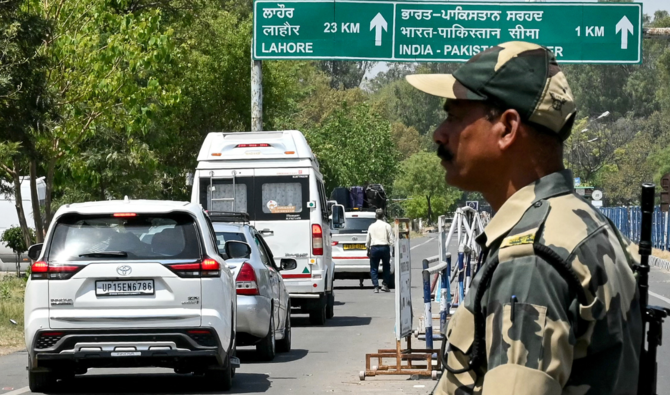
An Indian Border Security Force (BSF) personnel stands guard as Pakistani citizens return to their country through the India-Pakistan Attari-Wagah border post, about 35kms from Amritsar on April 26, 2025,. (AFP)
Short Url
Updated 30 April 2025
Follow

Pakistan urges US to ask India to ‘act responsibly’ amid threat of war

  • US Secretary of State Marco Rubio calls Prime Minister Shehbaz Sharif to discuss tensions with India
  • Sharif says India’s “deeply worrisome” behavior will distract Pakistan from battling militants based in Afghanistan

ISLAMABAD: Prime Minister Shehbaz Sharif on Wednesday urged US Secretary of State Marco Rubio to impress upon New Delhi to “act responsibly” amid fears of a military confrontation breaking out between nuclear-armed neighbors India and Pakistan. 

Tensions have surged between the two countries following a deadly attack on tourists in Indian-administered Kashmir on Apr. 22 that New Delhi has said Pakistan was involved in. Islamabad denies the charges and has said it will participate in any credible and transparent investigation of the assault. 

Several countries such as China, Saudi Arabia, Iran, UK, US and others have called upon both India and Pakistan to exercise restraint and avoid a military confrontation. Pakistan has vowed to give a “strong” response to any aggression after Indian Prime Minister Narendra Modi gave the military freedom to respond to the Kashmir attack during a closed-door meeting on Tuesday. 

Sharif received a call from Rubio during which he offered the American official Pakistan’s perspective on the recent developments after the Apr. 22 attack, the Prime Minister’s Office (PMO) said in a statement. 

“He [Sharif] categorically rejected Indian attempts to link Pakistan to the incident and pointed to his call for a transparent, credible, and neutral investigation to bring out the facts,” the PMO said. 

“He urged the US to impress upon India to dial down the rhetoric and act responsibly.”

Sharif condemned “terrorism” in all its forms and manifestations and underscored Pakistan’s leading role in the “war against terror,” the statement said. 

He described India’s recent behavior as “deeply disappointing and worrisome,” saying it would only serve to distract Pakistan from its ongoing efforts to defeat militants, particularly those based in Afghanistan. 

India and Pakistan have fought two out of three wars since 1947 over the issue of the disputed Himalayan territory of Kashmir. Both countries claim Kashmir in full but administer only parts of it. 

“The Prime Minister emphasized that peaceful resolution of the Jammu & Kashmir dispute was the only way to ensure lasting peace in South Asia,” the PMO said. 

On bilateral cooperation, Sharif told Rubio there were several areas where both sides could cooperate. He cited counterterrorism and enhanced economic cooperation, “particularly the minerals sector.”

“Secretary of State Rubio thanked the Prime Minister for the detailed conversation and emphasized the need for both sides to continue working together for peace and stability in South Asia,” the statement said. 

Earlier on Wednesday, fears of a military conflict were reignited when the state-run Pakistan Television (PTV) reported India had carried out “unprovoked” firing in the Kayani and Mandal sectors of the Line of Control on Tuesday night. 
The LoC runs 742km (460 miles) dividing the parts of Kashmir governed by India and Pakistan, and acts as part of the de facto border between the two countries.
Small arms were used by the Indian forces, prompting Pakistan to respond, PTV said.
“There are also reports that multiple enemy posts were destroyed by the Pakistan Army’s effective response,” PTV said, naming one of them as the Chakpathra post.
Earlier on Wednesday, the state-run Associated Press of Pakistan reported that a “timely” response by the Pakistan Air Force (PAF) had “forced” four Indian Rafale jets to retreat after payrolling near the two nations’ de facto border. 
“On the night of April 29/30, four Indian Rafale jets conducted patrolling within Indian geographical boundaries” near the LoC, APP reported, saying PAF “immediately” detected the jets. 
“A timely and swift response by the Pakistan Air Force forced four Indian Rafale jets to retreat … The Pakistani armed forces remain fully prepared and alert to give a befitting response to any aggression from India.”


Pakistan increases Reko Diq investment to $244 million as Barrick reviews project

Updated 5 sec ago
Follow

Pakistan increases Reko Diq investment to $244 million as Barrick reviews project

  • State-owned PPL injects $50.2 million more in special purpose vehicle formed to manage Islamabad’s 25 percent stake in copper-gold mine
  • Canadian operator Barrick Mining Corporation this month ordered project’s review following deadly separatist attacks in Balochistan province

KARACHI: The state-run Pakistan Petroleum Limited (PPL) has invested an additional Rs14 billion ($50.2 million) equity in the multi-billion-dollar Reko Diq copper-gold mine, the company said in its latest financial report on Thursday, as the project’s Canadian operator reviews the project following recently deadly attacks. 

Canada’s Barrick Mining Corporation owns a 50 percent share in Reko Diq in the southwestern Balochistan province, along with three Pakistani federal state-owned enterprises including PPL that own 25 percent, while the Balochistan government has the remaining 25 percent share in the project.

The Canadian company announced earlier this month it planned to “immediately” begin a comprehensive review of all aspects of the Reko Diq project following coordinated attacks in Balochistan on Jan. 30-31 that killed 36 civilians and 22 security forces personnel. 

“With respect to the Reko Diq project, the company has made further equity investment in Pakistan Minerals Private Limited (PMPL) during the period amounting to Rs14,025 million ($50.2m),” PPL told its shareholders in its financial statement for the half year ending at Dec. 31.

The additional equity has increased PPL’s total cost of investment in the PMPL to Rs68.1 billion ($243.6 million), it added. 

The PMPL is a special purpose vehicle formed to manage the federal government’s 25 percent stake in the Reko Diq project. It is a consortium of three state-owned enterprises (SOEs) namely the PPL, the Oil & Gas Development Company Limited (OGDCL) and Government Holdings (Private) Limited (GHPL) which is responsible for handling financing, equity contributions and strategic, legal or technical dealings with partners like Barrick.

“The project continued to advance site works during the period (July-December FY26),” the PPL said. “The operator (Barrick) is undertaking a review of all aspects of the project, including with respect to the project’s security arrangements, development timetable and capital budget.” 

This week, Balochistan Chief Minister Sarfraz Bugti assured investors that Pakistan has the “capacity and capability” to secure the Reko Diq project amid surging militancy. 

The PPL explores, drills, and produces oil and natural gas. Its current portfolio, together with its subsidiaries and associates, consists of 47 exploratory blocks that include one offshore Block-5 in Abu Dhabi and one onshore block in Yemen.

In December, PPL signed a strategic Deed of Assignment under which it assigned 25 percent of its participating interest (PI) and operatorship of Eastern Offshore Indus C block to Turkish Petroleum Overseas Company, a unit of state-owned Türkiye Petrolleri Anonim Ortaklığı.

Assigning 20 percent PI each to OGDCL and Mari Energies Limited, the company has retained the remaining 35 percent PI to play a key role in the block’s development.